





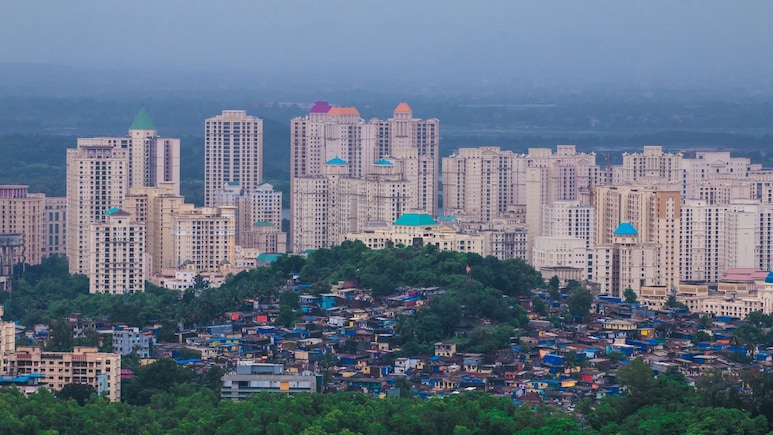
In a world where everything is interconnected, how long can India's financial capital be insulated from the impacts of the ongoing Iran war? Realtors operating in Mumbai say: "not long enough".
In fact, construction cost has already risen due to a rise in the price of crude oil, steel, and aluminium. To add to this, there is a drop in demand for office spaces from international players as the war has increased global risk sentiment. Further, the war-induced jitter in global equity markets has led to a liquidity squeeze.
Vijay Raundal, Managing Director of Teerth Realties, explains that Iran's geopolitical situation is exerting indirect but tangible pressure on Mumbai's real estate, particularly on construction execution and costing.
"Mumbai has a highly expensive market and for construction developers in such markets, even the slightest change in the cost of any construction input tends to alter the feasibility and development cost and pricing strategies of construction and development projects," said Raundal.
Ongoing projects may absorb some of the cost increases to sustain sales and keep construction moving, while new projects are likely to see higher selling prices to safeguard profit margins. According to Raundal, supply chains are being adjusted, with developers purchasing inputs in a staggered way to protect project interests.
Pakshal Sanghvi, Director of Sanghvi Realty, echoes this view, pointing out that the crisis affects Mumbai's real estate indirectly through macroeconomic channels, especially rising crude oil prices.
"India being a major energy importer, any sustained increase in oil prices tends to push up inflation and construction costs. Inputs such as cement, steel and logistics are all energy-linked, which can gradually increase project costs and pricing for new developments," Sanghvi said.
He added, "Residential real estate in Mumbai today is largely end-user driven, and decision-making tends to be more gradual. What we may see instead is a short-term 'wait-and-watch' approach from buyers."
'Less About Disruption, More About Sentiment'
Several real estate players also pointed out that caution tends to be higher among buyer during times of geopolitical uncertainty.
"From a demand perspective, the Iran conflict is less about short-term disruption and more about how it will affect sentiment and the demand and investment paradigm for the Mumbai real estate market. With geopolitical uncertainty, caution tends to be higher, particularly in the premium and luxury markets where spend/hold decisions are made due to individual wealth and the global economy," said Anurag Goel, Director, Goel Ganga Developments.
He added, "We are seeing a slow-down amongst those high-net-worth individuals and second-home buyers in terms of deal closures, but it is more of a measured approach. History has shown that NRI investment in Mumbai, particularly in the Middle East, has been strong. However, when geopolitical issues arise, it tends to halt the investment and, therefore, reduce demand for luxury housing due to low transactional activity in that segment."
In contrast, Ravikant, Founder, Elegance Enterprises & Elegance Infra, sees more impact on the mid segment instead of luxury. He said, "The increase in the cost of steel, fuel, etc., is affecting the cost of construction. In cities like Mumbai, the cost of real estate may increase by 3-5 per cent. The mid segment may be affected due to the increase in cost, but the luxury segment is not affected."
'Drop In Demand For Office Spaces'
Mumbai's real estate sector has started witnessing a drop in demand from global companies for office spaces. "On the commercial side, we are witnessing a slight slowdown from American and other global companies when it comes to large office space acquisitions, with many adopting a more cautious, wait-and-watch approach toward expansion," said Rohan Sheth, Founder of Volney Commercial Real Estate Advisory.
Adding to this, Snehith Reddy Meda, Partner, E-Infra, said, "For a city like Mumbai, where construction is heavily dependent on imported materials and energy-intensive processes, rising fuel costs are translating into higher input costs. Steel prices have already seen an increase of nearly 20% in recent weeks, and logistics costs have risen due to disrupted shipping routes and higher insurance premiums."
Meda added, "Rising construction costs are likely to push developers toward price revisions. In micro-markets such as South Mumbai, this could translate into 5 per cent price increases or Rs 50-150 per sq. ft. hikes, especially in premium projects. In the near term, the market is likely to see a slowdown in decision-making rather than a demand collapse." He, however, added, "Geopolitical shocks create volatility, but real estate cycles are ultimately driven by long-term urban fundamentals."
Mohit Nawany, Chief Executive Officer, Nawany Group, also highlighted the issue of rising costs. "One of the immediate pressures is on construction inputs linked to crude. For instance, packaging for cement relies on polypropylene, a crude-derived material, and volatility in oil prices is beginning to affect both costs and supply consistency. We are also seeing steady inflation in key materials. Aluminium prices, which were in the Rs 250-290 per kg range last year, are now closer to Rs 350-400 per kg. Similarly, specialty and coated glass has become more expensive due to rising input costs, including metals like silver. So the challenge is not just higher costs, but unpredictability in procurement and planning," he said.
'Demand For Residentials Remain Intact'
According to the stakeholders of the sector, underlying fundamentals of Mumbai's residential market remain intact. "In the short term, we might see some buyers put off making decisions, especially investors or people looking for high-end homes. But structural factors like urbanisation, building new infrastructure, and demand from end users are still helping the residential market. We have also seen during uncertain times, some people may prefer being closer to home or having a place in India. Over time, this can slowly add to housing demand," said Ankita Luharuka, CEO of Alliance City Developers.
In a similar vein, Sheth said, "Volatility in the equity markets amid the conflict has prompted investors to reassess their portfolios, leading to a gradual shift towards more stable, tangible assets like real estate. As a result, we are seeing increased traction in property sales, with prices experiencing a modest upward movement... In uncertain times like these, real estate being a 'brick-and-mortar' asset continues to be perceived as a safe haven."
Ravi Saund, Founding Director of Emperium Group, said, "While the ongoing Middle East conflict is undeniably creating cost pressures on crucial imported construction elements, with raw aluminium for modern facades recently hitting four-year highs of nearly $3,500 per tonne, the broader Indian real estate story is one of incredible domestic resilience." He mentioned that the real estate market in Delhi-NCR is actually witnessing a massive surge in investment, attracting over $3 billion in capital.
'Demand May Shift From Dubai To Mumbai'
It is expected that the war in Iran may prompt Indians based in the Middle East to explore opportunities in India as part of a broader portfolio strategy. "The current geopolitical environment, along with the sharp run-up in property prices in Dubai and other markets, may encourage NRIs to consider allocating a greater share of their capital to India. The depreciation of the rupee further strengthens the investment case, making Indian real estate relatively more attractive from a currency perspective," said Rajat Khandelwal, Group CEO, Tribeca Developers.
To this, Nawany added, "A significant portion of Indian and NRI capital had been flowing into markets like Dubai, but with rising uncertainty in the region, there are early signs of a re-evaluation of that trend. Mumbai, being one of the most stable and mature real estate markets, could benefit from this shift in sentiment."
Aakash Ohri, Managing Director & Chief Business Officer, DLF Homes, notes a similar shift. "India has consistently served as a reliable investment destination for Indians living across the world. Over the past five to six years, particularly since the pandemic, interest in investing in India has grown meaningfully. We have observed a steady rise in enquiries from overseas investors exploring real estate opportunities in India," said Ohri
'Impact Depends On How Long The War Goes On'
If the conflict remains prolonged, developers may face margin pressure, according to realtors. "Ongoing projects dependent on imported inputs or energy-linked materials may face pressure if the war goes on for long. Meanwhile, buyers could turn more cautious in the mid-income segment... The near-term impact is less about demand collapse and more about cost pressure, delayed decision-making, and a more selective market," said Navin Aswani, Managing Director, Aswani Industries (Ascolite).
Sanghvi also believes that only a prolonged conflict can lead to considerable disruption. He said, "Unless the geopolitical situation escalates into a prolonged global energy crisis, the impact on Mumbai's real estate market is likely to remain moderate and more cost-driven rather than demand-destructive."
Track Latest News Live on NDTV.com and get news updates from India and around the world

