

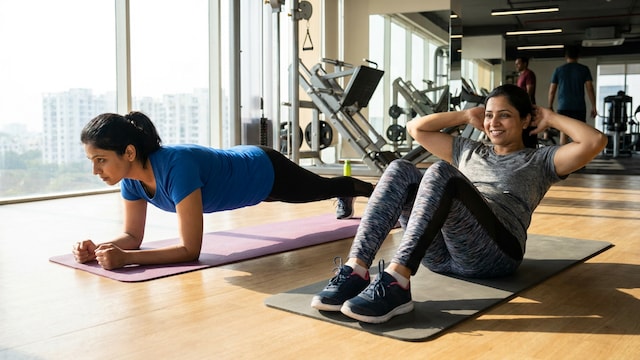
A strong core is important for more than just visible abdominal muscles. It helps maintain good posture, supports the spine, improves balance and makes everyday movements such as bending, lifting and walking easier. There are two exercises that are commonly added to core workouts, and those are planks and crunches. While both target the abdominal muscles, they work the body differently and give different benefits.
Planks are static exercises that require you to hold your body in a straight position while engaging your core muscles. Crunches, on the other hand, need repeated movements that target the abdominal muscles by lifting the upper body towards the knees. Both exercises can help strengthen the midsection, but the choice depends on your fitness goals, physical ability and exercise routine.
What Do Planks And Crunches Target?
The core is made up of several muscles that support the spine, pelvis and trunk. These include the rectus abdominis (the muscles commonly known as the six-pack), transverse abdominis, internal and external obliques, and deeper muscles around the spine and pelvis.
Planks primarily train the core muscles to stabilise the body and maintain a steady position. They also engage the shoulders, back, glutes and legs.
Crunches mainly target the rectus abdominis. They involve bending the spine forward, which helps strengthen the muscles responsible for flexing the trunk.
What Are The Benefits Of Planks?
- Improve core stability: Planks train the abdominal muscles to support the spine and keep the body stable. This can improve control during everyday activities and other exercises.
- Support better posture: A stronger core helps maintain proper alignment of the spine and pelvis. Practicing plank regularly may help improve postural control, especially when it's combined with exercises that strengthen the back and hips.
- Work multiple muscle groups: Unlike exercises that target the abdominal muscles, planks engage several muscle groups at the same time, including the shoulders, glutes, legs and back.
- Improve endurance: Holding a plank requires the core muscles to remain engaged. This builds muscular endurance, which helps the body maintain stability during physical activities.
What Are The Benefits Of Crunches?
- Strengthen the abdominal muscles: Crunches directly target the rectus abdominis. Regular practice can improve the strength and endurance of these muscles.
- Focus on abdominal movement: Unlike planks, which involve holding a position, crunches involve repeated spinal flexion. This makes them useful for specifically training the muscles responsible for bending the body forward.
- Easy to perform: Crunches require very little equipment and can be performed at home.
However, it is important to note that crunches need to be performed with proper technique.
Planks vs Crunches: Which Is Better For Core Strength?
Planks generally have an advantage when it comes to overall core stability because they train the abdominal muscles to resist movement and keep the trunk steady. This is important for activities such as running, lifting weights, carrying groceries and maintaining balance.
Crunches, on the other hand, are beneficial for strengthening the rectus abdominis through controlled movement. They can be included in a workout when the goal is to improve abdominal muscle strength.
Neither exercise is automatically better for everyone. Planks may be more suitable for people looking to improve core stability and muscular endurance, while crunches can be useful for those who want to focus on abdominal strength. It is also important to understand that neither exercise can burn belly fat. Reducing abdominal fat requires an approach which involves regular physical activity, a balanced diet, adequate sleep and a calorie deficit.
Can You Do Both Planks And Crunches In The Same Workout?
Yes, in fact, combining both exercises can give you a more balanced core workout because they train the abdominal muscles in different ways. Planks strengthen the core through stabilisation, while crunches train it through controlled movement. You can begin with two or three sets of each exercise, adjusting the duration and repetitions according to your fitness level.
For beginners, holding a plank for 15-20 seconds and performing 8-10 controlled crunches can be a good starting point. Gradually increase the duration and repetitions as your strength improves.
Disclaimer: This content including advice provides generic information only. It is in no way a substitute for a qualified medical opinion. Always consult a specialist or your own doctor for more information. NDTV does not claim responsibility for this information.