

)
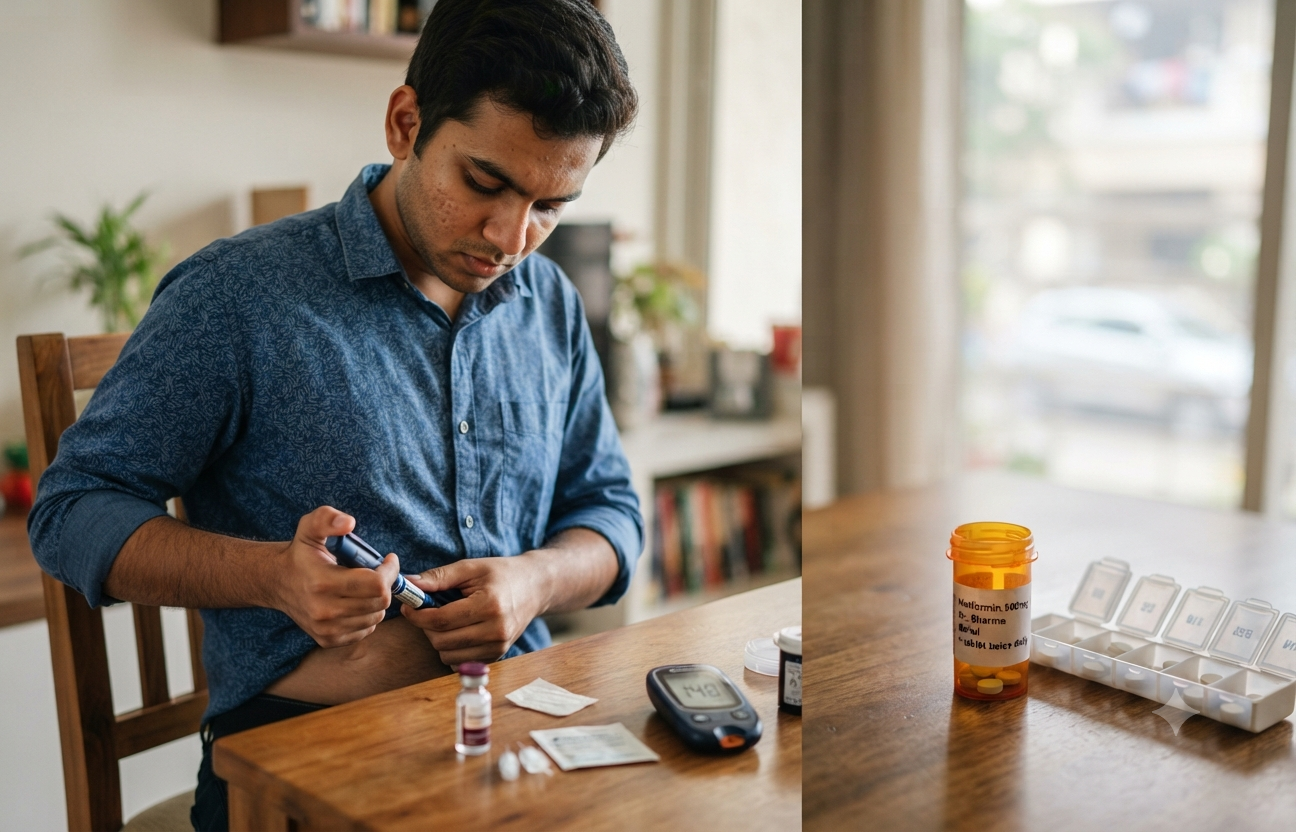
Living with an autoimmune condition demands relentless vigilance. For individuals diagnosed with Type 1 diabetes, daily management means navigating an endless cycle of finger-prick blood tests, strict carbohydrate counting, and multiple injections. The phrase "injection fatigue" doesn't even begin to cover the mental and physical exhaustion that patients face over the years. This fatigue breeds a completely understandable, desire to take a pill instead of injecting yourself can occur. However, attempting to bypass needles without understanding the underlying medical reality can lead to catastrophic consequences. Insulin injections have been designed to be an ideal delivery system for processing insulin in the body, and those who have been prescribed to take it need to diligently follow the routine.
Why Insulin Injections Can't Replace Pills
A case study brought to light by Dr Priyam Bordoloi, MBBS, MD Internal Medicine Resident, has sent shockwaves through the medical community, serving as a grim reminder of how unforgiving this condition can be. The case involved a 26-year-old man who had been diagnosed with Type 1 diabetes during his teenage years. Having endured the painful, daily routine of injecting insulin for over a decade, he grew severely burnt out by the physical constraints of his therapy. In a desperate bid to free himself from the needles, he made a fatal decision: he completely stopped his insulin injections and attempted to replace insulin with pills.
A 26-year-old DIED from diabetes.
— Dr. Priyam Bordoloi (@DocPriyamMD) July 8, 2026
We all think diabetes is a slow killer. A disease that takes decades to damage your eyes and kidneys.
But one attempt to outsmart his diagnosis killed him overnight.
A medical breakdown on what actually happened 👇
He began secretly swallowing oral tablets that he had borrowed from an older relative who was managing Type 2 diabetes. Tragically, within less than twenty-four hours of stopping his injections, the young man passed away overnight. People often mistakenly think of diabetes as a slow, progressive ailment, but it is a disease that silently takes decades to damage your eyes, heart, or kidneys. However, as this case demonstrates, an abrupt halt to your primary Type 1 diabetes treatment can turn into a swift, sudden killer.
What Went Wrong?
To dissect exactly why this tragedy occurred, medical experts have stepped forward to explain the severe physiological chain reaction that takes place when a Type 1 patient misses their medication. Dr Anoop Misra, Chairman, Fortis C-DOC Hospital for Diabetes and Allied Sciences, explains, "One of the biggest dangers is diabetic ketoacidosis. The combination of severe dehydration, electrolyte loss, and rising blood acidity can cause confusion, altered consciousness, and cardiovascular complications. Patients with Type 1 diabetes should never stop taking insulin, even when they are unwell or unable to eat normally, without medical guidance. "
While Dr Ambrish Mithal, Chairman and Head, Endocrinology, Max Healthcare, highlights, "Many people underestimate how quickly Type 1 diabetes can become dangerous when insulin is skipped. Insulin deficiency forces the body into a starvation-like state despite high blood sugar levels. The resulting metabolic imbalance affects multiple organs, including the brain, heart, and kidneys, making prompt insulin replacement absolutely critical."
Why Oral Diabetes Medications Fail In Type 1 Diabetes
The mistake made by the young man stemmed from a fundamental misunderstanding of how different classes of diabetes medications interact with human anatomy. There is a vast biological divide between oral tablets and external hormone replacement.
Standard oral diabetes medicine is designed exclusively for type 2 diabetes, a state where the pancreas still possesses the capacity to synthesise its own insulin, even if the body's tissues have grown highly resistant to it. The tablets work by either sensitising your tissue cells or forcing the sluggish pancreas to squeeze out whatever residual insulin it has left inside.
But in Type 1 diabetes, the story is entirely different. The body's immune system has completely wiped out the insulin-secreting beta cells within the pancreas.
Borrowing a relative's Type 2 prescription to treat Type 1 diabetes is effectively the equivalent of pressing the gas pedal on a car that has a completely empty fuel tank. No matter how hard you press the pedal, the vehicle cannot move without actual fuel.
The Threat Of Diabetic Ketoacidosis (DKA)
One of the most terrifying elements of an absolute insulin deficiency is the staggering speed with which it compromises human life. Unlike chronic complications that creep up over years of poor glucose tracking, DKA behaves like a sudden poisoning.
According to diabetologists, diabetic ketoacidosis can move from initial cellular starvation to a critical medical emergency within a few hours to a couple of days. The timeline accelerates rapidly depending on secondary factors like baseline sensitising levels, underlying infections, or physical stress.
When the body enters this crisis state, it exhibits clear, unmistakable warning signs that require emergency ICU intervention.
Critical Symptoms Of DKA To Identify Immediately:
- Fruity or Chemical Breath: Dr Kovil notes that a distinct, sweet smell resembling rotten fruit or nail-polish remover is caused by the heavy buildup of acetone in the blood.
- Kussmaul Breathing: This manifests as continuous, deep, heavy, and laboured breathing. It is the respiratory system's desperate attempt to expel excess metabolic acid by blowing out massive amounts of carbon dioxide.
- Rapid Dehydration and Altered Consciousness: As blood sugar levels rocket upward, the kidneys work overtime to flush out the glucose, leading to extreme thirst, projectile vomiting, profound weakness, and eventually a total loss of consciousness.
Can Insulin Ever Be Replaced By A Pill?
Given how gruelling injections are, the global scientific community has poured millions of dollars into researching a genuine oral insulin pill. So, why isn't one availble in the pharmacy shelves for those who need it. The barrier isn't the insulin itself; it's the sheer power of the human digestive tract. Insulin is a highly complex protein hormone. The human stomach is an incredibly hostile environment designed explicitly to break down proteins using hydrochloric acid and proteolytic enzymes like pepsin. The moment a standard insulin capsule is swallowed, the digestive fluids shred the hormone molecules into pieces, rendering them completely useless long before they can ever cross the intestinal lining to begin managing high blood sugar.
While modern pharmaceutical laboratories are experimenting with cutting-edge drug delivery designs such as shielding the insulin inside protective nanotechnology matrices, microscopic microneedle capsules, or lipid-coated armour that only dissolves in the alkaline environment of the small intestine. This means that researchers are still years away from a commercially viable, widely approved oral capsule option for Type 1 patients.
For the time being, injected or pumped insulin remains the absolutely indispensable cornerstone of Type 1 survival. Innovation is moving forward in other directions, such as rapid-acting inhaled insulins for mealtime coverage, but standard oral tablets are simply not a viable path.
If you are experiencing severe burnout or injection fatigue, do not suffer in silence, and never experiment with alternative remedies or someone else's prescription. Talk openly with your endocrinologist about integrating modern technology like Continuous Glucose Monitors (CGMs) or smart insulin pumps to help reduce the daily burden of care. It is important to remember that your insulin routine isn't a lifestyle choice; it is your lifeline, take it as prescribed.
Also Read: House Of The Dragon's James Norton Has Type 1 Diabetes: How Actors Like Him Manage The Condition
Disclaimer: This content including advice provides generic information only. It is in no way a substitute for a qualified medical opinion. Always consult a specialist or your own doctor for more information. NDTV does not claim responsibility for this information.