

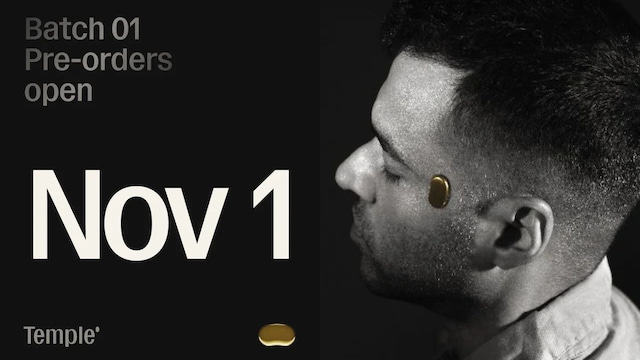
Deepinder Goyal, co-founder of Zomato, is set to open pre-orders for his much-discussed health wearable, Temple, on November 1. The device which monitors signals associated with brain blood flow, has attracted attention. Goyal recently announced that the first batch, called Temple Batch 01, will be available for pre-orders. In an earlier post, he also revealed that the device will be launched in six colours: True Gold, Rose Gold, Black Mirror, Real Jade, Deep Blue and Purple Funk.
According to Goyal, each device will be handmade after an order is placed and delivered within three months of purchase. He says that Temple helps users understand how their bodies respond to physical activity, mental stress, sleep and recovery. Unlike conventional fitness trackers, it focuses on physiological signals associated with the brain. However, there are questions about how accurately it can measure these signals and whether the information it provides can genuinely help people understand their health better.
The wait is over. Temple Batch 01 pre orders open November 1. Each @temple is hand-made to order and delivered to you within three months of your purchase. https://t.co/t6qth9sUeV
— Deepinder Goyal (@deepigoyal) October 21, 2026
But First, What Is The Temple Wearable?
Temple is a health-tracking wearable developed by Deepinder Goyal's startup of the same name. It is worn on the side of the head, around the temple region, using an adhesive attachment. The device is designed to continuously collect information about changes in blood flow and other physiological signals. It uses light-based sensing technology which is also found in smartwatches and fitness trackers. These sensors shine light into the skin and measure changes in the light reflected back by blood flowing through nearby blood vessels.
The information collected is then used to generate readings related to brain blood flow and a measurement called Entropy. Goyal says that the device aims to give users a better understanding of how their bodies respond to different physical and mental demands throughout the day.
Can Temple Really Help Improve Brain Health?
Temple aims to make brain-related health monitoring better by allowing people to track physiological changes continuously. Monitoring changes in blood circulation and the body's response to stress could provide useful information about physical strain and recovery. However, there is a difference between tracking signals associated with brain health and actually assessing the health of the brain.
For instance, measuring changes in blood flow does not automatically tell whether someone has a neurological condition, reduced brain function or an increased risk of stroke. Similarly, a change in a wearable's stress-related reading does not necessarily indicate a mental health problem.
There are also questions about how accurately a device placed outside the skull can measure blood flow inside the brain. Light passing through the temple region has to travel through different layers, including the skin, scalp, blood vessels and skull. Earlier, Dr Arun L Naik, an AIIMS-trained neurosurgeon, raised concerns about whether measurements taken from this region can accurately represent blood flow in deeper brain structures. He has also cautioned against treating the device as a replacement for established neurological investigations.
Therefore, while Temple may offer information about physiological changes, more independent clinical studies are needed to establish how useful and accurate its readings are.
What Does The Temple Device Claim To Measure?
According to information shared by Goyal, the wearable focuses on the following measurements:
1. Brain Blood Flow
One of Temple's main features is BrainFlow, a measurement designed to track changes associated with blood circulation in the brain. Blood flow is important because the brain needs a continuous supply of oxygen and nutrients to function properly. The device aims to monitor changes in this circulation over time.
Does @temple really monitor blood flow to the brain, or just the scalp? In our second validation study, we tested Temple BrainFlow against time-domain NIRS, one of the few technologies that can separate brain blood volume changes from scalp blood volume changes. We had 60 participants go through three physiological challenges: head-down tilt, stand-to-squat, stand-to-supine. Across all three challenges, Temple BrainFlow tracked brain blood volume at r=0.84-0.91, significantly more than scalp blood volume. The most significant result came from head-down tilt, where Temple's correlation with the brain was 0.91, and scalp correlation was just 0.49. Key takeaway: Temple tracks the brain, much more than the scalp. Why this matters: Cerebral Blood Flow responds to almost everything longevity-oriented people already do. It rises with aerobic exercise, and VO2max correlates directly with it. It rises with cold exposure. It rises with meditation. Better sleep sustains it. It drops when you sit for too long. It drops when you are dehydrated. It is one of the most responsive and integrative biomarkers of how well your body is actually running, and aging. Until now, you could only measure it in a clinical setting, in a single snapshot. Temple measures it continuously, in real time, while you live your life. And Temple is, as of today, the only wearable in the world with validations against brain blood volume, and not just scalp. This study was guided by our Scientific Advisor, Prof. David Boas, Director of Boston University's Neurophotonics Center, and the mind behind several new, high-impact, biomedical optical technologies in neuroscience, including NIRS. This is the second modality Temple BrainFlow is now validated against, after Transcranial Doppler. More coming soon. Link: https://t.co/zETs9gn5Cg The paper is posted as a preprint and submitted for peer review. We encourage researchers to replicate this. We'll happily loan Temples to any qualified researcher who wants to pressure-test any of our metrics independently. Cc @agingroy
— Deepinder Goyal (@deepigoyal) September 25, 2026
2. Entropy
Temple also measures something called Entropy, which Goyal describes as the body's real-time metabolic and sympathetic demand. It is displayed as a numerical reading that changes with the body's activities and physiological state. According to Goyal, factors such as sleep, exercise, stress, caffeine consumption and meditation can influence this measurement. The idea is to help users understand how much physical or mental demand their bodies are experiencing at a particular time. Goyal describes it as a measure of the body's real-time "cost of being alive".
The Temple team has made a breakthrough. We have discovered (literally discovered) a biomarker, only readable on the temple region, and nowhere else, that measures the real-time cost of you being alive. We are calling it Entropy™. It's a live number on Temple's home screen, updating every second, on an index from 1 to 250. 1 is the deepest rest we've ever recorded. We've only seen fit, experienced meditators touch it, for fleeting moments deep in practice. 250 is the highest we've seen in elite athletes at the peak of their output and flow. Everything moves Entropy. Sleep, stress, a sprint, coffee, a meal, a cold plunge, meditation, strength training... everything moves your metabolism, your cost of being alive. And Entropy tracks it, live. Heart Rate doesn't come even close to this level of precision in calculating the cost of being alive. We benchmarked Entropy and Heart Rate against a standard metabolic cart (calorimeter). Over a hundred cardio sessions, Entropy tracked the calorimeter's curve at r=0.93 and p <0.001. Heart Rate managed a meagre r=0.55. Here's why Entropy should matter to you – Your Entropy Maxima is the highest your body can reach when you push it hard. A high peak is the signature of a capable body, one that can rise to meet effort and recover from it. As we age, that ceiling naturally falls, so this is the number to push upwards. Your Entropy Minima is the lowest your body settles to at rest. Across the animal world, a lower cost of being alive at rest tends to go with a longer life. Your Entropy Minima is the number to bring down, every single day. Living with Entropy is magical. It teaches you so much about yourself, that no other metric ever has. We are looking forward to you trying out Temple. But not before it's perfect. Apply for early access at https://t.co/XxGR9Hpq58 Follow @temple for updates.
— Deepinder Goyal (@deepigoyal) June 18, 2026
3. Cognitive Load
The device is also associated with tracking changes linked to cognitive load. This refers to the amount of mental effort required to perform a task or process information. For example, concentrating on a demanding task, solving a complicated problem or working for long hours can increase mental demands. Temple aims to help users understand how their bodies respond to such activities.
Should You Rely On Temple For Brain Health?
Temple provides an interesting approach to wearables by focusing on signals associated with the brain rather than conventional fitness measurements alone. Its ability to track changes continuously can offer useful insights into how the body responds to everyday demands.
However, users should understand that tracking physiological signals is not the same as diagnosing or preventing brain disorders. Its readings cannot replace neurological examinations, brain scans or other medical investigations recommended by doctors. Until there is more independent clinical evidence, Temple should be used as a wellness-tracking device rather than a tool for diagnosing or monitoring brain diseases.
Disclaimer: This content including advice provides generic information only. It is in no way a substitute for a qualified medical opinion. Always consult a specialist or your own doctor for more information. NDTV does not claim responsibility for this information.