

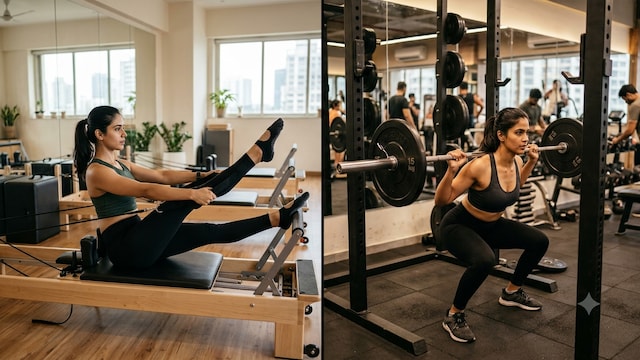
Pilates is among the most popular workouts in the world right now, and strength training is steadily gaining ground as the exercise doctors increasingly recommend. Both have loyal fans and big promises. From a bone and joint perspective, the real question is simple: which one protects bones, muscles and joints better as the years go by?
What Are They?
Pilates is a low-impact method built around core control, posture, breathing and alignment. It uses body weight or spring resistance, on a mat or a reformer machine.
Strength training means working muscles against external resistance, such as dumbbells, barbells, machines or bands, and gradually increasing the load over time. That gradual increase, called progressive overload, is what drives adaptation.
Who Needs to Pay Attention?
Almost everyone, but a few groups especially:
- Women approaching or past menopause, when falling oestrogen speeds up bone loss
- Adults over 50, when muscle and bone decline quietly in the background
- Desk-bound professionals with weak cores, stiff hips and poor posture
- Anyone with osteopenia or osteoporosis, or a family history of fractures
- People returning to exercise after an injury or a long break
Men are not exempt either. Age-related bone loss affects them too, particularly after 70.
When Does It Start Mattering?
Peak bone mass is reached in the late twenties to early thirties. After that, the goal shifts from building bone to holding on to it. Muscle mass also begins to decline from around the thirties, and the loss speeds up after 60.
The catch is that none of these hurts. Osteoporosis is called the "silent disease" because it often shows itself only through a fracture: a broken wrist, a spinal compression fracture or a hip fracture after a minor fall. Waiting for symptoms means waiting too long.
READ | Planks vs Crunches: Which Is Better For Building A Truly Strong Core?
Why Does Bone Care About Exercise?
Bone is living tissue, constantly broken down and rebuilt. Mechanical load is the signal that tells it to stay strong. When muscles pull hard against bone, bone-building cells are stimulated. When that load drops, bone thins.
This is where the two methods differ most.
Where Pilates Shines
- Balance and coordination, which directly lower fall risk
- Core and hip stability, supporting the spine and pelvis
- Posture and mobility, useful for desk-related stiffness
- Body awareness, which helps people move better in every other activity
- Low-impact, joint-friendly work, useful when recovering from injury or starting from scratch
- Confidence, since many people find it less intimidating than a gym
A trial in women aged 60 to 80 found that both Pilates and a resistance programme improved functional ability, and Pilates showed particular gains in hip and trunk extension strength. Neither caused adverse events. Interestingly, the only injuries in that study occurred in the non-exercising group, including two broken wrists after falls.
Where Pilates Falls Short
- Limited loading. Body weight and springs have a ceiling. Once that is reached, the stimulus stops growing.
- Modest effect on bone density. In a trial of postmenopausal women with low bone mass, high-intensity resistance training improved bone density, while a Pilates programme did not change bone mass or muscle strength.
- Not clearly superior for strength. A systematic review found no clear advantage for Pilates over other exercise for strength, though the evidence quality was low to very low.
- Not a weight-loss tool. Calorie burn is modest.
- Some moves need caution. With low bone density, loaded spinal flexion, excessive twisting and exercises such as Rolling Like a Ball, Jackknife and Roll Over are generally best avoided.
Where Strength Training Wins
- Bone density. Heavier loading at the hip and spine is the stronger stimulus bones respond to. Reviews in postmenopausal women show resistance training can improve bone density, with results depending on intensity, frequency and duration.
- Muscle mass and power. Muscle that is preserved protects joints and bones and keeps people independent.
- Fall and fracture protection. Stronger legs mean better balance.
- Metabolic health. Better body composition, blood sugar control and long-term resilience.
- No "bulky" risk. Visible size takes years of heavy training and deliberate eating. For most people, the result is a stronger, leaner body.
Where Strength Training Needs Care
- Technique matters. Poor form under heavy load can strain the lower back, knees and shoulders.
- Progress should be gradual. Jumping to heavy weights without a base invites injury.
- Osteoporosis needs a plan. People with weakened bones should speak to a doctor first, as some exercises may need modification.
- Overdoing it. Obsessive training without recovery does more harm than good.
The Osteoporosis Angle
For anyone with osteopenia or osteoporosis, the message is clear: do not avoid exercise. Inactivity is one of the worst things for bone.
The evidence points to a sensible hierarchy. Progressive resistance training, and suitable weight-bearing activity, are the main bone-loading tools. Pilates and balance work are valuable partners, because most fractures follow a fall, and preventing the fall matters as much as strengthening the bone. Exercise also works best alongside adequate calcium, vitamin D and protein, and some people will need medical treatment as well. Vitamin D deficiency is common in India, so a simple blood test and a conversation with a doctor are worthwhile.
Why This Matters in India
- Sedentary urban lifestyles mean weak cores and deconditioned legs from the start
- Low vitamin D levels are widespread despite abundant sunshine
- Fractures often arrive late. Many people only discover bone loss after a fall
- Pilates is booming, and many assume that it alone is enough for bone health
- An ageing population means hip fractures will carry a growing human and economic cost
A Practical Weekly Blueprint
The good news is that this is not an either-or choice:
- Strength training two to three days a week, focusing on squats, hip hinges, rows and carries, with weights increased gradually
- One or two Pilates sessions for core control, balance and posture
- Walking on most days, adding hills or a brisk pace where possible
- Balance work, such as single-leg stands and sit-to-stands
- Rest days, because recovery is when the body adapts
- Protein with every meal, plus calcium and vitamin D as advised by a doctor
Beginners can start with bodyweight, bands or machines under a trained instructor, and build from there. Strength training is the foundation, and Pilates is the refinement.
When to See a Doctor
Medical advice is recommended before starting if there is a history of fractures, known osteoporosis, long-term steroid use, or significant back, joint or heart problems. Prompt checks are advised for:
- Sudden or persistent back pain, especially after a minor fall
- Loss of height or a more stooped posture
- Pain that worsens with every session
- Joint swelling, locking or a sense of giving way
Pilates is not a bad choice, and it should not be dismissed. It builds the control, balance and body awareness that keep people steady on their feet. But for bones, the research favours progressive resistance training. The smartest plan uses both: lift to build bone and muscle, and practise Pilates to move well and stay upright.
The best routine is the one that is sustained for years, and it is never too late to begin.
(By Dr. Dasaradha Rama Reddy Tetali, Clinical Director & HOD Of Orthopaedics, Sr. Consultant Robotic Orthopaedic Surgeon, Yashoda Hospitals, Hyderabad)
Disclaimer: The opinions expressed within this article are the personal opinions of the author. NDTV is not responsible for the accuracy, completeness, suitability, or validity of any information on this article. All information is provided on an as-is basis. The information, facts or opinions appearing in the article do not reflect the views of NDTV and NDTV does not assume any responsibility or liability for the same.