





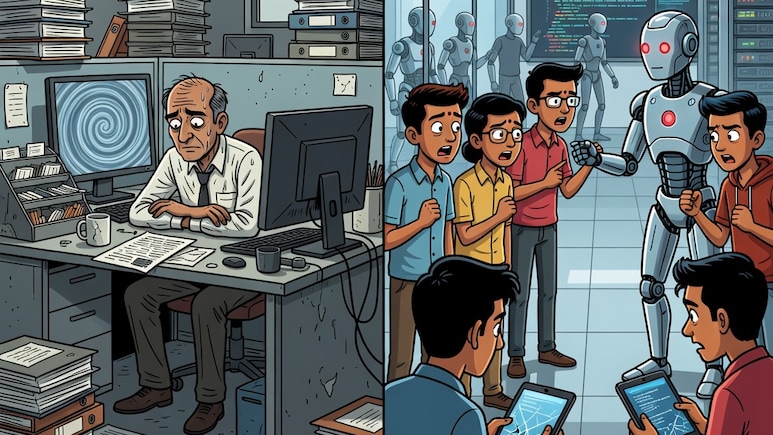
A new study by Great Place To Work India reveals that around 13 per cent of employees are in the high-burnout category, while nearly one in four CHROs expects AI to reduce workforce headcount by 1-20 per cent over the next two years.
At the same time, organisations are dealing with a workforce that is becoming younger, more demanding and less willing to give discretionary effort without a strong sense of purpose.
Balbir Singh, CEO, Great Place To Work India, said organisations are now dealing with the simultaneous impact of workforce transformation, AI adoption and changing employee expectations.
Also Read | Layoffs Are Rising In Tech, But These Skills Are Helping People Unlock Better Pay
AI Is Creating A New Job Security Question
AI adoption has moved well beyond experimentation. Companies are now putting the technology to work across teams and functions.
But the transition is far from smooth.
Around 44 per cent of CHROs say one of their biggest concerns is that high performers are using AI to move further ahead while others struggle to keep pace. This creates a new workplace divide -- not just between people with different skills, but between those who can effectively use AI and those who cannot.
There is also a trust problem. About 32 per cent of CHROs report that employees are unsure about which AI-generated outputs need to be verified and which can be trusted.
And then comes the bigger question: jobs
Nearly 25 per cent of CHROs anticipate a 1-20 per cent reduction in workforce headcount because of AI over the next two years. However, the full impact is still unclear. Almost 45 per cent of CHROs say it is too early to estimate how AI will affect workforce size in the long term.
Balbir Singh, CEO, Great Place To Work India, told NDTV that the challenge is not simply about adopting AI. It is about building confidence around how jobs, careers, performance and opportunities will change.
That uncertainty is already visible inside organisations. Around 21 per cent of managers are unsure how to evaluate performance in an AI-enabled workplace, while 26 per cent of employees feel that leadership is not clearly addressing job security concerns.
Burnout Refuses To Go Away
Despite all the talk around employee well-being, burnout remains a concern. The good news is that the situation is not getting dramatically worse.
Medium burnout has fallen from 21 per cent in 2019 to around 15 per cent currently. About 72 per cent of employees are in the low-burnout category.
But the improvement has stalled. Burnout levels have remained broadly stable between 2022 and 2026. And around 13 per cent of employees continue to report high burnout.
Gen Z employees are bringing another major shift. They now account for 26 per cent of the workforce, almost twice its share in 2023. Their growing presence is forcing companies to rethink what employees want from work.
As many as 81 per cent of CHROs say workplace flexibility is the number one priority for Gen Z. The corresponding figure is just 8 per cent for Gen X and older generations.
Employees Are Pulling Back
Discretionary effort has fallen 4 per cent since 2023, with six in 10 organisations reporting a year-on-year decline. In simple terms, employees may still be doing their jobs. But fewer are willing to go the extra mile.
Nearly 58 per cent of CHROs say they are dealing with AI and generational challenges simultaneously. Balbir Singh said organisations that succeed in the coming years will be those that can combine faster technology adoption with trust, clarity and meaningful work.
Track Latest News Live on NDTV.com and get news updates from India and around the world

