





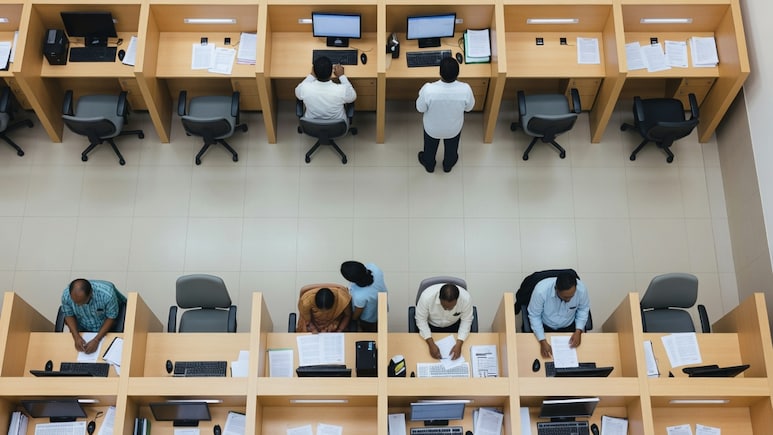
Four large private lenders -- ICICI Bank, HDFC Bank, Axis Bank and Kotak Mahindra Bank -- have cumulatively cut their employee strength by 13,000 in FY26.
ICICI Bank saw the biggest decline. Its permanent employee count fell by 5,148 to 1,24,029 as of March 31, 2026, from 1,29,177 a year earlier. Including employees other than permanent staff, its total workforce fell by 6,633.
HDFC Bank's employee count dropped by 3,343 to 2,11,178. Axis Bank's workforce fell by about 3,100 to 1,01,300. Kotak Mahindra Bank saw a decline of 1,269 to 74,054. .
Industry experts point out that the job cuts continue even as these lenders continue physical expansion. ICICI Bank added 528 branches in FY26, taking its network to 7,511. HDFC Bank added 234 branches and ended the year with 9,689.
Axis Bank also expanded its branch network by nearly 400 locations. Kotak added 128 branches.
Why Are Banks Cutting Jobs Despite Adding More Branches
A branch today does not look like a branch from a decade ago. Routine transactions have moved to mobile banking, internet banking, UPI, ATMs and self-service channels. Account opening, document verification, loan processing, payments and several customer-service functions can now be handled digitally or through centralised operations.
The branch is increasingly becoming a place to acquire customers and sell financial products. This means fewer people may be needed for processing. But banks still need relationship managers, sales staff, wealth advisers and specialists who can deal with customers.
"Private banks are increasingly focusing on productivity rather than headcount-led expansion," Balasubramanian A, Senior Vice President, TeamLease Services, told NDTV. He said banks are slowing replacement hiring and moving employees towards sales, advisory and customer-facing roles. Branch expansion and workforce reduction can therefore happen at the same time.
Are Banks Actually Laying Off People?
This is where the FY26 numbers need some caution. A fall in annual headcount does not automatically mean 13,000 people were fired.
Banks have high employee turnover. People leave every year. If lenders replace fewer of those employees, the total workforce can fall without a mass layoff programme.
Jayanth Neelakanta, Founder & CEO, Equip, told NDTV, "It's mostly banks being cautious in a slower year, not machines taking jobs," he said.
According to Neelakanta, banks lose a significant number of employees through normal attrition. The headcount can therefore decline simply because lenders slow down replacement hiring. This also explains why the numbers should not be read as 13,000 people being directly shown the door.
Kotak's FY26 numbers illustrate the point. The bank hired 28,846 employees during the year, even as its overall workforce fell by 1,269. Its management attributed the optimisation to process simplification, technology adoption and greater internal mobility.
So, Is AI Taking Banking Jobs?
Yes, but perhaps not in the dramatic way the headline suggests. AI and automation are changing banking. But the FY26 headcount decline cannot be pinned entirely on AI.
Neelakanta argues that the AI angle is being overstated. "Less about AI than the headlines suggest," he said, pointing out that only some banks have explicitly linked workforce changes to technology.
His argument is that automation is a gradual process. It is first affecting repetitive back-office work rather than suddenly replacing large numbers of frontline employees.
Balasubramanian takes a similar view. "AI and automation are important but not the sole drivers," he said. The bigger factor, according to him, is workforce optimisation. That includes slower hiring, natural attrition, tighter cost management and productivity gains after several years of aggressive hiring.
What Is Changing Inside A Bank?
The easiest way to understand the shift is to look at the work itself. A bank has traditionally needed large teams to check documents, verify information, process transactions, reconcile accounts and handle routine service requests.
Much of that work can now be digitised. This allows banks to move employees towards functions where human interaction still matters.
Shailesh Khana, Business Leader at ManpowerGroup, told NDTV that modern branches are increasingly becoming "sales and relationship" centres. He said banks are putting greater emphasis on wealth management, lending, SME relationships, cross-selling and customer acquisition. The result is a workforce that is smaller in some areas but more specialised in others.
This is also visible in HDFC Bank's numbers. The bank's total employee count fell by 3,343 in FY26. But the decline was concentrated among non-supervisory employees. Its managerial workforce increased, suggesting that the lender was not simply cutting people across the board.
If Digital Banking Is Growing So Fast, Why Are Banks Still Opening Branches?
Branches help banks acquire customers in smaller cities and towns. They also matter for loans, deposits, wealth management and SME relationships.
ICICI Bank's annual report, for instance, shows that its branch network increased from 6,983 in March 2025 to 7,511 in March 2026. HDFC Bank added 234 branches during FY26, taking its network to 9,689.
The difference is that a new branch no longer has to bring a large operations team with it. Technology does much of the work in the background.
The branch can therefore become the front end of a much larger digital and centralised banking machine. Khana estimates that about 70-80 per cent of the workforce change is structural, with the remaining portion linked to cyclical factors. He expects overall bank headcount to remain flat or decline slightly in the near term, even as lenders continue hiring selectively.
Banks have already invested heavily in digital onboarding, centralised processing, workflow automation and self-service channels. Once those investments start producing productivity gains, there is little reason to reverse them.
Axis Bank, for example, has said its technology investments over the past few years are beginning to produce productivity gains. Its technology spending accounted for around 9-10% of operating expenses, while its workforce fell by about 3,100 in FY26.
If credit growth picks up, frontline hiring could strengthen. But a return to the old model, where every new branch automatically meant a large number of new operational employees, looks unlikely.
Track Latest News Live on NDTV.com and get news updates from India and around the world

