





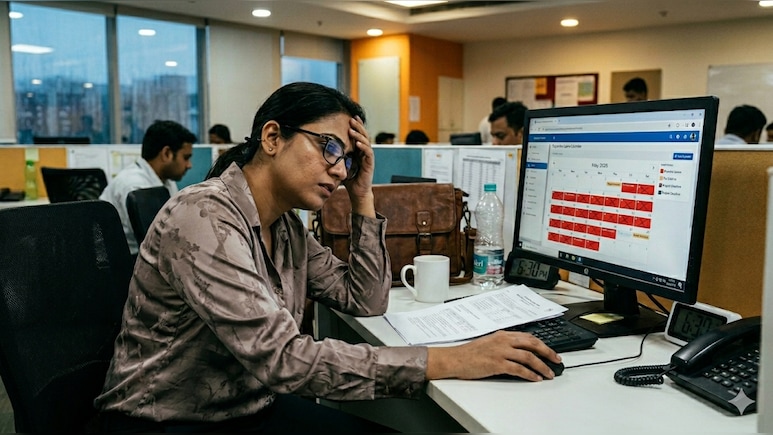
"Burnout has become a constant companion."
For Prakriti Bhat, an assistant editor in New Delhi, work rarely stays confined to office hours. It follows her to family dinners, weekends, weddings, and even movie nights. The result, she says, is not work-life balance but "work-life khichdi".
Her experience may sound familiar to millions of Indian professionals.
A new analysis by global payroll and HR platform Deel suggests that while Indian employees enjoy relatively generous leave entitlements compared to many Asia-Pacific countries, they are among the least likely to use them fully.
The finding points to a growing workplace paradox. Employees have leave days. Yet many struggle to take them.
Leave Available, But Not Fully Used
The analysis, based on data from more than 4,500 full-time workers on Deel contracts across the Asia-Pacific region, found that Indian employees used a smaller share of their annual leave entitlement in 2025 than workers in Singapore, Hong Kong, South Korea, Malaysia, and Japan.
The median leave taken by Indian workers stood at 12 days annually.
More strikingly, only 17.2 per cent of Indian employees exhausted their annual leave entitlement. In comparison, 57.2 per cent of workers in Singapore used all their leave days. The figure was 53.3 per cent in South Korea, 50.8 per cent in Malaysia, 42.9 per cent in Hong Kong, and 35.9 per cent in Japan.
India also recorded the lowest rate of employees using at least 80 per cent of their leave entitlement.
The data shows that Indian workers are not necessarily avoiding time off altogether. Instead, they appear to be taking shorter breaks more frequently. Nearly half of all multi-day vacation requests were for exactly two days.
Sharing her insights on the data, Sanchita Tuli, HR director, Great Lakes Institute of Management, told NDTV, "The leave paradox in India is less about workload and more about workplace psychology. Many professionals subconsciously treat unused leave as a badge of dedication, staying connected signals commitment, while switching off feels career-risky. The fear isn't just missing work; it's becoming invisible. Some employees also quietly worry that taking extended leave reveals how replaceable they are, making avoidance a defense mechanism rather than a genuine choice."
Why Employees Hesitate To Disconnect
According to Rakesh Gaur, Head of Sales for India at Deel, the trend reflects a more cautious approach towards leave.
"India's leave data suggests employees are not stepping away from work less often; they are more selective about how they use time off," he said.
Gaur believes the reasons may range from workload pressures and workplace expectations to cultural habits of saving leave for festivals, family obligations, or emergencies.
The bigger concern, however, is what lies beneath the numbers.
"Employers need to ask whether underused leave reflects productivity or whether it signals burnout, pressure, and workplace cultures where employees don't feel comfortable fully switching off," he added.
The Fear Of Coming Back To More Work?
For many employees, taking leave does not feel like a break.
Anoushka Mudgil, who works in India for a US-based marketing firm, says the challenge is often psychological. "Many Indian professionals struggle with work-life balance because it's difficult to switch off mentally," she said.
According to Mudgil, leave frequently feels like a burden rather than a benefit. "Taking time off often creates extra work before and after the leave period. Instead of helping people recharge, it can become another source of stress," she said.
She also points to rigid leave structures that discourage employees from using their time off.
In her organisation, employees receive five leave days every quarter. Any unused days expire at the end of the quarter rather than carrying forward. "When you only get limited personal leave days each quarter, you tend to save them for emergencies rather than using them for rest and recovery," she said.
The issue extends beyond corporate offices.
Ankit Mishra, a mentor at a UPSC coaching institution in Lucknow, says workers in several sectors face relentless demands on their time. "Many private school chains have no concept of public holidays, let alone Sundays," he said.
Teachers and staff members are often expected to report to work outside official hours and remain available during events, even on weekends. The result, according to Mishra, is widespread fatigue and a shrinking social life.
His observation highlights a broader reality of India's work culture. In many professions, being constantly available is often viewed as commitment.
When Work Enters Every Corner Of Life
For employees like Bhat, technology has made the boundaries between personal and professional life even harder to maintain.
"Work-life integration feels more realistic when your office, family group, food delivery apps and bank OTPs all exist on the same phone," she said.
The problem, she argues, is that integration often becomes a one-way street -- work enters every space, but personal time rarely enters work.
This may explain why so many Indian workers prefer short breaks instead of longer vacations. A two-day leave feels manageable. A week away from work can feel risky.
A Culture Problem, Not Just A Policy Problem
Interestingly, Deel's analysis found that employees on flexible leave policies tended to take more time off than those on fixed leave structures.
The finding suggests that workplace culture and policy design can influence leave behaviour as much as the number of leave days available.
For employers, the message is becoming harder to ignore. "The data is telling us something organisations don't want to hear, the problem is no longer leave availability, it's leave safety. Employees need to trust that taking time off won't cost them opportunities, pile guilt onto colleagues, or bury them under a mountain of catch-up work upon return. Until senior leaders visibly and unapologetically switch off themselves, no policy will shift behavior. Culture is set from the top, and right now, the top is setting the wrong example," added Tuli.
When workers continue to save their leave but spend their energy, the cost eventually shows up elsewhere. In fatigue. In burnout. And in what many professionals increasingly describe as the true price of profession.
(With inputs from Aastha Ahuja)
Track Latest News Live on NDTV.com and get news updates from India and around the world

