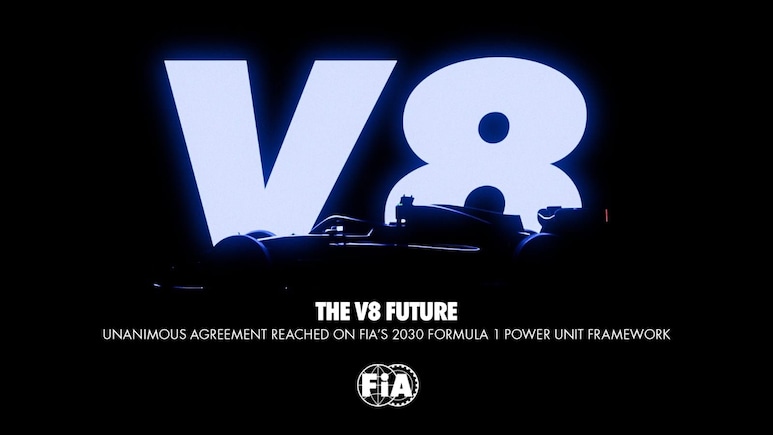
Formula 1 has unanimously agreed on a technical framework to introduce 2.1-litre turbocharged V8 engines from 2030. This brings an end to the current V6 hybrid era a year earlier than planned. The FIA, Formula One Management, teams and power-unit manufacturers have backed the proposal, though final approval still rests with the World Motor Sport Council.
Engine Changes Sharply
The 2030 power unit will be a 2.1-litre turbocharged V8 running on advanced sustainable fuels, with limited hybridisation and a lighter chassis. It will carry over some geometrical specifics from the current engine architecture, but the electrical component will be significantly smaller than the near 50-50 combustion-electric split used in 2026.
READ | Watch: China's Ghost EV' Tries To Park Itself 800 Times Overnight
Reports indicate the hybrid system will be capped at around 200kW, half of the 350kW available under the current rules. Of that, 100kW is expected to serve as a base electric contribution, with the remaining 100kW functioning as a push-to-pass overtaking aid.
The turbocharger stays, partly to meet manufacturer demand and partly to aid fuel efficiency, avoiding larger tanks and higher fuel consumption at the start of races. The overall aim is to make the car and engine around 80kg lighter, with almost half of that reduction coming from the engine side.
GM's Engine Debut Delayed
General Motors, which backs the Cadillac team, had planned to introduce its own engine under the current rules in 2029. With the new V8 era arriving a year early, GM will delay that debut to 2030 rather than build a V6 for a single season.
READ | BYD India Crosses 20,000 EV Deliveries; Atto 3, Sealion 7 Lead Charge
Cadillac will therefore remain a Ferrari customer through 2029 before bringing its own power unit online in 2030. GM's purpose-built engine facility is due to open in mid-December, allowing its development resources to focus fully on the new V8 rules rather than splitting effort between two engine programmes.
Final Approval Is Still Pending
The unanimous agreement covers the technical framework, but the definitive 2030 regulatory package must still be presented to the FIA World Motor Sport Council in Shanghai next month. Only after that approval will the rules be formally locked in.
READ | Elon Musk Hints At Tesla Model Y With No Steering Or Pedals
The FIA has not yet specified the exact hybrid architecture, including how the push-to-pass system will be managed or whether active aerodynamics with movable front and rear wings will be retained. Those details are expected to emerge in the detailed regulatory framework due before the Shanghai meeting.
What Drivers Think
Drivers have broadly welcomed the return of V8s, though some have caveats. Red Bull's Isack Hadjar said he was excited for a full-attack racing car, while Max Verstappen indicated he would have preferred a V10 but accepted the V8 as a step in the right direction.
READ | Shahid Kapoor Buys Land Rover Defender Octa Worth Rs 2.42 Crore
Lewis Hamilton welcomed the return of V8 sound but stressed that the final regulations will determine whether the change delivers. His main concern remains avoiding engines dying halfway down the straight, a criticism that has dogged the 2026 rules since their debut.
