

Building muscle does not always require a gym membership, expensive equipment or a complicated workout routine. It aways your intent and desire to stay fit will matter the most. Bodyweight exercises use your own weight as resistance and can help strengthen major muscle groups when performed consistently and with the right technique. From push-ups that target the chest and triceps to squats and lunges that work the lower body, these movements can form the foundation of an effective home workout. However, muscle growth depends on progressively challenging your muscles. As an exercise becomes easier, you may need to increase repetitions, add sets, slow down the movement or progress to a more challenging variation. The American College of Sports Medicine's 2026 resistance training guidelines recognise home-based and other non-traditional forms of resistance training as effective ways to improve muscle strength and function. Here are seven bodyweight exercises you can include in your home workout routine to build strength and support muscle growth.
1. Push-Ups
According to Havard Health pushups train you to move 50% to 75% of your total body weight, drastically improving your pound-for-pound strength and body control. To perform a push-up, begin in a high plank position with your palms placed slightly wider than shoulder-width apart. Keep your legs extended, feet together or slightly apart, and your body aligned from head to heels. Slowly bend your elbows to lower your chest towards the floor. Push through your palms to return to the starting position without allowing your hips to sag. Beginners can start with knee push-ups or incline push-ups, using a stable elevated surface. As strength improves, standard push-ups can be made more challenging through slower repetitions, pauses at the bottom or feet-elevated variations.
READ | Aditya Roy Kapur Turns 41: How His Fitness Routine And Body Transformations Have Evolved
2. Bodyweight Squats
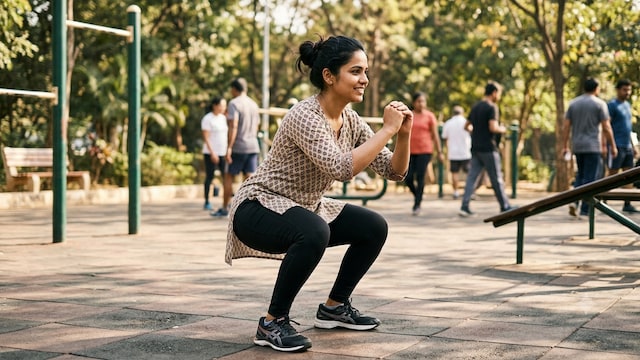
Bodyweight squats help develop the muscles of the lower body, particularly the quadriceps, glutes and hamstrings. They also engage the core and improve lower-body strength. Stand with your feet approximately shoulder-width apart and toes pointing slightly outwards. Keep your chest lifted and brace your core. Push your hips backwards and bend your knees to lower yourself, as if sitting on an imaginary chair. Descend as far as you can comfortably while keeping your heels on the floor. Push through your feet to return to the standing position. Avoid allowing your knees to collapse inwards or lifting your heels off the ground. Once regular squats become easier, you can try pause squats, slow-tempo squats or single-leg variations to increase the challenge.
3. Reverse Lunges
Reverse lunges are useful for strengthening the quadriceps, glutes and hamstrings while also challenging balance and coordination. Since each leg works independently, the exercise can help address differences in strength between the two sides. Stand upright with your feet hip-width apart. Step one foot backwards and lower your body until both knees are bent comfortably. Your front knee should remain aligned with your foot, while your back knee moves towards the floor without hitting it. Push through the front foot to return to the starting position. Repeat with the other leg. Keep your torso upright and avoid leaning excessively forwards. Beginners can hold a wall or sturdy support for balance. To increase the difficulty, slow down the lowering phase or progress to walking lunges and more demanding single-leg exercises.
4. Pike Push-Ups
Pike push-ups are a challenging bodyweight exercise that primarily targets the shoulders and triceps. They are also useful for developing the upper-body pushing strength required for more advanced movements. Begin in a downward-facing V position, with your hands and feet on the floor and hips raised towards the ceiling. Keep your legs relatively straight and position your hands slightly wider than shoulder-width apart. Bend your elbows and lower your head towards the floor, keeping your hips elevated. Push through your palms to return to the starting position. Avoid allowing your elbows to flare excessively or dropping your hips as you lower yourself. If the movement is too difficult, reduce the range of motion or begin with an easier variation. As your strength improves, you can gradually work towards more challenging pike push-ups.
5. Glute Bridges
Glute bridges primarily strengthen the gluteal muscles, while also engaging the hamstrings and core. They are particularly useful for people who want to improve hip strength without using weights. Lie on your back with your knees bent and feet flat on the floor, positioned approximately hip-width apart. Keep your arms by your sides and brace your core. Press through your heels and lift your hips until your body forms a relatively straight line from your shoulders to your knees. Squeeze your glutes briefly at the top before slowly lowering your hips. Avoid arching your lower back to lift your hips higher. Once standard glute bridges become easier, try single-leg glute bridges, keeping your hips level throughout the movement.
6. Inverted Rows
Inverted rows are a pulling exercise that targets the upper back, particularly the latissimus dorsi, rhomboids and biceps. They help balance pushing exercises such as push-ups and contribute to overall upper-body strength. This exercise requires a sturdy, appropriately designed low bar or secure suspension setup. Position yourself underneath it and grip the bar with both hands, keeping your body straight and heels on the floor. Pull your chest towards the bar by bending your elbows and squeezing your shoulder blades together. Slowly lower yourself to the starting position. Choose a setup specifically designed to support your body weight. Do not use an ordinary table, loose furniture or an unstable household surface, as it could tip or collapse. If you do not have a safe setup, consider using a resistance band or another suitable pulling exercise instead.
7. Single-Leg Calf Raises
Calf raises strengthen the calf muscles, particularly the gastrocnemius and soleus, which play an important role in walking, running and lower-body movement. Stand upright with your feet hip-width apart. Hold a wall or sturdy support for balance if required. Shift your weight onto one foot and slowly raise your heel until you are standing on your toes. Pause briefly at the top and lower your heel in a controlled manner. Complete the repetitions before switching legs.
Avoid bouncing through the movement. Focus on a full, controlled range of motion. Beginners can start with calf raises using both feet before progressing to single-leg repetitions. You can also perform them on a stable step to increase the range of motion, provided you have adequate balance.
How Often Should You Do Bodyweight Exercises To Build Muscle?
Consistency and progressive overload are important for muscle growth. The American College of Sports Medicine's 2026 position stand recommends resistance training at least twice a week, with all major muscle groups engaged. Its review of 137 systematic reviews also found that higher weekly training volume, including around 10 sets per muscle group, can support muscle hypertrophy. For beginners, starting with two to three full-body sessions a week is a practical approach. You can begin with two sets of each exercise and choose a number of repetitions that challenges you while allowing you to maintain proper form. As your fitness improves, gradually increase the number of repetitions or sets, or move to more difficult variations.
Allow your muscles time to recover between demanding sessions. Avoid training the same muscle groups intensely on consecutive days, particularly when you are new to resistance training.
Can Bodyweight Exercises Build Muscle Without Weights?
Bodyweight exercises can help build muscle, particularly among beginners and people returning to exercise. The key is to provide enough resistance to challenge the muscles and gradually increase the difficulty as your strength improves. However, bodyweight training has limitations. Once you become stronger, some movements may no longer provide enough resistance to stimulate further progress. More challenging variations, resistance bands or external weights can help address this. Nutrition and recovery also matter. Eating adequate protein, consuming enough overall calories to support your training goals and getting sufficient sleep can help your muscles repair and adapt. Remember that muscle growth takes time, and results depend on your training consistency, nutrition, recovery and starting fitness level. If you experience pain rather than normal muscular effort during an exercise, stop and reassess your technique. People with existing injuries or medical conditions should seek appropriate professional guidance before starting a new workout routine.
Disclaimer: This content including advice provides generic information only. It is in no way a substitute for a qualified medical opinion. Always consult a specialist or your own doctor for more information. NDTV does not claim responsibility for this information.