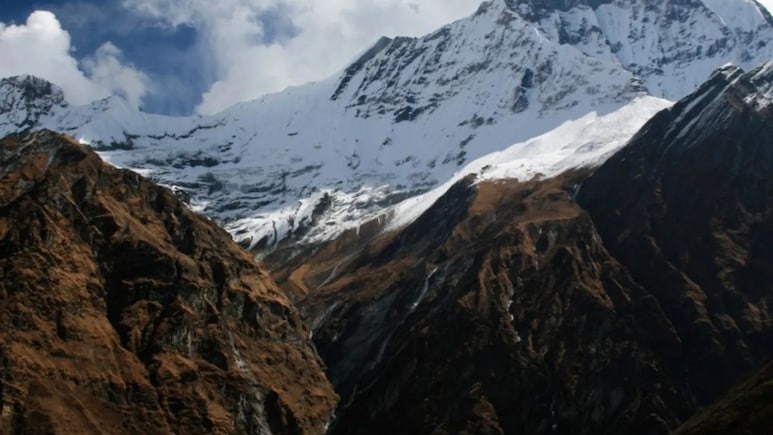
Scientists have found evidence of huge ancient mountains beneath Antarctica's thick ice sheet. These mountains were as large as the Himalayas and were formed hundreds of millions of years ago.
The discovery was made by scientists from the Australian National University (ANU) and Germany's GFZ German Research Centre for Geosciences. Their study was published in the journal Earth and Planetary Science Letters.
According to the researchers, these mountains formed between 650 million and 450 million years ago. During the period, Antarctica collided with India and Africa to form a giant landmass called Gondwana. The researchers said these were the biggest mountain-building events in Antarctica's history.
Ian Campbell, Emeritus Professor at ANU, said, "They are by far the largest mountain-building events to have affected Antarctica."
Also Read | Why Harry Potter Fans Can't Stop Talking About This 9th-Century German Town
He added that these mountain-building events happened around the time when the first animals with hard shells appeared, about 539 million years ago. Soon after, the number and types of animals on Earth increased. This period is known as the Cambrian explosion.
More than 99.5 per cent of Antarctica is covered by thick ice. So, instead of studying the rocks directly, the researchers examined tiny mineral grains called zircons. They collected 1,712 zircon grains collected from sediments during ocean drilling near Antarctica's coast.
These tiny crystals contain information about the age and chemical makeup of the rocks they came from. By studying the crystals, scientists were able to find out when the rocks that once existed in Antarctica formed.
The researchers believe these mountains have created conditions that supported the animal life on Earth. So, when the mountains slowly broke down due to rain, wind and other natural processes, called erosion, they released large amounts of nutrients into the oceans.
The process also reduced carbon dioxide in the atmosphere and increased oxygen levels. Some of the carbon was stored in deposits formed by rivers. So, scientists believe these changes helped create better conditions for early animals to survive and grow.
"Their significance is that they correlate with the appearance of the first shellfish 539 million years ago and the Cambrian explosion, which saw a dramatic increase in the abundance and diversity of animal life, some 10 to 30 million years later," Campbell said.
Also Read | Love GTA 6? These Real-Life Florida Locations Should Be On Your Bucket List
Campbell also said it was unlikely to be a coincidence that one of Earth's biggest periods of animal evolution happened around the same time as the formation and erosion of the Gondwana mountains.
"It is unlikely to be a coincidence that Earth's dramatic period of evolution coincides with Earth's most important period of mountain building: the formation and erosion of the Gondwana Supermountains," he added.
This is not the first time scientists have found hidden mountains and landforms beneath Antarctica.
In January 2026, a study published in the journal Science revealed a new map of the land beneath the continent's ice sheet. The map also showed sharp mountain ranges, deep valleys and ancient river channels.
Track Latest News Live on NDTV.com and get news updates from India and around the world


