





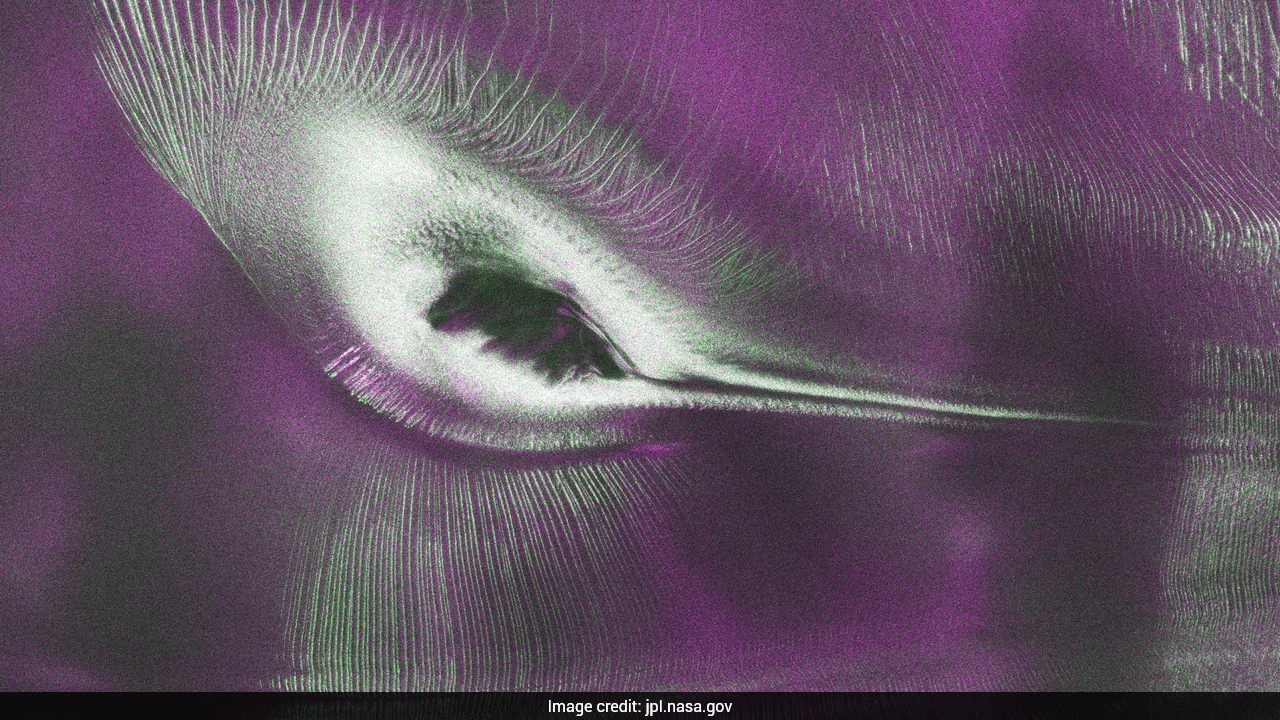
The joint NASA-ISRO satellite, NISAR, has beamed back images from Earth orbit, including one that resembles a giant bird etched into the East Antarctic ice. The "hummingbird" shape emerged from radar data released by both agencies, demonstrating how the mission can scan beneath snow to reveal hidden features of the planet's frozen regions.
What is NISAR?
NISAR (NASA-ISRO Synthetic Aperture Radar) is a pickup-truck-sized, Earth-observation satellite launched on July 30, 2025, from the Satish Dhawan Space Centre in Sriharikota, India.
The $1.5 billion mission is the first to carry two distinct radar frequencies: NASA's L-band radar, which can see through forest canopies and deep into ice, and ISRO's S-band radar, which is optimised for monitoring crops, shrubs, and soil moisture.
Also read | Delta Pilot Warned Of Possible 'Rocket Launcher Attack' Before Landing At LaGuardia Airport
The 'Hummingbird' Over East Antarctica
NASA used data from NISAR's L-band radar to produce an image of Nunatak Zaterjavshijsja, a mountain peak seen through the East Antarctic ice sheet.
As the glacier flows around the mountain, structural stress creates deep crevasses. In the radar view, these crevasses appear as sharp green lines, while smoother ice shows up as magenta.
The overall pattern resembles a bird with outstretched wings - described by the space agency as a "hummingbird" - hidden in the frozen landscape.
"First, it's a beautiful image, with rich details of features that provide insights into how the glacier is moving," said Seongsu Jeong, a signal analysis engineer at NASA's Jet Propulsion Laboratory who processed the image.
Also read | Air India Passenger Claims Rs 55,000 Tripod Damaged During Goa-Mumbai Flight, Company Responds
"Then, because radar can often see through snow and deep into the ice, NISAR can observe fundamentally different properties of Antarctic ice than what can be seen in optical imagery. With NISAR, we're seeing what's hidden beneath the surface."
NISAR is designed to detect changes in Earth's surface down to fractions of an inch. That sensitivity allows scientists to monitor ice sheets, glaciers, natural hazards, ecosystems, agriculture, and coastal changes.
"Anything that moves, NISAR will see with unprecedented fidelity," said Karen St. Germain, director of NASA's Earth Science Division. "We'll see land subsidence and swelling, movements and deformations, melting of glaciers and ice sheets in Greenland and Antarctica, and forest fires."
The hummingbird over Antarctica is a striking preview. It shows that NISAR won't just measure the planet-it will reveal patterns and processes that have remained invisible until now.
Track Latest News Live on NDTV.com and get news updates from India and around the world

