





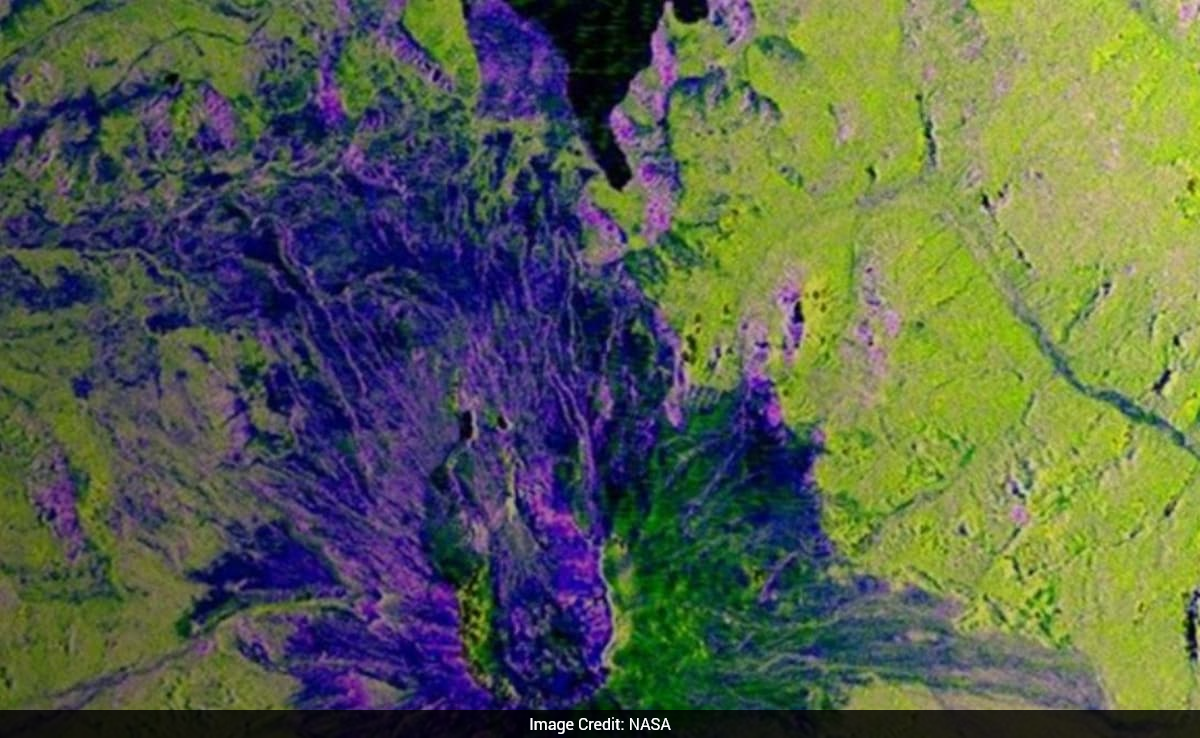
A new image captured by the NISAR has provided a detailed look at Mount St. Helens in the United States. The image, taken on November 10, 2025, shows the region despite cloudy conditions, highlighting the satellite's ability to observe the Earth's surface through clouds, reported NASA.
This image captures a large area of the Pacific Northwest and was recorded using NISAR's L-band synthetic aperture radar. This technology allows the satellite to see through clouds and gather detailed information about the surface below.
Understanding Colours
Different colours are used in this image to represent different surface features. Magenta represents areas where radar signals are reflected strongly from flat surfaces, such as roads and buildings. Yellow can appear due to factors such as landforms, moisture, and surface structure. Yellow-green colours typically indicate vegetation, such as forests and wetlands.
Dark blue areas represent relatively smooth surfaces, such as bodies of water or devoid of vegetation on mountaintops. Purple square patches appear among the green areas near the base of the mountain, with straight edges indicating they are man-made. These are likely caused by deforestation or regrowth of vegetation in previously cleared areas.
NISAR, a joint NASA and ISRO mission, was launched from the Satish Dhawan Space Centre in July 2025.
The project is managed by the California Institute of Technology, with its Jet Propulsion Laboratory leading the US portion. NASA provided the L-band radar system and antenna reflector, while ISRO provided the satellite's hull and S-band radar system.
Advanced Surveillance Capabilities
NISAR is the first satellite equipped with radar instruments operating at two different wavelengths. It is designed to monitor Earth's land and icy surfaces every 12 days. It features a 39-foot-wide drum-shaped antenna reflector, the largest radar antenna ever launched into space by NASA.
This mission is expected to provide critical data for studying Earth's changing surface and environment.
Track Latest News Live on NDTV.com and get news updates from India and around the world

