






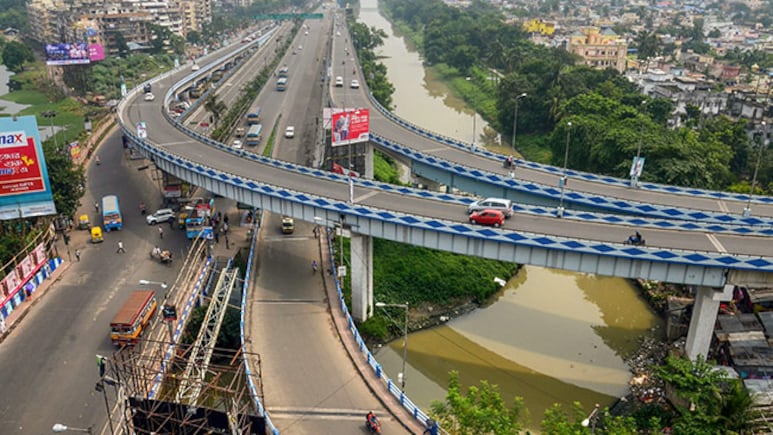
Half a century ago, far removed from the cacophony of today's reality, Calcutta - now Kolkata - glistened with the promise of progress and prosperity. It stood as an emblem of industrial might, a city that whispered to the ambitions of a newly independent nation.
A journey from Asansol-Burnpur, twin cities where I spent my school days, southwards to Calcutta, was a route that spoke volumes about the industrial trajectory. The ancient national highway, the Grand Trunk Road, besides which my school, St Patrick's, as well as my home, lay, wove through booming towns where manufacturing giants thrived-Barakar, Kumardhubi, Kulti, Burnpur, Asansol, Raniganj, Durgapur-each a cog in the vast ecosystem of Bengal's surging economy.
From my home, which lay at the border between Asansol and Burnpur, I could observe the glow of the Indian Iron and Steel Company (IISCO) factory, first incorporated in 1918. Its precursor was Bengal Iron Works Company, established in 1875, at Barakar, which later became part of IISCO.
I grew up in an atmosphere rich with the scent of melting iron and the promise of intricately forged steel. The foundries and factories that lined our path to the Burnpur Club, where I participated in debating competitions, were more than mere brick and mortar; they were the lifeblood of a society intertwined with ambition and enterprise. The Durand Institute, walking distance from my school, where I learnt to appreciate art, culture, music and dance, combined the best of cosmopolitan Anglo-Indian tradition with that of Rabindra Sangeet.
As you drive eastward, the landscape transformed into a montage of colliery towns like Nirsa, Sitarampur, Jamuria, Pandaveswar, Chinakuri, and Raniganj, once basking in the glow of ownership by titans like the Tatas and Bird & Company and smaller ancillary units owned by Marwari, Gujarati and Punjabi entrepreneurs. Other nearby industrial hubs, with many mining and manufacturing workers from Bihar and Uttar Pradesh, included Neamatpur, Satgram, and Mugma. Westwards, the journey would take you to Bihar, industrial hubs of Dhanbad, Bokaro and Jamshedpur. After the IISCO plant of Burnpur, Durgapur's steel plants and chemical factories were the crown jewels of this industrial kingdom of Bengal.
Calcutta was more dynamic than Hong Kong, Singapore, Bahrain and Dubai
Calcutta stood firm with its deep-water ports in Kidderpore Docks and Budge Budge wharves, which served as a key hub for petroleum products. Calcutta was not just a metropolis those days; it was a global hub-a metropolis larger and more dynamic than Hong Kong, or Singapore, or Bahrain and Dubai, the largest and most bustling in India, a haven for those seeking commercial horizons.
Calcutta radiated with a cosmopolitan ethos, inviting an array of immigrants-Hong Kong Chinese, Armenians and Iraqi Jews-each threading their dreams into the fabric of this vibrant metropolis. Calcutta magnetically attracted writers such as the Nobel laureate Gunter Grass, Dominic Lapierre, Alain Ginsburg, Clark Blaise and others, who wrote about the city's majesty as well as its misery.
Here, amid the bustling stock exchange in B.B. D. Bagh (Dalhousie) and iconic buildings, the Fortune 500 flourished, intertwining their fates with that of Calcutta. The significance of this city was tangible; it was where money promised to manifest into opportunity. Bengal was often described as the Ruhr belt of Germany, the preeminent powerhouse of German industrialisation due to massive coal and steel production.
From the Ruhr belt to the Rust belt
In a tragic irony, the Ruhr belt has today become the Rust belt of Bengal and of India. The evidence lies littered when I travelled from Durgapur to Asansol. The main highway is much broader, but the industrial units are shut, and the colliery towns appear like ghost towns.
While Hong Kong, Singapore, and Dubai became world-class financial hubs, Kolkata and the industrial ecosystem around it not only stagnated but also declined. Like the premature sunset shrouding a once-vibrant day, calamity lay in wait. The tragic narrative of Bengal's decline unfolds not merely with the shuttering of factories, but with the gradual suffocation of an entrepreneurial spirit that once thrived. A tumultuous transformation initiated in the 1970s and 1980s under the Left Front marked the beginning of the end. In a fervour to empower labour unions, strikes, unrest, and chaos became the norm, turning the wheels of industry into a cautious crawl.
The failure of the Tata Motors plant in Singur sealed Bengal's fate as an industrial desert
Mamata Banerjee, Chief Minister since 2011, failed to arrest that decline, let alone encourage industrial revamp.
Tata Motors announced its decision to pull out of the Singur Nano project on October 3, 2008. The decision was made under the CPI-M Chief Minister Buddhadeb Bhattacharjee. However, the late Ratan Tata announced the withdrawal following intense, long-running protests and political agitation led by Mamata Banerjee against the forcible acquisition of farmland for the factory. While Buddhadeb Bhattacherjee initiated the project to promote industrialisation in Bengal, the agitation led by Mamata made the construction of the nearly complete facility untenable. Result: The Tata Nano project was subsequently moved to Sanand, Gujarat.
Bengal's failure is existential, not merely economic
Even after the charismatic Mamata ousted the Left Front from power after 34 uninterrupted years, the decline of Bengal, instead of reversing, continued. The failure of the Tata Motors plant in Singur effectively sealed Bengal's fate as an industrial desert. The destruction wasn't just an economic one; it was existential. A generation of aspiring industrialists found themselves pushed from familiar soil to foreign pastures. Calcutta, a once-unassailable titan, began to flounder, rendered impotent by its own misplaced ideologies.
The subsequent rise of Mamata-led Trinamool, for the next 15 years, only cemented this reality-a continuation of anti-entrepreneurial fervour that had become synonymous with Bengal's political landscape.
Industrial decline haunts Trinamool in 2026 as BJP campaigns on industrial revival
The industrial decline of West Bengal has come to haunt the Mamata-led Trinamool Congress (TMC) in the 2026 assembly elections. The BJP has made the industrial revival of Bengal, under a double-engine government, a central pillar of its election plank for the 2026 Assembly elections, focusing on bringing investment back to the state. The BJP campaign, led by Prime Minister Narendra Modi, calls Bengal under TMC as "Maha Jungle Raj", emphasising lawlessness and industrial decline. The BJP campaign contrasts their vision of industrial growth in states like Gujarat with the "lost industries" under the ruling TMC, highlighting the state's potential to become a manufacturing hub.
How chronic structural decline fuels economic backwardness
As of early 2026, Bengal faces a complex economic landscape characterised by high welfare spending, significant debt, and slow industrial growth, despite its potential as an eastern trade hub. While the state is projected to grow its economy by 7.62% in the 2025-26 fiscal year, underlying structural weaknesses continue to fuel its economic backwardness compared to other coastal states of western and southern India.
Bengal is witnessing a chronic, structural decline in its relative economic standing. Bengal's share of India's GDP (Gross Domestic Product) has been shrinking continuously, decade after decade. In 1960-61, Bengal was India's third-largest economy, contributing 10.5% to the national GDP. By FY 2023-24, this fell to about 5.6%, according to EAC-PM data. Despite being a coastal state, Bengal has failed to leverage its coastal advantage, unlike Gujarat, Maharashtra and Tamil Nadu.
Since the TMC came to power (May 20, 2011), Gross State Domestic Product (GSDP) growth has remained below India's national average-Bengal at 4.3% versus India's 5.6% (2012-13 to 2021-22).
High population density and sluggish growth have led to weak per capita income. Bengal ranks 21st among all states, with per capita GSDP roughly 20% below India's national average. In sharp contrast, in 1960-61, Bengal's per capita income was 127.5% of the national average. The decline in the case of Bengal is so dramatic that the per capita income of Bengal by 2023-24 at 83.7% is even below that of Odisha at 88.5%
Key issues affecting industrial growth and investment in Bengal
Manufacturing and investment performance have been consistently weak. Bengal's manufacturing sector grew only 6.6 % between 2012 and 2020 compared to the all-India average of 8.6 %. The record has somewhat improved after the COVID years, touching almost 8 %. The state has struggled to attract major industrial investments due to complex land acquisition policies, infrastructural shortcomings and bureaucratic delays. Bengal ranks below high-performing coastal industrial states such as Gujarat, Maharashtra, and Tamil Nadu in ease of doing business.
Despite high social-sector spending, social indicators remain a concern
Bengal's HDI lags behind southern states. Bengal's Human Development Index (HDI) stands at around 0.65, ranking between 22nd and 25th among Indian states, which is well below Kerala's 0.78 and Tamil Nadu's 0.71.
The state has adopted a model that prioritises social welfare, such as the expansion of the Lakshmir Bhandar scheme. Around 45% of the budget is allocated to social wages, which experts argue masks a failure to create a self-sustaining, productive economy
For those of us who remember Bengal and Kolkata in its prime, its collapse is heartbreaking. The fall of this once-mighty metropolis epitomises the dire consequences of disregarding the essence of wealth creation. It serves as a clarion call to understand the critical nature of supportive governance in cultivating an atmosphere where businesses can thrive rather than be stifled.
2026 election campaign: BJP pitches bringing back Bengal's glory
The high-pitched election campaign of 2026 has become an albatross around Mamata Banerjee's neck.
The BJP has focused on the abandoned Tata Nano factory site in Singur to symbolise "missed opportunities" and promised a return to industrialisation. A core promise is to create employment to stop the forced migration of workers and bring back "Bengal's glory".
The Opposition party has pledged to encourage heavy industry and set up investments within one year of taking power, specifically promising no acquisition of multi-crop farmland, a key issue in previous political clashes.
BJP leaders argue that West Bengal has fallen behind significantly in GDP contribution and industrial output under the Left and TMC governments, pitching themselves as the party that can reverse this trend. This economic narrative is part of a broader strategy against the TMC, which includes concerns over "syndicate raj" (corruption), law and order, and infiltration. The industrial pitch is designed to win over youth and entrepreneurs.
(The author is Editor, Research, NDTV)
Disclaimer: These are the personal opinions of the author

