





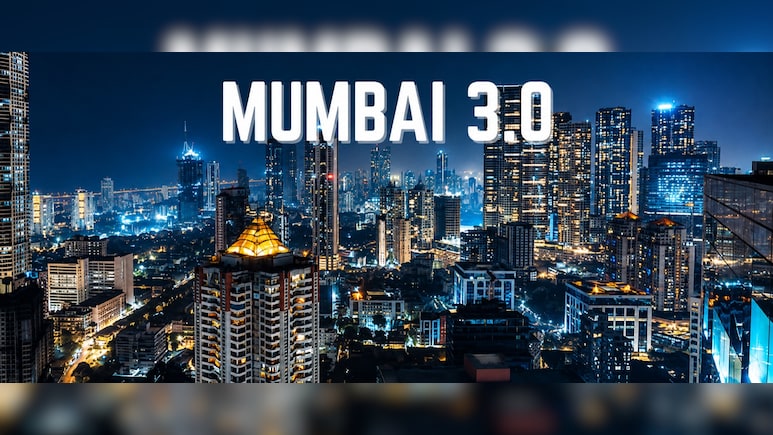
Mumbai has run out of room to grow the way it once did. Land is limited. Property prices are high. And the pressure on roads, housing and infrastructure keeps rising.
Now, Maharashtra is looking at a much bigger solution -- a new urban centre beyond Navi Mumbai.
Called Mumbai 3.0, the Karnala-Sai-Chirner (KSC) New Town will bring 124 villages across Uran, Panvel and Pen talukas of Raigad district into a planned urban development spread over 323.44 sq km. The Mumbai Metropolitan Region Development Authority (MMRDA) has been appointed as the New Town Development Authority for the region.
The proposed city sits close to the Atal Setu and Navi Mumbai International Airport, putting it at the centre of one of India's fastest-growing infrastructure corridors.
Why Mumbai Needs A '3.0'
Mumbai has already expanded far beyond its original island city. Navi Mumbai became the next major urban centre. But even Navi Mumbai is seeing increasing pressure for land.
Hence, the need for KSC New Town. The project is being planned as a new economic and residential centre rather than simply another housing suburb. The vision includes commercial districts, technology hubs, logistics, data centres, healthcare, education and residential areas.
The goal is to create jobs and homes together, instead of forcing people to travel long distances every day. According to the plan, around 104 sq km will have townships and industrial corridors, while other areas will retain green zones, forests and rural settlements. The project is being positioned as a modern, technology-led urban centre with a strong focus on planned development.
Amar Shah, Director & Co-founder, Golden Abodes, said, "When people talk about a "Third Mumbai," the conversation usually jumps straight to the greenfield master plan. But if you study how regional urban growth historically unfolds around Mumbai, greenfield boundaries tell only half the story."
He added, "Development fundamentally occurs between two established economic anchors rather than in isolation. This dynamic is visible across the major highway corridors radiating out of Mumbai. The corridor heading north toward Gujarat is already densely built out through Vasai and Virar. Along the Mumbai-Nashik corridor, real estate and industrial velocity taper off after the outer municipal limits, functioning primarily as a one-way feeder into Mumbai rather than creating balanced, two-way economic pull."
Atal Setu Changes The Equation
The biggest advantage for Mumbai 3.0 is connectivity. The Atal Bihari Vajpayee Sewri-Nhava Sheva Atal Setu has dramatically reduced travel time between Mumbai and the Navi Mumbai-Raigad side.
The proposed city will also benefit from the Navi Mumbai International Airport, Panvel-Karjat railway corridor, Virar-Alibaug multimodal corridor and the Mumbai-Pune Expressway.

The proposed economic ecosystem is expected to include IT and IT-enabled services, financial services, global capability centres, data centres, healthcare, education, logistics and other businesses.
Vishal N Ratanghayra, Founder & CEO of Platinum Corp., told NDTV that the project could change the growth trajectory of the Mumbai Metropolitan Region. "Mumbai 3.0 has the potential to fundamentally reshape the growth trajectory of the MMR by moving beyond the traditional model of residential expansion and creating a new, integrated economic centre."
The MMRDA has also secured a proposed $12 billion investment commitment from Brookfield covering areas such as real estate, transit-oriented development, logistics parks, data centres and GCCs.
Real Estate Could Get A New Growth Corridor
For property buyers and developers, a massive infrastructure-led development can create entirely new micro-markets.
Abhishek Raj, Promoter, Jenika Ventures, said Mumbai 3.0 could change the way the MMR accommodates future growth. "The development of Mumbai 3.0, or the Karnala-Sai-Chirner New Town, marks a significant shift in the way the Mumbai Metropolitan Region can accommodate future growth," he told NDTV.
Raj said the combination of Atal Setu, Navi Mumbai International Airport and emerging multimodal corridors could create opportunities across residential, commercial and investment markets. "Such large-scale and infrastructure-driven development can offer new micro-markets, create employment opportunities, and generate housing needs, commercial needs and allied services demands," he said.
Significantly, the project is not being conceived as a concrete jungle alone. Raj said the focus on green belts and smart-city infrastructure is encouraging because future urban expansion will have to balance economic growth with liveability.
Ratanghayra makes a similar point. He said investment needs to translate into a well-planned urban ecosystem, with multimodal connectivity, social infrastructure, green spaces and mixed-use neighbourhoods developing alongside commercial and residential projects.
Rs 4,000 Crore Already Earmarked
The project is also getting a significant push from the MMRDA. For 2026-27, MMRDA has earmarked Rs 4,000 crore for the Karnala-Sai-Chirner New Town as part of its infrastructure-focused budget.
Land acquisition is also moving ahead. MMRDA has offered landowners in the 124 villages different compensation routes, including monetary compensation, development rights and land pooling. This will be one of the most important parts of the project.
However, the city will not appear overnight. Planning and land-related processes are already underway. The first phase could take shape toward the end of this decade, while the larger urban ecosystem is expected to take much longer to develop.
According to Amar Shah, "The Mumbai-Pune axis displays the opposite momentum. Development along this corridor remains the most active across the region. Both the metropolitan centres are actively expanding toward each other. Parallel to this is the Mumbai-Goa highway corridor, the NH-66. It carries crucial strategic weight due to its port connectivity. It is anchored by India's largest container gateway at JNPT and supported by coastal port infrastructure further down the belt. This highway serves as a vital artery for national import-export freight and cargo movement... When you map these transit corridors, a distinct industrial triangle emerges. One node along the Mumbai-Pune corridor, one along the Mumbai-Goa highway corridor and one central junction connecting both to the broader metropolitan region. Substantial land parcels across this belt have already been acquired and notified by state industrial development agencies for manufacturing and logistics zones tied to national industrial initiatives. Direct access to major maritime ports makes this geography uniquely positioned for export-oriented manufacturing and freight operations."
Track Latest News Live on NDTV.com and get news updates from India and around the world

