





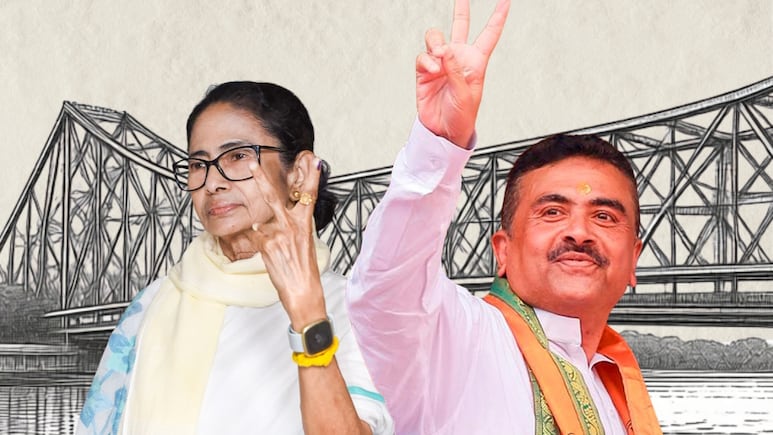
Following the BJP's resounding victory in West Bengal, the long-running standoff between the state and the Centre can now finally be resolved, especially on matters of internal security, sources within the party said.
Significant differences of opinion persisted between the Trinamool Congress government and the Union Ministry of Home Affairs. One major contentious issue among these was border fencing and the associated land acquisition process. A substantial stretch of Bengal's 2,217-km international border still remains unfenced.
"Due to the state government's policy of refusing to acquire land, the fencing work remained stalled for several years. Consequently, this porous border evolved into a safe corridor facilitating infiltration, cattle smuggling, and the illicit trade of counterfeit currency," a source said.
In 2021, the Ministry of Home Affairs issued a notification extending the operational jurisdiction of the Border Security Force (BSF) from 15 km to 50 km in border states, specifically West Bengal, Punjab, and Assam.
The Bengal government denounced the decision as an infringement of the state's policing powers and an assault on the federal structure of the country. A resolution condemning the move was passed in the Assembly, and the state government categorically refused to comply with the directive.
This friction led to a breakdown in coordination between the Border Security Force and the state police. Complaints frequently surfaced regarding the BSF failing to get cooperation from local police authorities during search-and-seizure operations.
CAA, NRC
Similarly, a conflict also arose regarding the implementation of the CAA (Citizenship Amendment Act) and the NRC (National Register of Citizens). The central government notified the rules for the CAA and issued directives for the identification of illegal migrants. However, Chief Minister Mamata Banerjee publicly declared that neither the CAA nor the NRC would be allowed to be implemented within Bengal.
As a result, the state government delayed sharing administrative data with the Centre and stalled the commencement of the necessary procedures. The consequence of this was a deadlock in the identification of infiltrators and the associated legal processes, thereby complicating the management of the international border.
The source alleged the state government also failed to cooperate with the NIA and other central agencies. The Centre had entrusted the investigation of terrorist activities - such as the Khagragarh blast - to the National Investigation Agency (NIA).
"However, on numerous occasions, the NIA teams failed to receive local cooperation. In some instances - such as the Bhupatinagar bomb blast in 2022, in which three people were killed - central investigative teams were even subjected to attacks by mobs. This hindered the swift action required against terrorist modules and sleeper cells, thereby escalating risks to national security," the source said.
Political Violence
Tensions also persisted between the state government and the Centre regarding the deployment of Central Armed Police Forces (CAPF). During key electoral events - such as the 2021 Assembly elections, the 2023 Panchayat elections, and the 2024 Lok Sabha elections - the Ministry of Home Affairs issued directives for the deployment of central security forces at sensitive polling booths. To circumvent these directives, the state government repeatedly approached the courts, frequently arguing that the state police were fully capable of maintaining law and order.
"Consequently, incidents of political violence during elections, like those in Sandeshkhali and Falta, surged, largely due to a lack of clarity regarding the chain of command between the central forces and the local administration," the source said.
"When state intelligence units and central agencies (such as the IB and NIA) fail to share information with one another, it creates an environment conducive to the proliferation of cross-border terrorist networks," the source added.
Prospects For Change
After the BJP forms the government in West Bengal, significant changes and accelerated progress are expected regarding these stalled projects. With the same political party governing both at the Centre and in the state, the existing 'deadlock' in Centre-State coordination can be resolved.
"By prioritising the land acquisition process, fencing work will be completed on a war footing. In its manifesto, the BJP has pledged that land for fencing along the India-Bangladesh border will be allocated within 45 days of forming the government. The BJP's primary agenda is to bring cross-border infiltration down to zero. With the full cooperation of the state government, the BSF and the police will be able to conduct joint operations, thereby curbing the demographic shifts currently taking place in the border districts. To this end, the party has promised to implement a policy of 'detect, delete, and deport'," said the source.
"Furthermore, central agencies will be granted a free hand. The NIA and other agencies will receive the necessary administrative and security support to dismantle terrorist networks and sleeper cells, thereby bolstering internal security," the source added.
Track Latest News Live on NDTV.com and get news updates from India and around the world

