





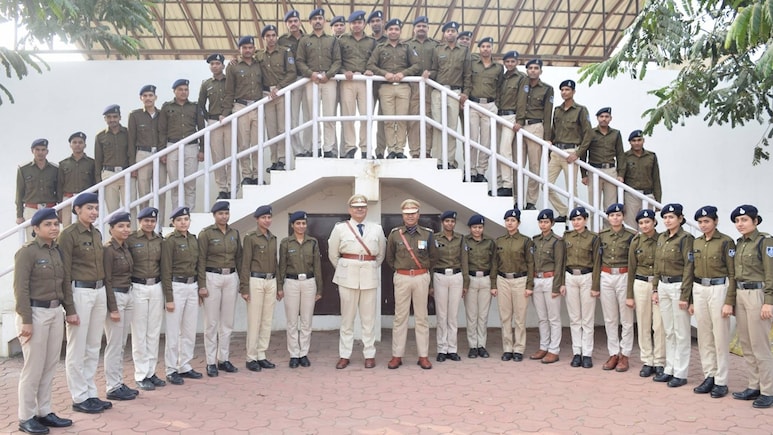
A new directive from the Madhya Pradesh Police Training Wing asking recruits to begin their day with the recitation of the Shri Dakshinamurti Stotram has sparked a fresh political controversy, reviving the debate over the role of religious and philosophical texts in state institutions.
The order, issued by Additional Director General of Police (Training) Raja Babu Singh, directs all Police Training Schools (PTS) in the state to start the day by playing the Dakshinamurti Stotram through loudspeakers installed across training campuses so that both trainers and recruits hear the verses before the day's training begins.
In a message sent to all training centres, Singh described Dakshinamurthy, an aspect of Lord Shiva, as the "ultimate cosmic teacher" representing wisdom, knowledge, meditation and yoga values he believes are essential for shaping a disciplined and compassionate police force.
"Knowledge is not merely the accumulation of information. A police officer must also have discretion, wisdom, empathy and sensitivity," Singh said in his communication to training schools. According to him, when the verses of the Dakshinamurti Stotram resonate across the campus, recruits will imbibe deeper understanding and moral clarity, ultimately emerging not just as skilled professionals but as responsible and humane officers.
The directive instructs that since speakers are already installed in police training campuses, the hymn should be played at the start of the day so that the entire training environment resonates with the stotram.
However, the order has reignited a political dispute that began earlier when the police training wing introduced similar initiatives involving religious and philosophical texts.
Last year, the department had asked recruits in eight police training schools to read one chapter of the Bhagavad Gita before nightly meditation sessions. The initiative came after another directive encouraging the recitation of verses from Tulsidas' Ramcharitmanas, which officials said would promote ethical discipline and clarity of thought among the nearly 4,000 police trainees in the state.
The latest order has once again drawn criticism from the opposition Congress.
Congress spokesperson Bhupendra Gupta said introducing such practices within police training institutions raises concerns about the neutrality of state agencies. According to him, institutions responsible for maintaining law and order must reflect constitutional values that treat all citizens equally, and any move that appears to promote one belief system could be seen as inappropriate for a public institution.
The ruling BJP, however, strongly defended the initiative and accused the opposition of politicising what it calls a cultural and philosophical exercise.
BJP spokesperson Pankaj Chaturvedi said texts and traditions such as the Bhagavad Gita and Dakshinamurti Stotram represent universal philosophical ideas about knowledge, discipline and duty rather than sectarian religion.
"In a country like India, if someone starts calling the Bhagavad Gita or such philosophical traditions communal, it raises questions about their understanding of India's civilisational ethos," Chaturvedi said, adding that such teachings can help police personnel develop moral clarity and better serve society.
Supporters of the initiative within the police establishment say the training programmes already include yoga, meditation and mental conditioning, and the recitation is intended to strengthen ethical thinking rather than enforce religious practice.
As chants of the Dakshinamurti Stotram begin to echo through police training campuses each morning, the directive has once again placed Madhya Pradesh's police training system at the centre of a wider political debate one that pits cultural philosophy against concerns over institutional neutrality.
Track Latest News Live on NDTV.com and get news updates from India and around the world

