

)
When individuals evaluate their heart health risk, the standard diagnostic checklist routinely features familiar biomarkers such as blood pressure readings, lipid panels, fasting blood glucose, and daily step counts. Yet, a growing body of medical research, such as the BMJ Journal, suggests that a fundamental reflection of heart health and long-term vitality sits right in the palm. Handgrip strength has long been viewed as a basic fitness metric, and it is increasingly recognised by medical authorities as a reliable, non-invasive vital sign for cardiovascular health and biological ageing.
A firm handshake serves as far more than a social gesture or an indicator of bodily confidence. Physiologically, the force exerted by the inner muscles of the hand and the flexors of the forearm offers a direct effect for overall musculoskeletal integrity, systemic vascular function, and functional independence.
How Grip Strength Is Related To Heart Health
Dr K. Srinivas, Senior Consultant Cardiologist and Preventive Heart Care Specialist at Apollo Hospitals, explains, "Handgrip strength is much more than a measure of how hard you can shake someone's hand; it is an underutilised, non-invasive biomarker of systemic arterial health and muscular integrity.”
He adds, “In clinical practice, when we see a significant decline in grip strength, it often reflects underlying arterial stiffness, chronic subclinical inflammation, or loss of skeletal muscle mass, all of which directly elevate cardiovascular risk. Simple resistance exercises and compound movements can significantly improve muscle quality and support long-term heart resilience.”
The shift toward treating muscle force as a clinical indicator gained significant momentum following the landmark Prospective Urban Rural Epidemiology (PURE) study led by researchers at McMaster University. Tracking nearly 140,000 adults across 17 diverse socio-economic nations over a multi-year follow-up period, the landmark investigation produced startling findings regarding muscle quality and cardiac risk.
The PURE study revealed that handgrip strength was a stronger predictor of overall mortality and cardiovascular death than systolic blood pressure, traditionally considered one of the primary indicators of cardiac strain.
Specifically, every 5-kilogram drop in grip strength over the course of the study was linked to a 17 per cent higher risk of cardiovascular mortality, a 9 per cent decrease in stroke risk protection, and a 7 per cent higher risk of non-cardiovascular death.
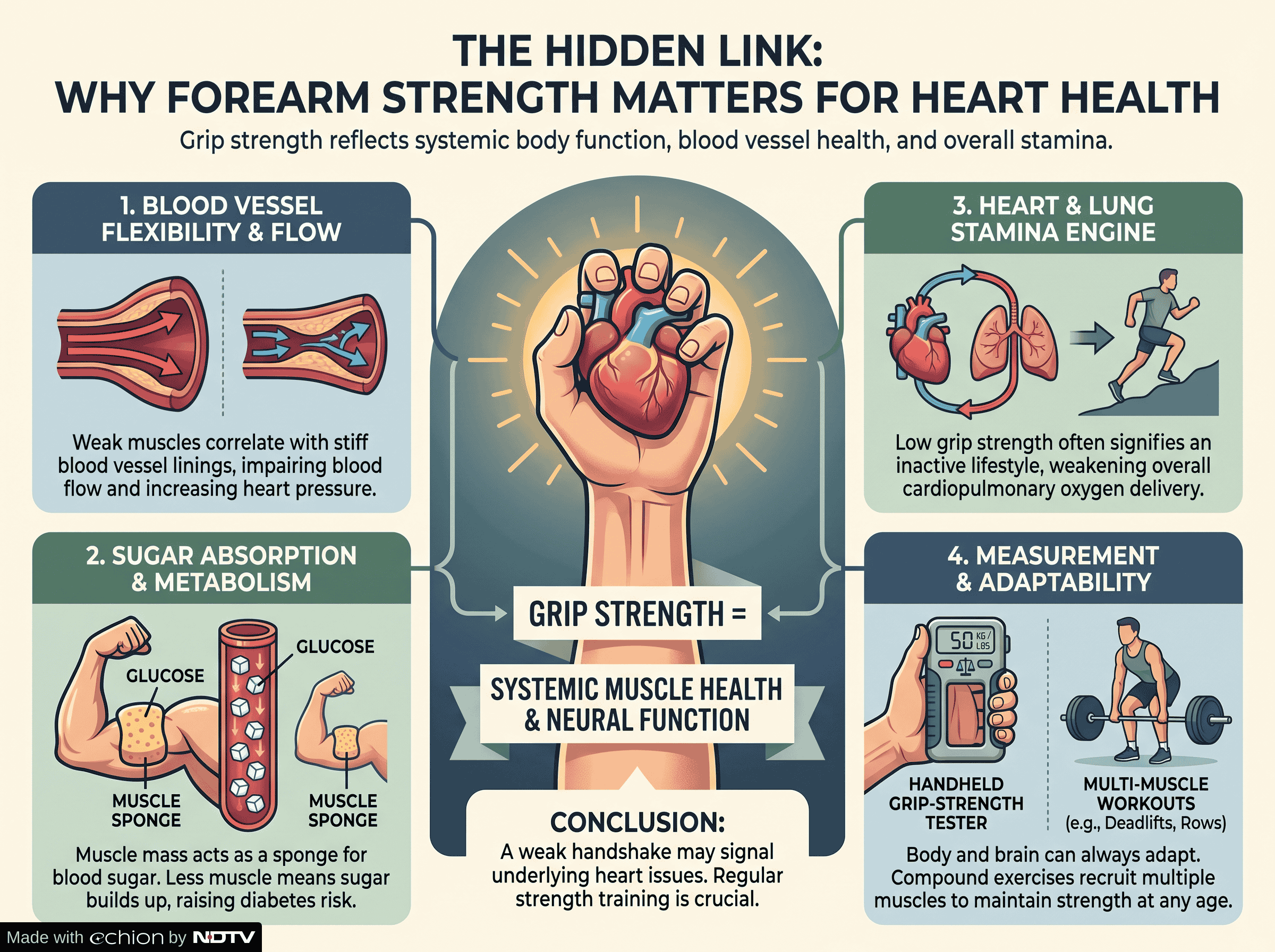
Why Your Forearm Strength Is Related To Heart Health
To understand why forearm strength correlates so strongly with heart performance, clinicians examine the systemic nature of muscle tissue. The hands and wrists do not operate in isolation; rather, grip strength reflects overall skeletal muscle mass, mitochondrial function, and neural activation patterns across the entire body.
How Blood Flow and Blood Vessels Work
Muscles need a massive network of tiny blood vessels to get oxygen and clear out waste. When muscles weaken, it usually means your blood vessels aren't expanding and contracting smoothly either. This leads to stiff arteries, higher inflammation, and extra pressure on your heart.
Stiff or Damaged Blood Vessel Linings
The inner lining of your blood vessels loses its flexibility, making it harder for blood to flow freely.
How Your Body Processes and Clears Sugar from Your Blood
Your muscles act like a massive sponge that absorbs sugar (glucose) from your food. If you lose muscle mass as you age, that sponge gets smaller, causing sugar to build up in your bloodstream. This raises your risk for diabetes and clogged arteries.
Age-related Muscle Loss and Weakness
The natural loss of muscle mass, strength, and function that happens as people get older if they don't do strength training.
Your Heart and Lungs' Stamina Engine
How well your heart and lungs can deliver oxygen when your body works hard. Low grip strength usually means an inactive lifestyle, which weakens your heart's overall stamina.
Static Squeezing: Power Without Moving the Joint
The strength your muscles use when gripping or holding something tightly in place (like holding a heavy grocery bag) without moving your arms up and down.
A Handheld Grip-Strength Tester
A small device with a handle that measures exactly how hard you can squeeze in kilograms or pounds.
Your Body and Brain's Ability to Adapt and Rewire
Your nervous system and muscles never lose the ability to learn, recover, and get stronger, no matter your age.
Multi-Muscle Strength Workouts
Exercises (like deadlifts, rows, or pull-ups) that recruit multiple large muscles at once instead of isolating just one tiny muscle.
A weak handshake could be related to heart health issues, and you need to work out to maintain your grip strength.
Also Read: Can Holding A Plank For 60 Seconds Lower Your Blood Pressure?
Disclaimer: This content including advice provides generic information only. It is in no way a substitute for a qualified medical opinion. Always consult a specialist or your own doctor for more information. NDTV does not claim responsibility for this information.