

)
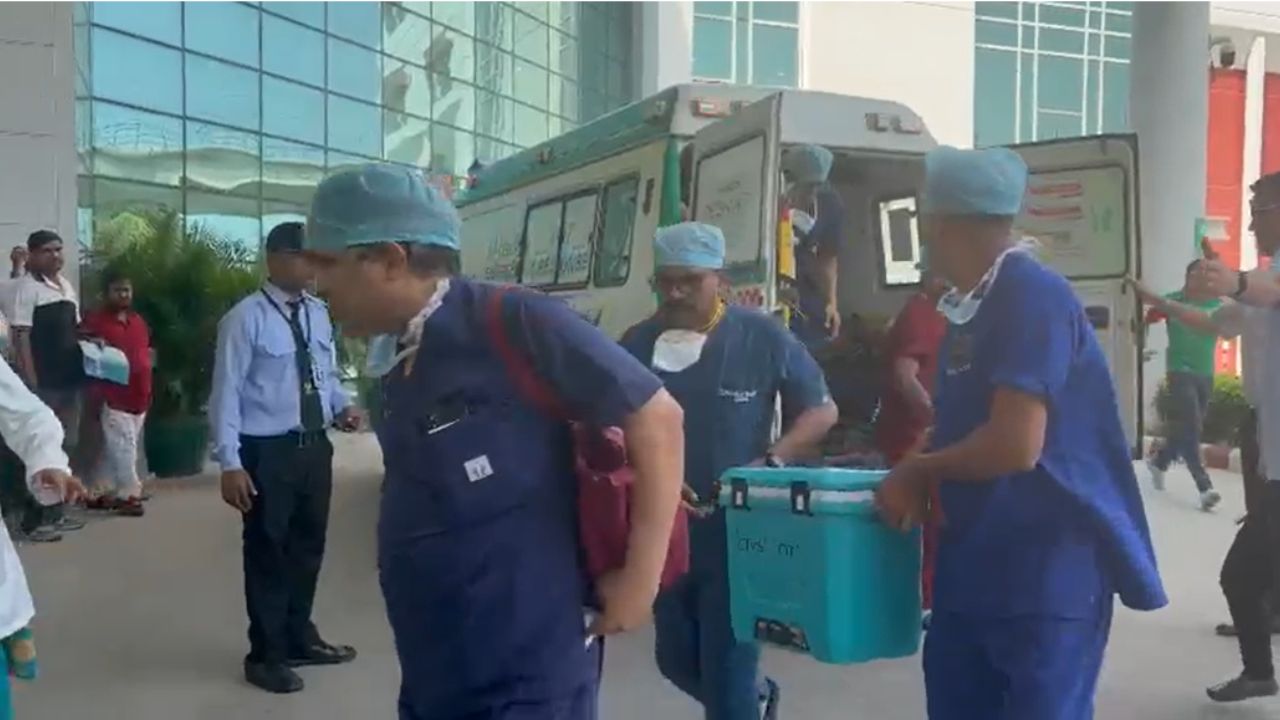
A high-speed Green Corridor recently helped transport a donor heart over 20 kilometres in just 16 minutes. This enabled a heart transplant at Fortis Hospital Noida. The life-saving journey began after a grieving family in Chandigarh made the decision to donate their loved one's organs. The donor heart was airlifted from Chandigarh to Hindon Airport in Ghaziabad, where it was immediately handed over to a waiting emergency ambulance. The ambulance then transported the donor heart to Fortis Hospital Noida, covering a distance of 20 kilometres in 16 minutes. During organ transportation, every minute is crucial, hence, traffic authorities in Ghaziabad and Gautam Buddh Nagar worked together to create a dedicated route for the ambulance.
The donor heart was retrieved from Command Hospital, Panchkula, Haryana, and transported to Chandigarh Airport before being flown to Hindon Airport. A suitable recipient had already been identified and the transplant team was preparing at the hospital in Noida. More than 100 police personnel were positioned along the route, while hospital teams, airport authorities and officials in Haryana, Ghaziabad and Noida coordinated the movement. The rapid transfer helped ensure that the heart reached the transplant centre within the critical time window required for transplantation.
What Is A Green Corridor?
A Green Corridor is a specially managed traffic route created to allow an emergency vehicle to travel quickly and without unnecessary stops. Traffic police coordinate signals, intersections and road movement along a predetermined route so that an ambulance carrying a critical patient or a donated organ can reach its destination in the shortest possible time.
Green Corridors are particularly important in organ transplantation because donated organs cannot be stored for a long time. Once an organ is retrieved, the clock starts ticking. A delay during transportation can affect the organ's viability and the chances of a successful transplant.
In the case of a donor heart, timing is especially important. The total cold ischaemic time, the period during which the organ is preserved outside the body, should ideally remain within about two hours and should not extend beyond the accepted safe window of approximately two and a half to three hours.
How Was The Donor Heart Transported To Noida?
The process began when a suitable donor heart became available at Command Hospital, Panchkula, at around 2 AM. Fortis Hospital, Noida, activated three teams simultaneously to avoid wasting time. The retrieval team travelled by road to Panchkula to collect the heart. At the same time, the clinical team at Fortis Noida began preparing the recipient for transplantation. A separate administrative team started coordinating with authorities across Haryana, Chandigarh, Ghaziabad and Noida.
The retrieval team took approximately four and a half hours to reach Panchkula. Meanwhile, arrangements were made to transport the heart from Panchkula to Chandigarh Airport. The organ was then flown to Hindon Airport in Ghaziabad.
20 Km Covered In Just 16 Minutes
The final road journey was one of the most time-sensitive parts of the operation. At around 7 AM, the Fortis Noida administrative team contacted DCP Traffic Ghaziabad Abhay Kumar Mishra and informed the authorities that a Green Corridor would be required from Hindon Airport to Fortis Noida.
Police personnel immediately began preparing the route. Inspector Arun Kumar was assigned to the Ghaziabad stretch, while Inspector Rajeev Balyan was responsible for the Noida section. The teams worked with the hospital to map the route, coordinate timings and prepare for the aircraft's arrival.
More than 100 police personnel were briefed and positioned at key points. The Ghaziabad Control Room was also assigned to monitor the movement and coordinate the operation. An additional escort police van was deployed to support the ambulance.
Once the donor heart arrived at Hindon Airport, it was quickly transferred to the waiting emergency ambulance. The Green Corridor then enabled the ambulance to cover approximately 20 kilometres to Fortis Noida in just 16 minutes.
Why Every Minute Matters During Heart Transplants
Unlike some organs, a heart cannot be preserved for an extended period. It needs to be removed from the donor, preserved appropriately and transplanted into the recipient within a limited period. The longer the heart remains outside the body, the greater the concern about ischaemic injury. This is why transplant teams begin preparing the recipient even while the organ is still being transported.
In this case, the clinical and administrative teams worked in parallel. The recipient was prepared at the Noida hospital while the retrieval and transportation arrangements were underway. This ensured that the transplant team could act immediately once the donor heart reached the hospital.
Airport Coordination Also Played A Key Role
The journey did not depend only on traffic police. Airport authorities and security teams also had to coordinate the movement of the organ. At Hindon Airport, the hospital team worked with airport security authorities and concerned Air Force security officials to obtain special permission for the Fortis ambulance to be stationed close to the airstrip.
This helped reduce the time between the aircraft landing and the donor heart being transferred to the ambulance. Even a few minutes saved at this stage can be important when an organ is being transported for transplantation. This was also significant because it was Hindon Airport's first experience involving the transportation of a live donor organ.
Mohit Singh, Zonal Director, Fortis Hospital, Noida, said that creating an inter-state Green Corridor for the 20-kilometre journey required exceptional coordination between law enforcement, airport authorities and the hospital's emergency teams. He also expressed gratitude to the donor's family, whose decision to donate the organs made the transplant possible. He said, "Creating an inter-state green corridor that safely navigates 20 kilometers in just 16 minutes requires exceptional synchronization between law enforcement, airport authorities, and our internal emergency teams. Above all, we extend our deepest gratitude to the donor's family for their selfless and courageous decision, whose supreme gift of life made this miraculous journey and successful transplant possible. This milestone underscores our unwavering commitment to advancing clinical excellence and spreading awareness about the vital importance of organ donation."
Disclaimer: This content including advice provides generic information only. It is in no way a substitute for a qualified medical opinion. Always consult a specialist or your own doctor for more information. NDTV does not claim responsibility for this information.