

)
What if one of the simplest exercises in the gym could help improve your grip, core stability, posture and overall strength at the same time? You do not necessarily need a complicated machine or a long workout to challenge your body. The farmer's walk, also known as the farmer's carry, is a straightforward exercise that involves carrying weights in both hands while walking for a set distance or duration. Despite its simplicity, the movement can put several muscle groups to work simultaneously. It is often used in strength and conditioning programmes because it combines resistance training with movement, requiring the body to stay stable while carrying an external load.
What Is A Farmer's Walk?
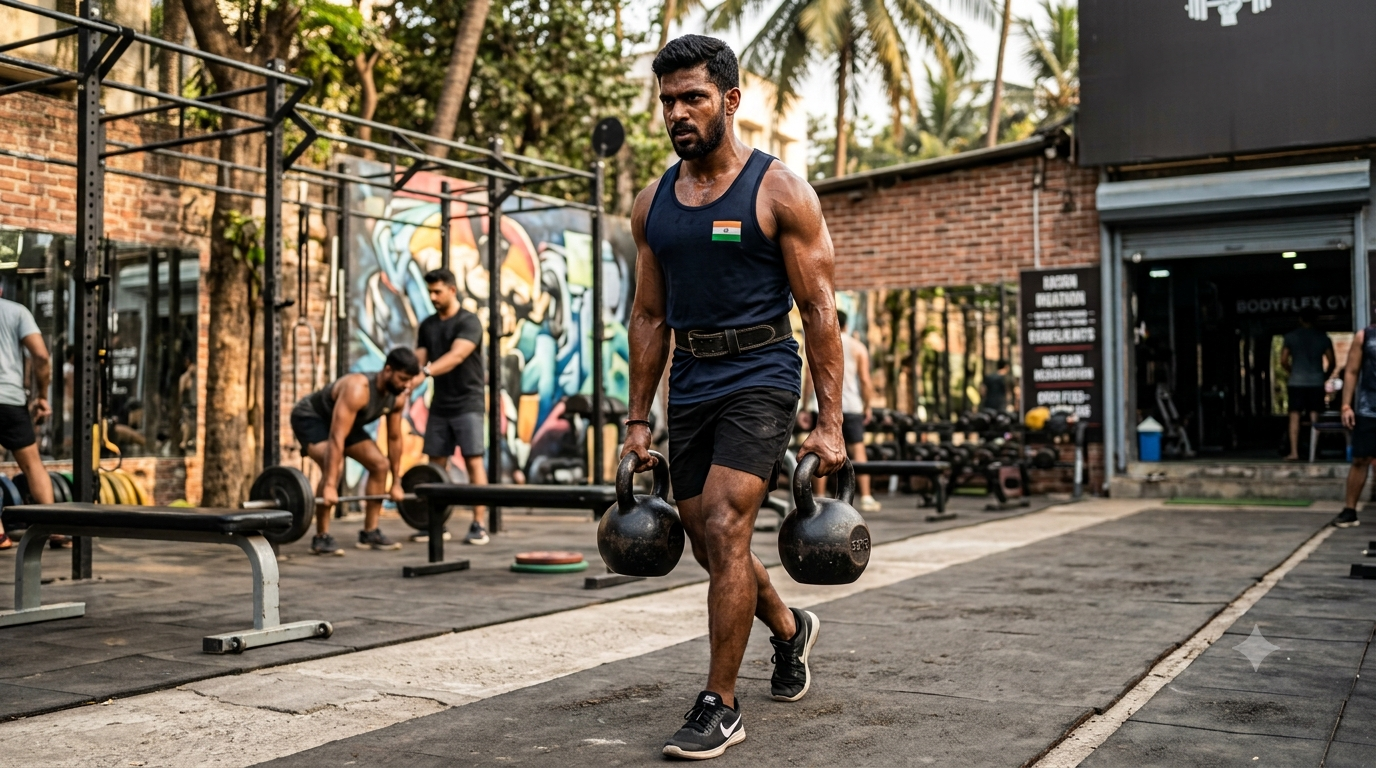
The farmer's walk is performed by holding a weight in each hand, standing upright and walking while maintaining control of the load. Dumbbells, kettlebells or specialised farmer's carry handles can be used. The exercise may look like simply walking with weights, but maintaining good posture while carrying a challenging load requires coordination between the hands, shoulders, core, hips and legs. The weight should be heavy enough to create a challenge but not so heavy that it compromises your technique.
It Can Strengthen Your Grip
One of the biggest benefits of the farmer's walk is its impact on grip strength. Holding weights for an extended period forces the muscles of the hands and forearms to work continuously.
Good grip strength is useful not only for gym exercises such as deadlifts and rows but also for everyday activities that involve carrying, lifting or holding objects. Because the hands have to maintain their grip throughout the walk, the exercise can also challenge muscular endurance in the forearms.
Your Core Has To Work Hard
The farmer's walk is not traditionally thought of as an abdominal exercise, but your core plays an important role throughout the movement. When you carry heavy weights on both sides, your trunk has to remain stable as you walk. Your abdominal and back muscles work together to prevent excessive movement and help you maintain an upright position. This makes the farmer's walk a useful example of functional core training. Rather than simply moving the trunk through a series of repetitions, the core has to resist unwanted movement while the rest of the body is moving.
It Trains More Than Just Your Arms
Although the weights are held in your hands, the farmer's walk is a full-body movement. Your shoulders and upper back help maintain the position of the weights, while your core stabilises your torso. Your glutes, quadriceps, hamstrings and calf muscles contribute as you walk. This combination makes the exercise particularly useful when you want to train several muscle groups without performing a long list of isolated exercises.
It Can Challenge Your Posture
Walking with weights requires you to maintain control of your body position. Ideally, the chest remains open, the spine stays relatively neutral and the shoulders remain controlled rather than excessively rounded or shrugged. This does not mean forcing yourself into an exaggerated upright position. Instead, the focus should be on maintaining a natural, stable posture while walking.
However, if the weights are too heavy, you may begin leaning, shrugging your shoulders or losing control of your steps. That is a sign that the load needs to be reduced.
Farmer's Walk Can Improve Carrying Strength
Carrying strength is a practical form of strength that translates into everyday activities. Whether you are carrying grocery bags, luggage or other objects, the ability to stabilise your body while holding weight can be useful outside the gym. The farmer's walk allows you to train this specific movement pattern under controlled conditions. It can also be particularly useful for people whose training is focused on functional fitness, athletic conditioning or overall strength rather than simply developing individual muscles.
How To Do A Farmer's Walk Correctly
Start by standing between two dumbbells or kettlebells. Bend down and pick up the weights while keeping your back controlled. Stand tall with your feet approximately hip-width apart. Hold the weights firmly at your sides. Keep your shoulders controlled, engage your core and look straight ahead. Begin walking slowly and deliberately. Take controlled steps rather than trying to move quickly. Keep your torso stable and avoid allowing the weights to swing excessively. Walk for a predetermined distance or time, then carefully place the weights down. The quality of the movement should take priority over how much weight you carry.
Common Mistakes To Avoid
One of the most common mistakes is choosing a weight that is too heavy. If the load causes you to lean to one side, round your back, shrug excessively or lose control of your walking pattern, the exercise becomes less effective and may increase unnecessary strain. Another mistake is rushing through the movement. The farmer's walk is not a race. Controlled steps help you maintain stability and keep the muscles under tension.
Holding your breath throughout the entire exercise is another issue to avoid. Breathing should remain controlled, particularly as the exercise becomes more challenging.
How Beginners Can Start
If you are new to the farmer's walk, start with a relatively manageable weight and focus on technique. You can begin with short carries and gradually increase the distance, duration or load as your strength improves. You do not need to immediately carry extremely heavy weights to benefit from the movement. For beginners, it can be useful to perform the exercise towards the end of a workout after learning the basic movement pattern. Those with existing back, shoulder, wrist or other musculoskeletal problems should consider getting professional guidance before adding heavy loaded carries to their routine.
The farmer's walk proves that an exercise does not have to be complicated to be effective. By simply picking up weights and walking with control, you can challenge your grip, core, shoulders, back and lower-body muscles while also training stability and carrying strength.
The key is to treat it as a strength exercise rather than simply a test of how heavy a weight you can carry. Start with a manageable load, maintain good posture, take controlled steps and gradually increase the challenge. Sometimes, the most effective exercises are the ones that look the simplest.
Disclaimer: This content including advice provides generic information only. It is in no way a substitute for a qualified medical opinion. Always consult a specialist or your own doctor for more information. NDTV does not claim responsibility for this information.