





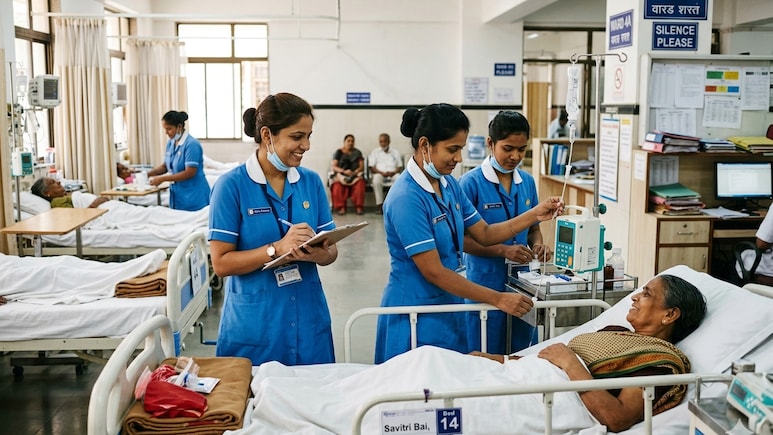
- India has over 36.14 lakh nursing personnel as of December 2022, with a 1:476 nurse-to-population ratio
- Nurses now perform advanced clinical, leadership, and decision-making roles beyond traditional bedside care
- Critical care nurses manage complex technologies like ventilators and haemodynamic monitoring systems
India has over 36.14 lakh nursing personnel as of December 2022, according to official government data. Furthermore, the 80% availability quota suggests a nurse-to-population ratio of 1:476, highlighting the critical role nurses play in healthcare delivery. Even though the government has expanded the role of nurses with the establishment of nursing colleges and taken steps to strengthen the healthcare ecosystem, the expanding role of nurses needs a dynamic approach. Especially on International Nurses Day, people need to understand that nurses are no longer limited to routine bedside responsibilities as they actively assist doctors and perform vital patient care during surgical procedures. Their responsibilities have expanded into specialised, technical, leadership, and decision-making roles.
With critical care as a defining space for this transformation, as nurses and their role evolve beyond bedside manner. The field of modern nursing needs to advance critical support that meets the population's growing demand for appropriate patient care in healthcare settings.
The Evolving Role Of Nurses In Critical Care Settings
Jigi Pradeep, Nursing Head, Fortis Gurugram, explains, "The role of nurses has significantly evolved beyond traditional bedside care, especially within specialised and critical care environments. Modern nursing practice now encompasses advanced clinical skills, leadership, and active participation in multidisciplinary decision-making."
- Nurses and their role have evolved as their training to assist in medical procedures is needed to practice.
- Advanced clinical judgement so that patients receive what they need to heal.
- Early detection of patient deterioration is vital for patient outcomes after surgical procedures are performed.
- Integration into multidisciplinary critical care teams is needed as the patient needs day-to-day support that can improve their current condition.
Managing Complex Technologies And Life-Support Systems
Nurses need to handle specialised and critical healthcare equipment that makes sure the patient stays alive. The medical expertise of nurses makes them able to handle, as explained by Jigi Pradeep, the following:
- Ventilators that ensure critical oxygen supply when patients are in medically induced comas or recovering from trauma.
- Haemodynamic monitoring, which involves multiple machines that record critical health data like a patient's vitals.
- High-risk infusions such as painkillers and essential and prescribed medications as per the doctor's assessment.
- Continuous patient assessment to make sure the patient's condition is improving.
A prime example is the management of patients on extracorporeal membrane oxygenation (ECMO), where nurses play a crucial role in monitoring circuit integrity, detecting complications, and ensuring patient stability. This is a part of the critical care that nurses provide in healthcare settings.
Specialised Nursing Fields Driving Advanced Patient Care
Jigi Pradeep pinpoints, "Nursing has diversified into multiple specialities, each requiring advanced competencies." These include:
- Critical care nurses
- Oncology nurses
- Cardiac nurses
- Nephrology nurses
- Emergency and trauma nurses
- Paediatric and neonatal nurses
- Infection control nurses
- Palliative care specialists
"Each speciality demands focused knowledge, technical expertise, and continuous upskilling to meet the growing complexity of patient care."
Real-world patient care is complex, and nurses need to adapt by building advanced competencies through continuous education and upskilling.
Expanded Clinical Roles - Nurse Practitioners And Physician Assistants
The two clinical roles that have expanded in the nursing field are nurse practitioners and physician assistants, who collaborate with doctors.
These roles are needed to bridge gaps in high-demand healthcare settings that handle a rising patient case load.
Global trends are influencing Indian healthcare systems, but adapting to the rising demand is needed.
Also Read: World Health Day 2026: PM Modi Salutes Healthcare Workers, Extends Greetings
Beyond Clinical Care - Patient Advocacy And Emotional Support
Patient advocacy and emotional support are two pivotal aspects that are performed by nurses in healthcare settings. From the necessary patient education and counselling to supporting families emotionally in their time of need. The time of critical illness is a mentally distressing time for families, and nurses are the ones who simplify the medical jargon that is posed as a barrier to understanding complex medical conditions.
The most critical and difficult part of a nurse's job is the end-of-life and palliative care communication that happens between families and the sick patients.
Nurses are practising a holistic and compassionate care model that serves patients, their caretakers, and families.
Leadership Roles Of Nurses In Modern Healthcare
Nurses serve in leadership roles in the following:
- Infection control
- Quality improvement
- Policy and protocol development
- Staff training and mentoring
- Healthcare safety initiatives
The frontline health workers' first line of defence is nurses, and they share a deep insight into shaping healthcare systems.
Why Nursing Roles Are Central To The Future Of Healthcare
Nursing as a field is central to the future of healthcare as diseases spread and the suffering of people multiplies. The complexity of medical practice and workforce shortages has made nursing a critical point of inflection.
Nurses are anchors of continuity and safety in any healthcare system and need an ecosystem that supports them in the same manner.
Nurses today are clinical experts, leaders, educators, and advocates for patients. As Jigi Pradeep explains, "Today's nurses are dynamic professionals who extend far beyond bedside care." And their expanded roles directly improve outcomes in specialised and critical care. The government and medical educational institutions need to invest in nursing development to strengthen the entire healthcare system as a whole.
Disclaimer: This content, including advice, provides generic information only. It is in no way a substitute for a qualified medical opinion. Always consult a specialist or your own doctor for more information. NDTV does not claim responsibility for this information.
Track Latest News Live on NDTV.com and get news updates from India and around the world

