





Stock Market News: Every market crash feels different when you're living through it.
The television screens turn red. Headlines scream about uncertainty. WhatsApp groups become filled with predictions of deeper declines. Investors start refreshing their portfolios every few minutes. And almost everyone asks the same question: "Should I get out before things get worse?"
History suggests that this may be the wrong question.
Also Read | Layoffs Are Rising In Tech, But These Skills Are Helping People Unlock Better Pay
Over the last two decades, Indian equity markets have survived some of the most dramatic shocks imaginable -- the Global Financial Crisis, the Eurozone debt scare, the Covid-19 pandemic, aggressive global rate hikes, and multiple bouts of geopolitical uncertainty. Yet the broader trend has remained remarkably consistent.
Markets have fallen sharply. Investors have panicked. And then, eventually, markets have recovered and moved higher. According to Ajay Kumar Yadav, CFPCM, Group CEO & CIO, Wise Finserv, this recurring pattern highlights one of the most overlooked truths in investing: wealth creation is often less about finding the perfect entry point and more about having the discipline to stay invested through periods of discomfort.
"Many investors believe successful investing is about predicting the next market move," says Yadav. "But history shows that the biggest gains often belong to those who remain invested when uncertainty is at its peak."
The Painful Lesson Of 2008
Few events tested investor conviction more severely than the Global Financial Crisis.
In January 2008, the Nifty 50 was trading around 6,357. Optimism was everywhere. India's economy was booming and equity investing had become a mainstream conversation.
Then the crisis struck.
By October 2008, the Nifty had collapsed to nearly 2,253, wiping out about 65 per cent of its value. For an investor who had put Rs 1 lakh into the market near the peak, the portfolio value shrank to roughly Rs 35,000 on paper.
"It was the kind of correction that makes investors question everything," says Yadav. "Many exited because they could not imagine the market recovering."
Yet that recovery eventually arrived.
By September 2024, when the Nifty touched around 26,277, the same investment made at the 2008 peak would have grown to roughly Rs 4.13 lakh based on the Nifty 50 Price Index.
The story becomes even more striking at the other end of the crash.
An investor who entered near the 2008 bottom would have seen Rs 1 lakh grow to more than Rs 10 lakh by 2024. The same market collapse that destroyed confidence also created one of the biggest wealth-building opportunities of the last two decades.
Covid Offered The Same Lesson
The pandemic crash of 2020 felt equally terrifying. The Nifty fell from around 12,430 in January 2020 to nearly 7,511 in March as lockdowns brought economic activity to a standstill.
Businesses shut down. Flights stopped. Entire industries faced uncertainty. Fear dominated the market.
Yet within a few years, the benchmark index not only recovered but climbed to fresh highs. A Rs 1 lakh investment made near the Covid lows would have grown to roughly Rs 3.5 lakh by September 2024.
For Yadav, the episode reinforced an important investing principle. "The best recovery phases often begin when the news still looks terrible," he says. "Markets move ahead of sentiment. By the time confidence returns, a significant part of the recovery may already be over."
20 Years, 13 Times The Money
Zoom out even further and the power of patience becomes impossible to ignore.
In January 2004, the Nifty 50 was trading around 2,015. By September 2024, it had climbed to approximately 26,277. That means a Rs 1 lakh investment tracking the Nifty 50 Price Index would have grown to nearly Rs 13 lakh over the period.
The figure does not include dividends, meaning actual returns through many index-based investment products could be higher.
For Yadav, this long-term data demonstrates why investors should focus more on years than months. "Compounding works quietly," he says. "It does not attract attention every day, but over long periods it becomes the single most powerful force in wealth creation."
Why Investors Lose More From Panic Than From Crashes
Market volatility is visible. Behavioural mistakes are not.
When markets decline sharply, selling often feels like a logical response. Investors believe they can avoid further losses and re-enter later.
In reality, that strategy frequently backfires. Investors sell after prices have already fallen. They wait for clarity before returning. By the time clarity arrives, markets have often recovered significantly.
This cycle has repeated itself after nearly every major correction. "The biggest risk is not always the market fall itself," says Yadav. "The bigger risk is exiting during panic and missing the recovery that follows."
This is one reason why many long-term investors underperform the very funds and indices they invest in. Their timing decisions work against them.
Why SIPs Shine During Difficult Markets
Systematic Investment Plans, or SIPs, are often described as a tool for disciplined investing. Their real strength becomes visible during market corrections.
When markets fall, the same monthly contribution buys more units. Those additional units can significantly boost returns when the recovery arrives.
Yadav believes investors often misunderstand market declines. "Corrections are uncomfortable, but for SIP investors they can actually be beneficial because every instalment purchases more units at lower prices," he says.
Stopping SIPs during crashes may feel comforting in the short term. Over the long run, it can reduce the benefits of rupee-cost averaging.
Asset Allocation Matters More Than Predictions
Staying invested does not mean taking excessive risk. Yadav stresses that asset allocation remains the foundation of successful investing.
A portfolio invested entirely in equities can experience sharp drawdowns during crises. A well-balanced portfolio that includes debt, fixed-income instruments, hybrid funds and adequate liquidity is often easier to hold through turbulent periods.
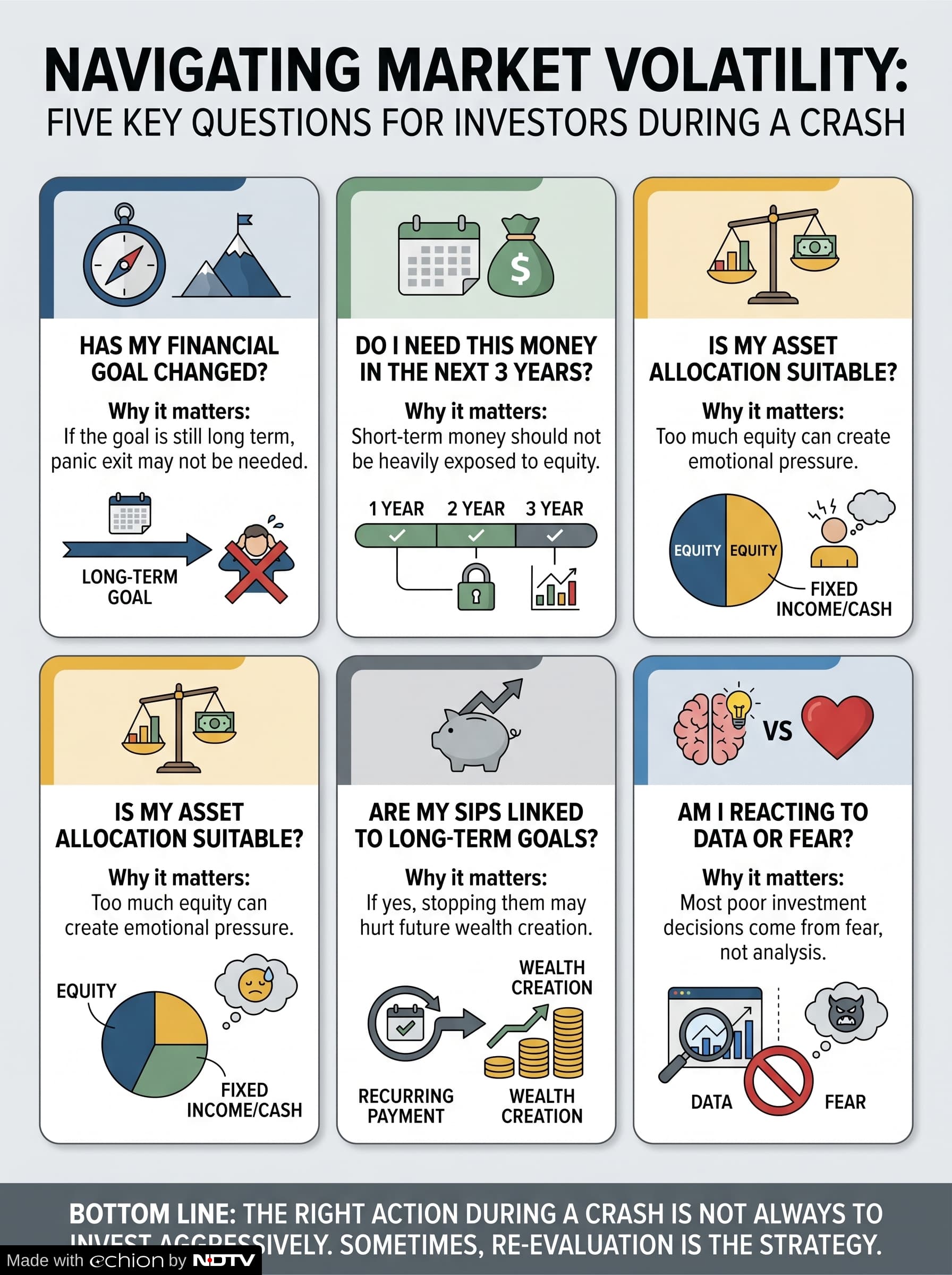
"The purpose of diversification is not only to improve returns," Yadav explains. "It also helps investors remain emotionally comfortable enough to stay committed to their long-term plan."
In many cases, asset allocation acts as a behavioural safeguard. If portfolio losses become overwhelming, even the best investment strategy can fail because the investor abandons it.
Equity Is A Long-Term Game
One of the most common mistakes investors make is using equity investments for short-term goals. Money required within the next few years generally belongs in more predictable instruments.
Equities demand time.
Yadav recommends that investors approach equity investments with a minimum five-year horizon, and ideally longer. "No one can guarantee returns in the short term," he says. "But history shows that the probability of success improves significantly as the holding period increases."
The goal is not to avoid volatility. The goal is to give investments enough time to recover from it. Here are the lessons every investor should remember:-
- Every decade brings new reasons to worry.
- In 2008, it was the collapse of the global financial system.
- In 2020, it was a once-in-a-century pandemic.
- In 2022, it was inflation and rising interest rates.
Today, investors worry about valuations, earnings growth and geopolitical risks. The headlines change. The emotions remain remarkably similar.
Anisha Kathotia, AMFI-registered mutual fund distributor and Founder & CEO of Nico Wealth, says market history consistently rewards patience.
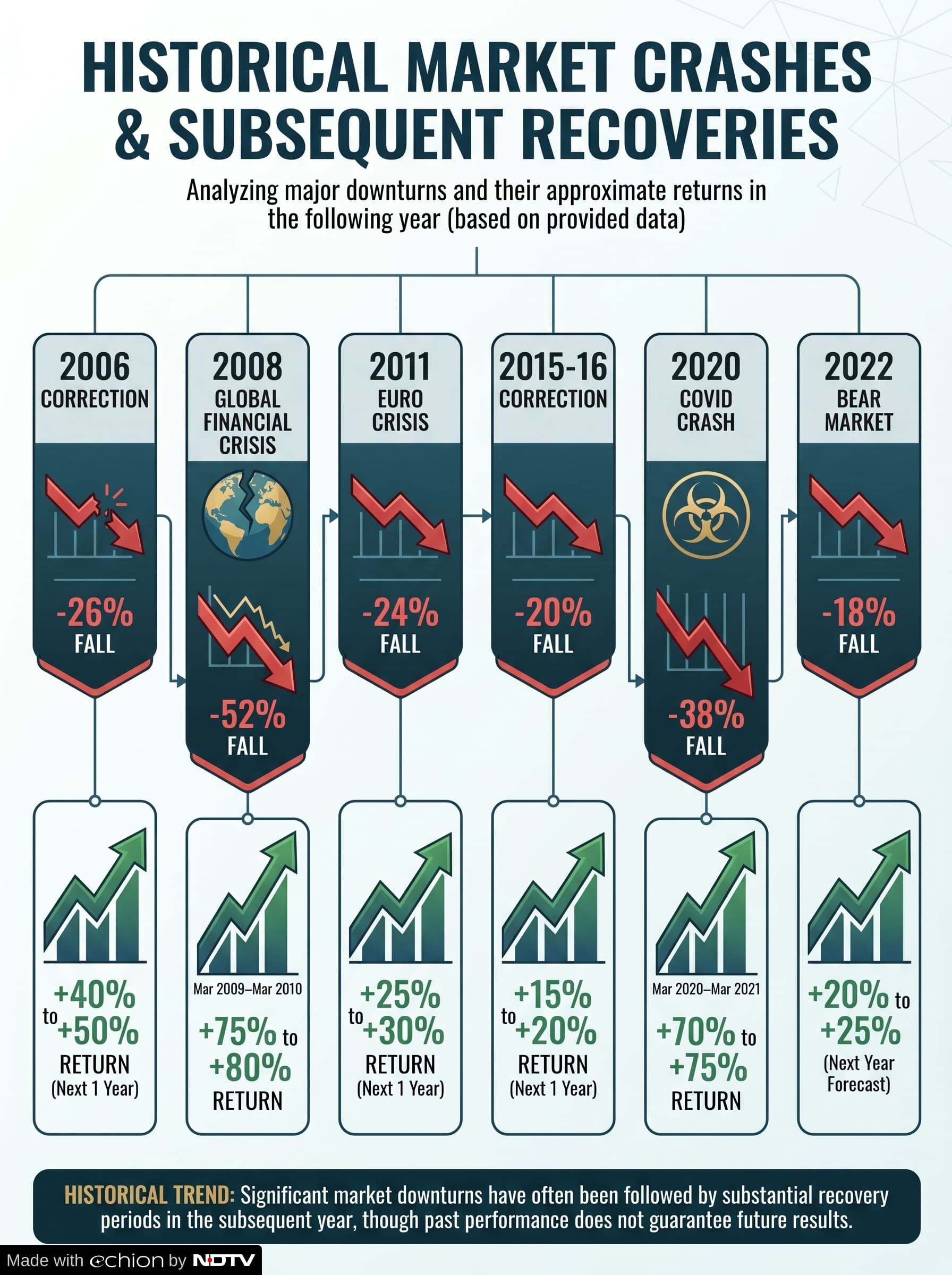
"The lesson is striking: the strongest returns often come after the sharpest declines," she notes. "Investors who exited during market crashes often missed the subsequent recovery, while those who stayed invested or continued their SIPs were rewarded the most."
Kathotia points out that every major Nifty correction since 2006 has eventually been followed by a meaningful recovery, proving once again that fear and opportunity often arrive together.
Her conclusion echoes one of the most enduring principles of investing: time in the market has historically been far more rewarding than trying to time the market.
And perhaps that is the biggest lesson from 20 years of Nifty crashes. The investors who built the most wealth were not necessarily the smartest forecasters. More often, they were simply the ones who stayed invested long enough for India's growth story to work in their favour.
Track Latest News Live on NDTV.com and get news updates from India and around the world

