





Planning to buy an electric vehicle? The first things you'll probably compare are battery range, charging time and price. That's what most buyers have done for years.
But that checklist is changing.
Increasingly, buyers are asking a different set of questions. Does the EV support voice commands? Can it predict battery usage based on my route? Is there app connectivity? Does it come with a portable charger? Can it alert me before a breakdown or adapt to my driving style?
Also Read | Layoffs Are Rising In Tech, But These Skills Are Helping People Unlock Better Pay
Manufacturers say these features are no longer premium add-ons. They're becoming key buying factors. In fact, some EV makers are now allocating 5-10 per cent of their development budgets to customised features, connected technologies and customer-specific solutions as personalisation emerges as the industry's next battleground.
The trend is especially visible in India's commercial electric two-wheeler three-wheeler market, where every additional feature can improve uptime, reduce maintenance costs and ultimately boost a driver's earnings. But experts say the shift is spreading across the wider EV industry as software increasingly becomes the biggest differentiator between vehicles with similar batteries and specifications.
From Hardware To Software
For years, EV manufacturers competed primarily on battery capacity, driving range and pricing. Now, differentiation is increasingly happening through software.
Voice-enabled controls, digital dashboards, GPS tracking, predictive maintenance alerts, app connectivity, remote diagnostics, battery-health monitoring and personalised riding modes are moving from premium offerings to mainstream expectations.
Ayush Lohia, CEO of Youdha, said customers today are no longer judging electric vehicles only by price or range.
"Personalisation is emerging as a key differentiator in India's electric vehicle market. Especially in the three-wheeler EV segment, customers are increasingly looking for solutions that match their specific business requirements," he said.
Fleet operators, last-mile delivery companies and individual owners all use vehicles differently, prompting manufacturers to build greater flexibility into product development.
According to Lohia, around 5-10 per cent of an EV's development budget is now being spent on customised features, connected technologies and customer-specific solutions.
These include telematics, battery monitoring systems, smart dashboards, portable charging solutions, digital controls and driver convenience technologies.
Convenience That Pays
For commercial operators, these features are no longer simply about comfort. They directly affect how much money a vehicle earns.
Lohia said voice commands, GPS tracking, app connectivity and remote diagnostics help improve fleet utilisation, maintenance planning and operational efficiency.
But the push towards personalisation also comes with a challenge. Every additional feature adds to manufacturing costs.
"The industry's focus is now on making these features modular, allowing customers to select solutions based on their requirements without increasing the cost burden unnecessarily," Lohia said.
He believes the next phase of competition will be defined not merely by battery range or pricing but by how effectively manufacturers solve customer-specific problems while keeping technology affordable.
The Real Intelligence Sits Beneath The Dashboard
Industry experts argue that consumers often mistake personalisation for flashy screens or smartphone apps.
The real engineering happens much deeper.
Abhilash Maurya, Co-founder and CEO of Naxatra Labs, said what buyers see on the dashboard represents only a small part of vehicle customisation.
"Personalisation in EVs is usually discussed as an app-layer feature. That's the visible ten percent. The other ninety is decided at the powertrain."
According to Maurya, the same electric motor can behave like multiple vehicles depending on how its control software is programmed.
One setup can prioritise smooth city driving, another can deliver aggressive acceleration, while a third can optimise performance under heavy loads.
That flexibility comes from advanced motor-control software rather than hardware changes. "As India's EV market matures, the surface is commoditising fast," Maurya said.
"Real differentiation is migrating downward, into how intelligently the powertrain adapts to the rider, the terrain and the duty cycle."
He added that the industry's next competitive battlefield will not be the infotainment screen but whether the motor itself is programmable.
One EV Cannot Fit Every Rider
The demand for personalisation becomes even more obvious at scale.
Hala Mobility, which operates more than 13,000 EVs across nine cities, has analysed over 216 million kilometres of operations, covering 28 vehicle variants, 18 battery manufacturers and more than 172,000 battery swaps every month.
Its findings suggest there is no such thing as an average EV user.
Range, charging behaviour, servicing needs and battery consumption vary significantly depending on the city, traffic conditions, payload, weather and working hours.
Srikanth Reddy Kalakonda, Co-founder and CEO of Hala Mobility, said meaningful personalisation for commercial users goes far beyond entertainment.
It includes accurate range prediction, route-based battery recommendations, predictive maintenance alerts, customised riding modes and nearby battery-swap availability.
These interventions, he said, have helped the company maintain fleet uptime above 96 per cent while reducing revenue losses for drivers.
Kalakonda expects manufacturers to steadily increase investments in software, sensors, telematics and cloud infrastructure as vehicles become increasingly software-defined.
However, he cautioned that essential intelligence should become standard across vehicles, while premium comfort and entertainment features remain optional.
"Personalisation must improve safety, uptime and operating economics without making EV ownership unaffordable," he said.
Trust Still Matters
The shift towards customisation comes as India's commercial EV market undergoes a broader transformation.
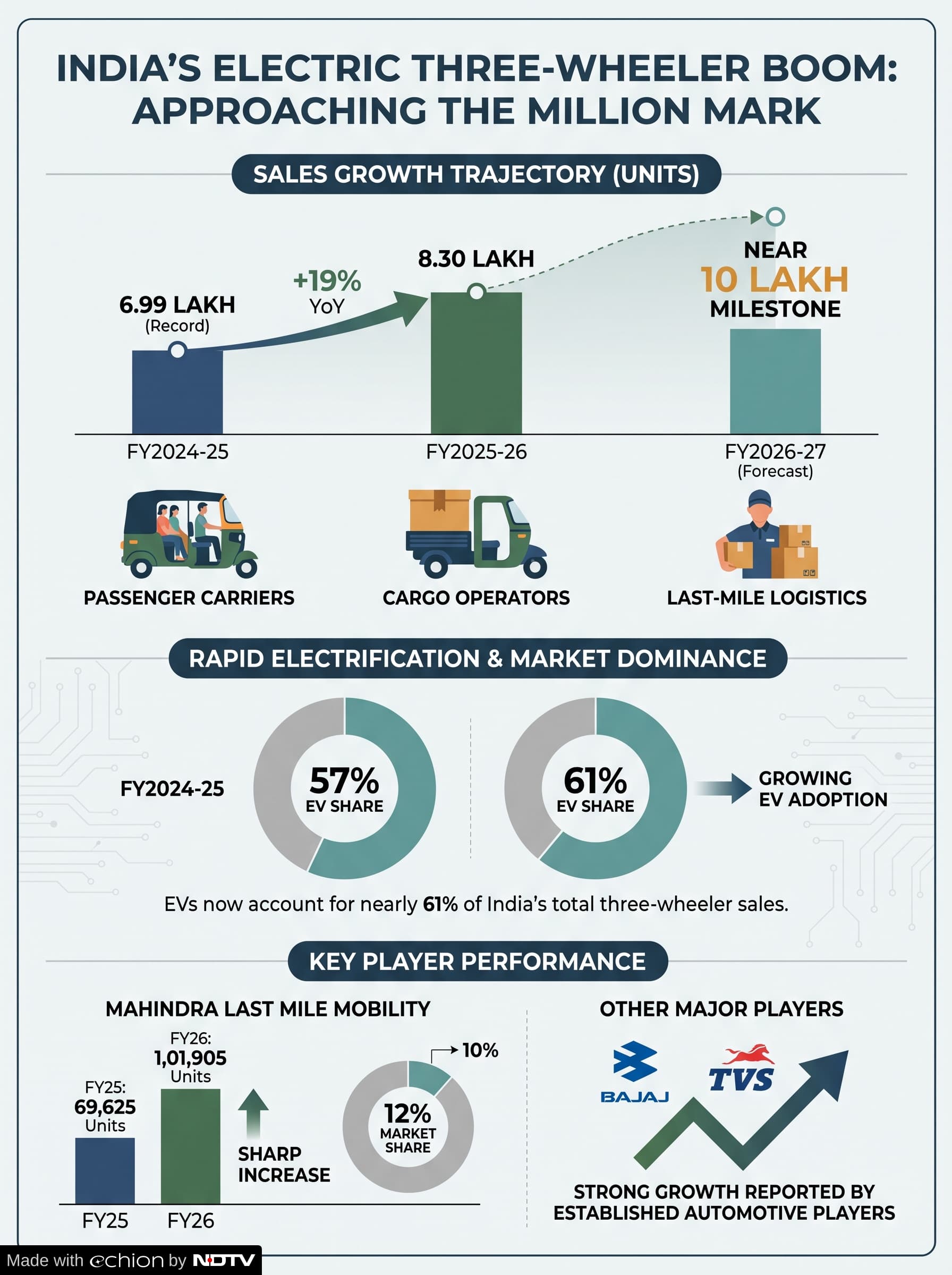
Electric three-wheeler sales climbed from 6.99 lakh units in FY25 to 8.30 lakh units in FY26, with EVs accounting for nearly 61 per cent of total three-wheeler sales, up from 57 per cent a year earlier.
The industry is now expected to approach the 10 lakh-unit milestone in FY27, driven by last-mile logistics, passenger transport and cargo mobility.
As the market matures, buyers are increasingly choosing vehicles based not only on connected features but also on reliability, service support and long-term returns.
Established manufacturers are benefiting as commercial operators increasingly view electric vehicles as business investments rather than technology purchases.
The result is an industry where software and trust are evolving together.
Battery range will remain important.
But increasingly, success may depend on something far less visible - how intelligently an EV understands its owner, adapts to their work and continues improving long after it leaves the showroom.
Track Latest News Live on NDTV.com and get news updates from India and around the world

