





For years, buying a car in India was a relatively simple decision.
You chose between petrol and diesel. Then came CNG. Now, the options are multiplying rapidly.
Electric vehicles (EVs) are becoming mainstream. Ethanol-blended fuels such as E20 are being rolled out across the country. Flex-fuel vehicles capable of running on multiple ethanol-petrol blends are entering the conversation. Meanwhile, conventional petrol cars continue to dominate roads.
Also Read | Layoffs Are Rising In Tech, But These Skills Are Helping People Unlock Better Pay
For millions of middle-class families planning their next vehicle purchase, the question is no longer just "Which car should I buy?" It is increasingly becoming "Which fuel should I bet on?"
Experts say there is no universal answer. The best choice depends on how much you drive, where you live and how long you plan to keep the vehicle.
What Exactly Are E20, E80 & E100 fuels?
The government has been aggressively pushing ethanol blending as part of its strategy to reduce crude oil imports and improve energy security.
According to Tarun Jain, Co-founder of LetzRyd, E20 contains 20 per cent ethanol and 80 per cent petrol, while E80 contains 80 per cent ethanol and 20 per cent petrol. E100 is largely ethanol, typically containing 93-95 per cent ethanol along with petrol and other additives.
Nikhil Anand Khurana, Founder and Managing Director of Folks Motor, says these fuels are expected to play an increasingly important role as India expands its ethanol-blending programme.
The country has already achieved its E20 blending target, a milestone that supporters see as a major step towards reducing dependence on imported oil.
Samir Somaiya, Chairman and Managing Director of Godavari Biorefineries, believes India should aim even higher. He says the E20 achievement should be viewed as a starting point rather than an end goal, arguing that the country now has the biomass capacity and policy support needed to scale ethanol use further.
The Hidden Catch Consumers Should Know
While higher ethanol usage may help the country, the economics for individual consumers are more complicated.
Abiram Menon, Co-founder and CEO of Magron Novus, points out that E20 fuel can lead to a decline in fuel economy. Ethanol contains less energy than petrol, meaning vehicles generally travel fewer kilometres per litre.
He also warns that older vehicles not designed for higher ethanol blends may experience accelerated wear because ethanol attracts moisture, potentially affecting metal and rubber components over time.
Ayush Patodia, Associate Vice President at Avalon Consulting, highlights another challenge. Ethanol's lower calorific value means E20 delivers roughly 7 per cent lower fuel efficiency than petrol. The efficiency gap widens further with higher blends such as E30 and E85.
In simple terms, if a vehicle consumes more fuel to travel the same distance, the pump price must be significantly lower to make economic sense for consumers.
What Are Flex-Fuel Vehicles?
Flex-fuel vehicles (FFVs) are designed to run on different ethanol-petrol combinations, unlike conventional vehicles that are calibrated for limited ethanol content.
According to Abiram Menon, these vehicles use smart engine control systems that automatically adjust performance based on the ethanol blend being used.
Tarun Jain says flex-fuel vehicles provide greater fuel flexibility than traditional petrol cars. However, their real-world benefit depends on fuel availability, pricing and long-term maintenance costs.
Subhabrata Sengupta, Partner at Avalon Consulting, explains that FFVs require additional hardware such as ethanol sensors, modified fuel injection systems and more corrosion-resistant components. As a result, they cost more upfront.
He cites the example of a flex-fuel version of the WagonR that costs around Rs 86,000 more than its standard petrol counterpart.
The key question, he says, is whether lower fuel prices can offset this higher purchase cost.
Will Flex-Fuel Cars Actually Save Money?
The answer depends heavily on future fuel pricing.
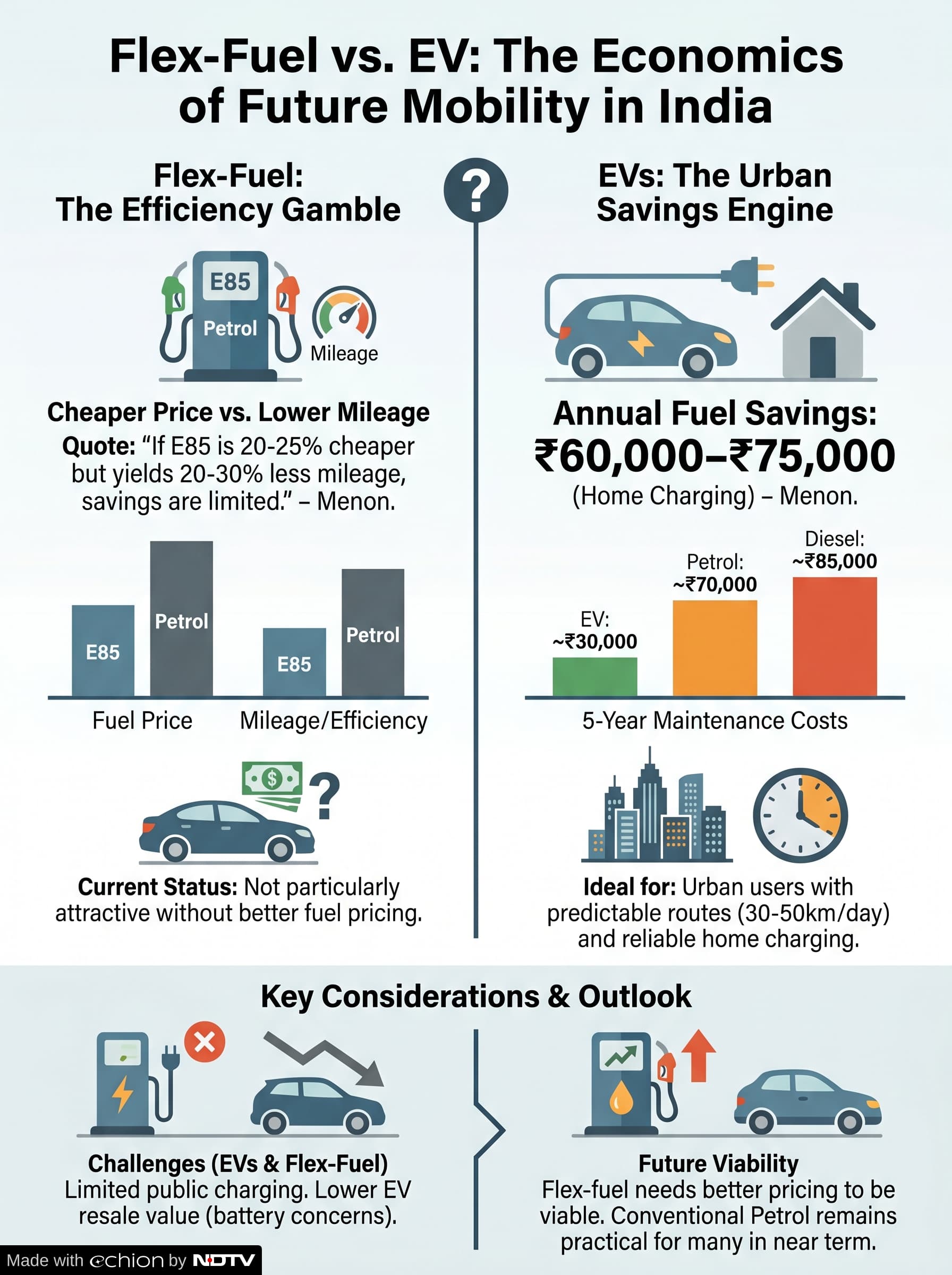
Sengupta argues that the current economics are not particularly attractive. While E85 fuel may be cheaper than regular petrol, the discount may not be large enough to compensate for reduced mileage and the higher upfront vehicle cost.
Patodia echoes a similar concern. He notes that while the government has proposed significant incentives and duty exemptions, much depends on how much of those savings are eventually passed on to consumers.
According to his calculations, ethanol-blended fuels need to be substantially cheaper than petrol to compensate for lower fuel efficiency. Menon adds that if ethanol fuel is 20-25 per cent cheaper but delivers 20-30 per cent lower mileage, the actual savings may be limited.
Add image caption here
In other words, consumers should focus on running cost per kilometre rather than fuel price alone.
So, Should You Buy An EV Instead?
For many urban users, experts say the answer may already be yes.
Menon estimates that EV owners can save Rs 60,000-Rs 75,000 annually on fuel costs when charging at home. Improved battery technology, longer driving ranges and extended battery warranties have also strengthened the EV value proposition.
Over five years, he estimates maintenance costs for EVs at around Rs 30,000, compared with roughly Rs 70,000 for petrol vehicles and Rs 85,000 for diesel vehicles.
Hari Krishna, Founder and CEO of Green Driver Mobility, says EVs make particular sense for urban users with predictable daily travel needs and reliable charging access.
Nikhil Anand Khurana shares a similar view. He says EVs work best for buyers with high daily usage, predictable routes and easy access to charging infrastructure.
However, EVs are not perfect.
India still has a relatively limited public charging network compared with global standards. Highway travellers and apartment residents without dedicated charging access may still face challenges.
There are also concerns around resale values. Menon notes that EV resale values currently tend to be lower than petrol and diesel vehicles because of buyer concerns around battery life.
The Biggest Mistake Car Buyers Make
Experts repeatedly emphasise that consumers should stop focusing solely on purchase price.
Tarun Jain says buyers are increasingly evaluating vehicles based on long-term ownership economics rather than just showroom costs.
Factors such as running costs, maintenance expenses, insurance premiums, resale value, downtime and infrastructure availability are becoming more important.
Hari Krishna says vehicle decisions should be driven by total cost of ownership rather than technology preferences.
Khurana advises buyers to compare per-kilometre running costs, financing options, warranties, resale value and local fuel or charging availability before making a decision.
Menon adds that safety features, technology, future fuel compatibility and long-term value are also becoming critical considerations for Indian buyers.
India's automotive future is unlikely to be dominated by a single technology. Instead, petrol, ethanol-blended fuels, flex-fuel vehicles and EVs are expected to coexist for years.
For a family that drives 30-50 km daily in a city and has access to home charging, an EV could offer the biggest savings.
For buyers in areas where liquid-fuel infrastructure remains dominant, flex-fuel vehicles may emerge as a viable alternative if ethanol pricing becomes attractive enough.
And for many consumers, a conventional petrol vehicle may still remain the most practical choice in the near term.
Track Latest News Live on NDTV.com and get news updates from India and around the world

