





A new study by the Council on Energy, Environment and Water (CEEW) says behavioural changes in passenger transport could cut annual emissions from G20 countries by 15-20 per cent by 2050.
In its higher-impact scenario, the three changes together could save about 538 million tonnes of CO2 (MtCO2) every year in 2050. That is roughly one-fifth of the G20's passenger transport emissions under the business-as-usual scenario.
The study, Mitigation Potential of Behavioural Change in Passenger Transport in G20 Countries, models three interventions -- hybrid work, shared mobility or carpooling, and higher bus ridership.
Also Read | Layoffs Are Rising In Tech, But These Skills Are Helping People Unlock Better Pay
And there is a bigger prize beyond the annual number.
Between 2025 and 2050, these behavioural shifts could cumulatively save 5.7-8 gigatonnes of CO2, equivalent to about 5-6 per cent of the remaining carbon budget for keeping global warming within 1.5 degrees Celsius.
Carpooling Packs The Biggest Punch
Of the three measures studied, carpooling has the strongest standalone potential.
Under a scenario where average car occupancy rises 50 per cent from current baseline levels, the study estimates around 237 MtCO2 of annual savings in 2050.
If countries converge towards the same average car occupancy, the savings rise to around 411 MtCO2.
The gains, however, are not evenly spread. Developed countries and China account for around 90-92 per cent of the savings because they have much higher car ownership and lower average occupancy.
Dr Vaibhav Chaturvedi, Senior Fellow, CEEW, told NDTV that the findings give global evidence to the idea behind India's Mission LiFE. He said, "Mission LiFE was India's call to go beyond production and make climate action about responsible consumption."
According to Chaturvedi, the largest gains from changing transport behaviour are in high-emitting economies, where mobility systems are more car-dependent. "This is a call for smarter cities, better workplaces, cleaner mobility, and lower oil dependence towards improving quality of life," he added.
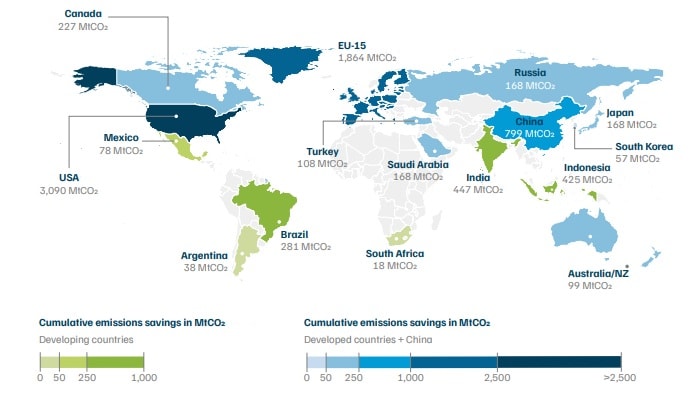
Behavioural change in transport can lead to 8 GtCO2 of emissions savings in G20 countries.
Hybrid Work Can Also Move The Needle
The office commute is another major piece of the puzzle. The CEEW study estimates that hybrid work could reduce G20 passenger transport emissions by 322 MtCO2 in 2050, or about 12 per cent compared with the business-as-usual scenario.
More than 65 per cent of those savings would come from developed countries and China. China alone accounts for about 96 MtCO2 of the reduction, followed by the US at around 45 MtCO2 and the EU-15 at roughly 32 MtCO2.
The study does not assume that everyone will work remotely every day. Instead, it models sustained reductions in commuting intensity. In other words, even working from home for part of the week can reduce travel demand.
Buses Help, But Buses Alone Are Not Enough
Then comes public transport. A shift towards buses can reduce emissions, but the study finds that simply getting more people onto buses will not be enough.
In the high-bus scenario, increased preference for buses results in 0.4-6.7 per cent lower emissions, depending on the country. The study estimates up to 54 MtCO2 of annual savings across the G20.
India's Opportunity Is Different
The study also highlights a sharp difference between developed economies and developing countries. In 2024, developed nations and China represented only 34 per cent of the world's population but accounted for more than 60 per cent of global road transport emissions.
India's motor vehicle ownership was much lower. The study cites around 33 vehicles per 1,000 people in India, compared with 860 in the US, 704 in France and 223 in China.
This means India has less scope for emission cuts from changing existing car-heavy lifestyles. Rohini Dikshit, Programme Associate, CEEW, said the geography of emission savings matters. "Developed countries and China have the greatest absolute savings potential because their mobility systems are more car-dependent, while India's per-capita potential is much lower," she told NDTV.
"For India and other developing countries, the opportunity is to avoid future lock-in to private-vehicle dependence. For richer, car-dependent economies, behaviour change must become a near-term climate mitigation lever," Dikshit added.
The numbers underline that contrast.
The study estimates India's hybrid-work potential at roughly 71 MtCO2 in 2050, largely because of its huge population. But its per-capita savings potential remains much lower than that of richer, more car-dependent economies.
In the combined scenarios, the US and EU-15 alone account for 61-63 per cent of the total savings. Developed countries and China account for 80-88 per cent overall.
Track Latest News Live on NDTV.com and get news updates from India and around the world

