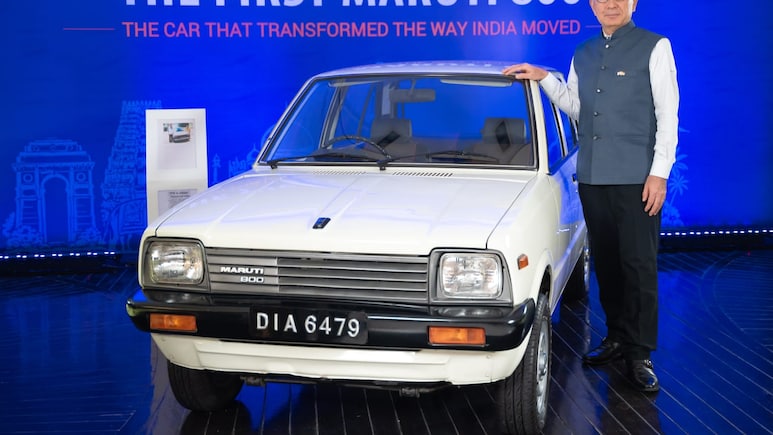
The Maruti 800 has become the first Indian vehicle to receive the FIVA World Vehicle Heritage Award. This places the humble hatchback alongside 21 historically significant automobiles from around the world. The recognition acknowledges its role in changing personal mobility, industrial capability, and everyday life in India.
Global First For India
The Federation Internationale des Vehicules Anciens, or FIVA, selected the Maruti 800 for its inaugural World Vehicle Heritage Awards. It was the only Indian vehicle among 21 recipients, joining cars from the United States, Brazil, Germany, France, Austria and Slovenia.
READ | Ultraviolette X-47 Venom Review: A Lighter Crossover With More Bite
FIVA, an international non-profit body for historic vehicles and a non-governmental partner of UNESCO, created the awards to recognise automobiles for their cultural and historical influence. Importantly, the criteria do not favour only rare or expensive collectibles; mass-produced vehicles with a lasting social and industrial impact can also be honoured.
Car That Changed Access
Introduced in December 1983, the Maruti 800 arrived when private car ownership in India was still limited, and the domestic market had few accessible alternatives. Its compact footprint, affordable positioning and simple driving character made it a practical entry point into car ownership for many households.
READ | JSW Motors Launches India Website Ahead Of Combat Debut In December
The original model was based on the Suzuki SS80 and was built under the partnership between Suzuki Motor Corporation and the Government of India, established in 1982. The early manufacturing programme began with an annual capacity of 40,000 cars, a modest figure that would soon prove inadequate for the demand the car generated.
Maruti 800 Sales
The Maruti 800 remained in production for three decades, during which more than 2.9 million units were manufactured. That scale helped create a domestic supplier base and strengthened India's ability to produce passenger vehicles locally.
READ | Next-Gen Toyota Fortuner Spied: What the Pictures Reveal
It also gave Maruti Suzuki an early international presence. Exports to Europe began in 1987, with Hungary, France and Belgium among the initial destinations, demonstrating that Indian-built cars could meet overseas market requirements.
Recognition Beyond Rarity
The award is a reminder that automotive heritage is not measured solely by horsepower, exclusivity or auction value. The Maruti 800 mattered because it made personal mobility more attainable, supported the growth of India's component industry and became part of the country's social memory.
Suzuki Motor Corporation President Toshihiro Suzuki recalled that the company had little sense of how extensively the Indian automobile market would develop when operations began. More than four decades later, India is the world's third-largest passenger vehicle market, while Maruti Suzuki exports more than 4 lakh vehicles annually to over 120 countries.
Track Latest News Live on NDTV.com and get news updates from India and around the world
