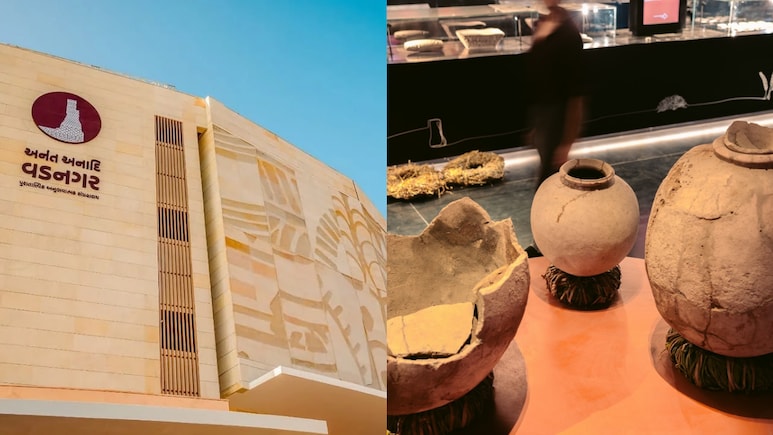
A town in Gujarat has been inhabited for nearly 2,750 years. Right under its present-day streets lie traces of settlements, walls, workshops and religious structures built by people who lived here centuries ago. Now, visitors can get a closer look at this history at the Anant Anadi Vadnagar Archaeological Experiential Museum, which has won the Red Dot: Best of the Best Award 2026 in Berlin, Germany.
Gujarat Deputy Chief Minister Harsh Sanghavi recently shared the win on X. "Making India proud, Vadnagar becomes the country's first and only museum to receive this distinguished honour, placing Gujarat's heritage on the global design map," he shared.
From the timeless legacy of our civilisation to global design excellence, Vadnagar is making history! Anant Anadi Vadnagar – Archaeological Experiential Museum has earned the prestigious Red Dot: Best of the Best Award 2026 in Berlin, Germany. Making India proud, Vadnagar becomes the country's first and only museum to receive this distinguished honour, placing Gujarat's heritage on the global design map. From our glorious past to global recognition, Gujarat continues to create history!
— Harsh Sanghavi (@sanghaviharsh) November 16, 2026
Opened to the public in February 2025, the museum brings together thousands of archaeological finds and immersive displays that trace the evolution of this ancient town. There is also something you don't get to see in most museums: an actual excavation site, where visitors can look at layers of history buried beneath the ground.
Vadnagar Is An Important Archaeological Site
Vadnagar, in Gujarat's Mehsana district, is among India's oldest continuously inhabited fortified towns. If archaeological evidence is to be believed, people have lived here since around 750-800 BCE.
Excavations by the Archaeological Survey of India between 2016 and 2022 uncovered evidence of seven cultural periods. Each of them left behind something different, like pottery, coins, fortification walls, Buddhist structures and even residential buildings.
They clearly show how the town changed with the centuries but continued to be inhabited. Its history runs through the Mauryan, Indo-Greek, Shaka-Kshatrapa, Maitraka, Solanki, Sultanate, Mughal and later periods.
And that is exactly what the museum sets out to explain.
The museum was completed in 2025 and covers approximately 1,35,000 square feet. The galleries here take visitors through seven cultural periods, using more than 6,000 artefacts, scaled replicas, interactive exhibits and audio-visual presentations.
Also Read: PM Modi Views Artefacts That Highlight India-Philippines Historic Connection
A massive collection of pottery, coins, weapons, tools, sculptures, idols, beads, ornaments and objects connected to traditional industries such as shell manufacturing are housed here.
But some artefacts like food grains, skeletal remains and DNA samples also show what the everyday lives of earlier residents looked like.
If you look beyond the objects, you'll get a picture of how the town functioned. Archaeologists found evidence of paved streets, drainage systems, residential complexes, industrial workshops, furnaces and defensive walls.
The museum also explores the religious life of the town. Hinduism, Buddhism and Jainism all have a place in Vadnagar's history. A large Buddhist monastery with monastic cells, prayer spaces and a structure believed to be an early stupa, dating to the Maitraka period, is one of the most important discoveries.
You Can Actually See An Excavation Site Here
This is possibly the most interesting part of the museum. The Amba Ghat excavation site is connected to the main museum building by a 50-metre bridge. Spread across approximately 4,000 square metres, it gives visitors a view of the remains uncovered during archaeological excavations.
The excavated layers extend 16-18 metres below ground level. There's a walkway here that allows visitors to look down at the site and see how different periods of habitation lie beneath one another. It is one thing to see an old coin or a piece of pottery in a display case. But to stand above the ground where generations of people once lived and built their homes is an experience that can't be stored in a box.
The museum describes itself as an archaeological experiential museum, and its approach goes beyond displaying recovered objects. There is also a 360-degree audio-visual tour for those who want to get a preview of the museum.
Also Read: Which Country Has The World's Happiest Passport In 2026?
Things To Know Before Planning A Trip
Vadnagar is around 110 km from Ahmedabad and approximately 51 minutes by road from Mehsana. If you're planning to catch a flight, Sardar Vallabhbhai Patel International Airport in Ahmedabad is the nearest airport, around 120 km away, and the drive to Vadnagar takes approximately two hours.
Taking a train is also convenient, as Vadnagar has its own railway station, around 10 minutes from the museum. You can drive from Ahmedabad in approximately two hours. Buses and private taxis are also available.
- Opening hours: 10 AM to 6 PM
- Last entry: 4:30 PM
- Weekly closure: Wednesday
- Other closures: Public holidays
- Entry for children: Free for children aged five years and below
- Facilities: Parking, ramps, elevators and accessible restrooms
Track Latest News Live on NDTV.com and get news updates from India and around the world


