




A flurry of activities initiated by the Karnataka government to get the Central government's approval for a multi-purpose reservoir at "Mekedatu" on the borders of Tamil Nadu to impound Cauvery river waters, has set off alarm bells in the neighbouring state. With emotions running high in both states, it could potentially trigger another round of "water wars" between the two states, which has periodically raged for over a century.
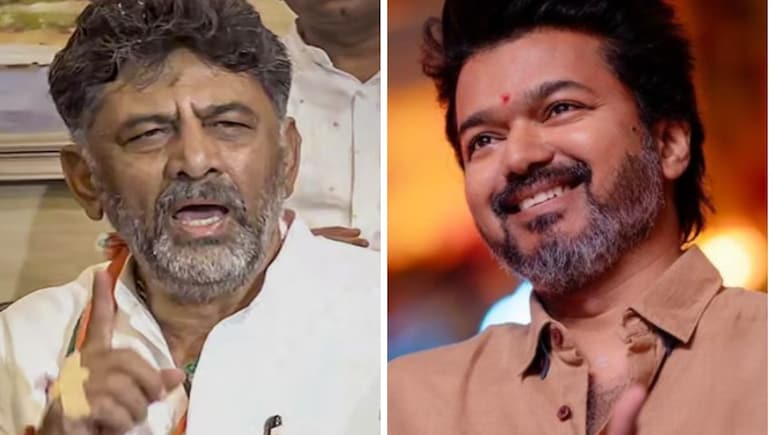
As Karnataka is battling one of its worst droughts in the last five decades, with agricultural production down to less than 30 per cent, the state's new Chief Minister DK Shivakumar has opened a new chapter in the fraught relationship between the two states over the Cauvery water dispute by proposing to build a reservoir at Mekedatu (which literally means "goat's crossing", to store 67.16 TMC ft (thousand million cubic feet) of water from the intermediate catchment flows for Karnataka's own use, and also put up a 400 mw capacity hydro-electric power station.
Though Mekedatu project has been on Karnataka's radar for a long time, the speed with which Shivakumar took it up with the Centre soon after becoming water resources minister in the Siddaramaiah government in 2023, and as chief minister since June this year, has got Tamil Nadu's "goat".
With Tamil Nadu also having a new, 'Young Turk' chief minister in celebrity actor-turned-politician Vijay behaving like a deer caught in headlights, hoards of veteran Tamil Nadu politicians are building up a frenzy to stop Shivakumar in his tracks.
They want Vijay to take an aggressive stand to preserve the state's "historical rights" over the inter-state river which originates in Karnataka, but has been Tamil Nadu farmers' lifeline over the centuries.
Alerted by a visit of the officials of the Union ministries of Jal Shakti and Environment at at Mekedatu and the prodding of Karnataka government, Vijay too rushed to Mekedatu last week and wrote a strong letter to the Prime Minister expressing his concerns. He said the Tamil Nadu farmers would view such developments "as a tacit movement on a project that would jeopardise their very livelihoods," and noted that "such actions of government of India officials have deepened the worries of the farmers of Cauvery delta."
Colonial-Era Arrangement
The Cauvery dispute between Karnataka and Tamil Nadu is not merely a disagreement over how much water each state should receive and on what basis. It is rooted in colonial era political arrangements, unequal bargaining powers, historical agricultural cultivations and competing irrigation priorities.
The origin of the dispute goes back to the late nineteenth century when Tamil Nadu, or the then state of Madras, was part of British India and had direct access to the colonial administrative machinery and enormous political influence, whereas Karnataka or the then state of Mysore, was a princely state subordinate to the British paramountcy. The difference in political status played a crucial role as matters involving inter-state river projects would be referred to the British Government of India whose ruling had to be followed.
The Madras government persuaded colonial rulers to draft the "1892 Cauvery river basin agreement" which required Mysore to obtain prior consent of the Madras government to take up new irrigation works "affecting the Cauvery and certain other rivers".
So, when the Maharaja of Mysore under the able guidance of its Diwans - the most celebrated of whom was engineer-statesman Sir M Visvesvaraiah, who functioned as the Divan from 1912 to 1918 - moved to restore its old irrigation works and take up the construction of the "Kannambadi Katte" (later renamed as Krishna Raja Sagara (KRS) dam), the state of Madras used its clout with the British regime to maintain its supremacy over the use of Cauvery river waters.
Since Madras already had a large, established irrigation network and millions of farmers benefiting from it, Madras entered the negotiations with an advantage: While it was seeking to protect and expand its existing agriculture, Mysore was looking for permission to set up its irrigation facilities. They were codified into the "1924 agreement" where Mysore was allowed to build the KRS dam subject to certain conditions, Madras was permitted to build a much larger Mettur reservoir downstream.
The agreement was framed for 50 years with the provision for "reconsideration of certain terms after 1974."
Mettur Dam Towers Over KRS
The scale of the two projects was also important. The water storage capacity of the KRS was fixed at 49.45 TMC ft, while Madras was allowed to build the Mettur dam with almost double the capacity of 93.50 TMC ft to facilitate abundant storage during good monsoon years. For a princely state with limited resources, funding the construction of even a moderate-sized dam was not easy. Sri Krishnaraja Wadiyar IV who ruled the state at that time, mobilised public resources but when it was found short, he reportedly pledged his personal wealth and jewellery to complete the construction of the dam.
The political scenario changed substantially after Independence and the reorganisation of states in 1956 and the 'colonial approval arrangement' could no longer operate. Some of the 'Kannada-speaking' territories which earlier formed part of Madras Presidency became part of Mysore. Madras became Tamil Nadu in 1969 and Mysore state was renamed Karnataka in 1973.
The political instability that dogged Mysore State since the 1956 reorganisation gave way to a strong personality in D Devaraj Urs, who became chief minister in 1971 and remained in office till 1980.
The visionary leader that he was, he introduced land reforms and first-of-its-kind caste-based reservations in the country which removed social discriminations and uplifted millions of people out of the poverty.
He boldly declared that the 50-year 1924 Cauvery river agreement with Tamil Nadu had run its course and "Karnataka was no longer bound by its restrictions." Ignoring protests from Tamil Nadu, he began or expedited the construction of Hemavathi (Gorur) (37.01 TMC ft capacity) dam, Kabini (19.51 TMC ft) and Harangi (8.50 TMC ft) dams which boosted irrigation potential of the state and helped millions of Karnataka's farmers.
Political Stalwarts In Battlefield
The decades from 1980s and beyond have seen several chief ministers of both the states, including political stalwarts like Ramakrishna Hegde, HD Deve Gowda, SM Krishna, Veerendra Patil, S Bangarappa and JH Patel on one side and M Karunanidhi, MG Ramachandran and J Jayalalitha on the other fiercely 'fighting' for their states' rights, while still trying to resolve the issue through negotiations.
The courts and the prime ministers including VP Singh, PV Narasimha Rao, AB Vajpayee and Manmohan Singh have been drawn into the battle to periodically douse the 'fire.' There was none of the 'drama' during years of copious rains as Tamil Nadu would have more water than it could store and millions of gallons would quietly flow into the Arabian Sea.
The year 1990 was a turning point when the VP Singh government at the Centre constituted the Cauvery Water Disputes Tribunal under the Inter-State River Disputes Act, 1956. The dispute now moved from political negotiations to the formal legal adjudication - a process which proved no less acrimonious as it dragged on for a good 17 years when the tribunal ultimately pronounced its "final award" on 5 February 2007.
The tribunal assessed the total utilisable water availability in the Cauvery basin at 740 TMC ft and made a "proportional allocation" of 419 TMC ft to Tamil Nadu, 270 TMC ft for Karnataka and 30 and 7 TMC ft respectively to Kerala and Puducherry, the two peripheral members to the dispute. The tribunal also directed the upper riparian Karnataka to release 192 TMC ft annually to Tamil Nadu at the Biligundlu interstate border, "regulated through a weekly and monthly schedule."
Supreme Court Enters The Field
With both Karnataka and Tamil Nadu raising objections to the quantity of allocations and lack of flexibility of sharing water in drought years, the matter reached the Supreme Court of India. The court delivered its judgment in February 2018, modifying the tribunal's allocation, primarily taking into consideration Bengaluru city's drinking water needs (yes, most of Bengaluru's thirst is quenched by river Cauvery) and the availability of groundwater in Tamil Nadu, which had escaped the tribunal's final order.
So, Tamil Nadu's allocation was reduced from 419 TMC ft to 404.25 TMC ft to enable Karnataka to gain 14.75 TMC ft over its initial allocation of 270 TMC ft.
The Supreme Court allocated 4.75 TMC ft to meet increasing drinking water needs of Bengaluru and another 10 TMC ft of water it offered to Karnataka was based on the estimated groundwater available to Tamil Nadu which had not gone into calculation earlier. The Supreme Court directed the upper-riparian Karnataka to release 177.25 TMC ft annually to Tamil Nadu at Biligundlu, the interstate measuring point.
Following the Supreme Court judgment, the Central government set up an institutional mechanism consisting of the Cauvery Water Management Authority (CWMA) and the Cauvery Water Regulation Committee (CWRC) consisting of high-ranking officials from the Centre as well as states to monitor the reservoir levels, assess the quantum of rainfall and availability of water in the reservoirs in all the states to the dispute.
A Calendar For Non-Periodic Rains
An interesting feature of this dispute is that political tensions disappear during years of abundant rainfall and it becomes particularly acute when the southwest monsoon fails. Though the Supreme Court bench went into minute details to resolve the long-standing dispute, it was nothing like a "perfect" solution which satisfied all states. The court's mandate to Karnataka to release specified quantity of water as per a weekly calendar to Tamil Nadu to meet its farming needs failed to take into account the unpredictability of rains and prolonged dry seasons.
From time to time Karnataka would come under tremendous stress from the farmers and politicians of Tamil Nadu to release Cauvery water from its depleting reservoirs "to meet the court-directed releases".
Tamil Nadu would knock on the doors of the Cauvery Water Management Authority and the Supreme Court to get its "rightful share of water".
The authorities would invariably order Karnataka to release "some quantity of water" immediately, even when it was obvious to everyone that Tamil Nadu was "hoarding" water in its reservoirs "for future use".
Water experts have argued that what the two states need is a transparent distress-sharing formula during periods of shortage of water in the river basin. When the total yield in the basin is substantially below normal, the available water should be shared proportionately by all stakeholders, but it rarely happens causing a lot of heartburns all around.
Mekedatu Faces Environmental Hurdles
The Shivakumar government's initiative to build a new reservoir at Mekedatu is clearly intended to augment Karnataka's water storage capacity within the framework of the tribunal and the Supreme Court's allocation of water to each state. He has been emboldened by the fact that the Supreme Court recently rejected Tamil Nadu's petition to stop Karnataka from going ahead with the Mekedatu project upholding Karnataka's contention that it was free to utilise its share of water as long as it complied with prescribed downstream releases. The court, however, told Karnataka that since Mekedatu reservoir is proposed to be built in an ecologically sensitive region, it has to fulfil all environmental and wildlife concerns before it could take up the works.
Environmental scientists and geologists have warned that building another large reservoir at an ecologically-sensitive place like Mekedatu is not wise.
That the controversial project would potentially submerge over 5,000 hectares of pristine forests, including the Cauvery Wildlife Sanctuaries in both Karnataka and Tamil Nadu, that it would disrupt the traditional movement routes of hundreds of elephants, increasing the man-animal conflict have all been flagged by several NGOs which are preparing to take the issue to the Prime Minister's Office and the Ministry of Environment, Forests and Climate Change.
Whether the Mekedatu projects takes off or not, it is evident that DK Shivakumar will continue to peddle it over the next 18 months as part of his "grand vision" to find relief for Karnataka in its dispute with Tamil Nadu over Cauvery dispute and encash it in the assembly elections of May 2028.

