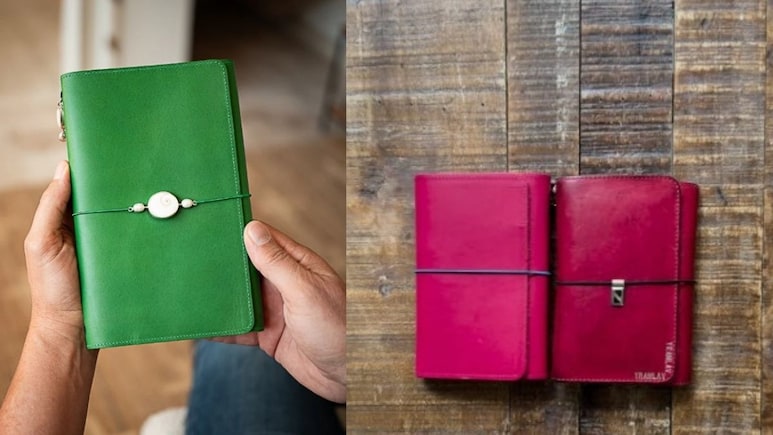
It starts like a small Parisian ritual. You arrive a little before noon, queue quietly under a glass-roofed passage, and step into a boutique that lets in only five people at a time.
There is no rush, no sales pitch. Instead, a patient associate walks you through leather swatches, paper textures, cord colours, embossing styles and tiny charms laid out like jewellery. By the time you leave, your journal is not just bought, it is curated, and you are told to come back in an hour once it has been handmade for you.
This is the experience influencer Lola Martinez Portero, documented when she visited Louise Carmen's Paris store, a viral video (with almost 3 million views) that has since fuelled a wave of similar pilgrimages.
Her Reel does not just focus on the final notebook but about the process itself: the quiet guidance, the indulgence of choice, the feeling of being treated as if time briefly revolves around you. That slowness has become part of the luxury.
It also explains (or not) why influencers are willingly spending Rs 16,000 to Rs 17,000 on what is, at its core, a journal.
'A Notebook Of Your Life'
For influencers and others who are buything these journals, the appeal is not limited to owning a beautiful object. The Louise Carmen purchase is content-friendly from start to finish. The hidden Paris passage, the limited-entry boutique, the close-up shots of leather being selected and embossed, and the final reveal all lend themselves to reels that feel intimate and aspirational.
Unlike a designer bag bought online or a perfume unboxed at home, this is an experience that unfolds step by step. Influencers can document indecision over cord colours, film the embossing process like ASMR, and frame the journal as something deeply personal. That narrative performs well on platforms like Instagram where audiences are increasingly drawn to slow luxury and craftsmanship over flashy logos.
Another justification that we have seen online for people spending this whopping amount is the claim that the journal, which is reusable, is supposed to last a lifetime.
Their bio also says, "Create the notebook of your life"
Then there is also a sense of being let in on a secret. The fact that the Paris boutiques operate with limited capacity and often have queues adds to the allure. For creators, especially those travelling to Paris, a Louise Carmen visit has become as much a content stop as a cafe; or concept store.
About The Brand Behind The Buzz
Louise Carmen is not new. The Paris-based luxury stationery brand was founded in December 2016 by Nathalie Valmary, who came up with the idea after a year-long family trip across Asia.
Managing multiple notebooks for sketches, addresses and memories left her frustrated with clutter. Her solution was a modular leather journal that could hold multiple refills and evolve with time.
Named after herself and her aunt, the brand positioned itself firmly within Paris's craftsmanship tradition. Production happens in France, and the journals use vegetable-tanned leather designed to age and develop a patina rather than look pristine forever. The idea is longevity. This is not a notebook you discard once it is filled, but one you keep refilling and reshaping over years.
Prices start at around Euro 139, which translates to roughly Rs 13,000-14,000, but with add-ons like charms, pockets and embossing, most buyers walk out spending closer to Rs 16,000 or more.
The brand frames this not as stationery but as a lifelong object, closer in spirit to a leather accessory than a diary.
Why It Feels Worth It To Many
Part of Louise Carmen's appeal lies in its resistance to the digital world. In a time dominated by note-taking apps and cloud storage, the brand leans into touch, weight and smell.
Customers are encouraged to feel the paper, compare leathers and choose the exact hide their journal will be made from.
For creatives, writers and planners, this tactile emphasis carries emotional value. The journal becomes a personal archive, one that can hold different notebooks for different phases of life. That promise of continuity is what allows many buyers to justify the price, especially when paired with attentive service and same-day craftsmanship.
Influencer marketing has amplified this message. With celebrities and Reels regularly crossing tens of thousands of views, the journal has been reframed as both a tool and a status symbol.
The Backlash That Followed The Virality
As with most viral luxury items, the attention has brought criticism. Online discussions have questioned whether a leather journal should cost as much as a mid-range smartphone or a short holiday.
Some viewers argue that the price reflects hype more than utility, especially when the core function can be fulfilled by notebooks costing a fraction of the amount.
Also Read | Home Address, Social Media Checks: How Hermes Stalks Its Buyers Before (And After) Selling A Birkin
Track Latest News Live on NDTV.com and get news updates from India and around the world
