





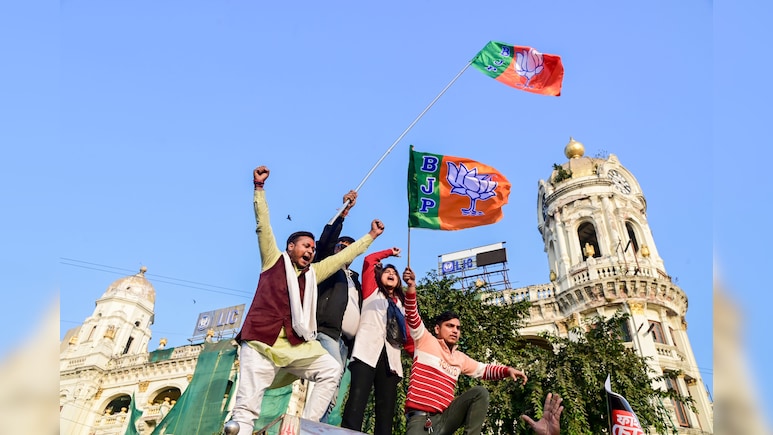
The BJP, which is hoping to wrest Bengal from the Trinamool Congress this time, had started its march in the state with a single seat in north Bengal. Today, the party has converted more than one district into its stronghold and has turned south, hoping to break into the Trinamool domain there.
It was one man who started the avalanche with a trip to Darjeeling - the crowning glory of north Bengal that provides an untrammelled view of the snow-capped Himalayan peaks.
Darjeeling's journey started during the British period in 1866. It was a tiny town where the rulers fled when the plains boiled in the summer heat.
For decades after Independence, tourists went to Darjeeling to see the Himalayan Mountaineering Institute, the zoo, Tiger Hill, Batasia Loop, the Darjeeling Ropeway, the Toy Train, Rock Garden, the Japanese Temple, and Gai Ghota.
Dilip Ghosh, then chief of the BJP's state unit, had reached Darjeeling on February 24, 2021, with a mission: Counter Mamata Banerjee's strategy in the region and secure the seats in the area that would set off a ripple effect across north Bengal.
Darjeeling was already, to an extent, BJP territory. The BJP won its first seat in Bengal - a Lok Sabha seat - in 2009. The victory of Jaswant Singh was followed by SS Ahluwalia in 2014. In 2019, the party had wrested seven of the eight parliamentary seats in north Bengal.
Ghosh felt it was time the BJP expanded and won the assembly seats in that part of the state. North Bengal has 15 to 16 assembly seats where the Gorkha factor matters. So, to neutralise Mamata's influence in North Bengal, Ghosh had decided to begin his campaign from Darjeeling.
At the time, the BJP had one MLA there .
Bimal Gurung -- the right-hand man of Subhas Ghising during the Gorkhaland movement -- was the hill leader of the Gorkhaland Territorial Administration, which is called the GTA. But Gurung suddenly left the BJP and joined hands with the Trinamool Congress.
Ghosh assured Gurung that if the BJP won, they would take care of the demands of the hills. When Gurung joined the BJP, Mamata Banerjee filed several cases against him and backed Binay Tamang, who became the new head of the GTA.
But that year, the BJP won all five assembly seats from Darjeeling and several more from north Bengal.
Back in 2019, Raju Bista had given the impression that the BJP would address the demand for a separate Gorkhaland, but the party knew that supporting the statehood demand will be an uphill task for a pan-Indian party.
On her part, Banerjee, who came to power in the state in 2011, gave importance not just to the Gorkha community, but other hill communities like the Lepchas and Bhutias as well. She formed separate councils which received funds from the state government and kept visiting Darjeeling regularly to maintain cultural coordination.
At that time, BJP's Surinder Singh Ahluwalia, to counter Mamata, gave significant importance to Bimal Gurung. But the BJP could not succeed.
Cut to 2026 -- the key leader in Darjeeling is Anit Thapa, whose Bharatiya Gorkha Prajatantrik Morcha is currently in power in the Gorkhaland Territorial Administration, and they are allied with the Trinamool.
Banerjee's Trinamool Congress - which announced its candidate list earlier this week - did not field any candidate from Darjeeling. All the seats have been left to Thapa.
Gurung's Gorkha Janmukti Morcha still chases the statehood dream. Earlier allied with the BJP, they are now seeking a third alternative. Ajay Edwards' Indian Gorkha Janshakti Front is allied with the GJM and aiming for statehood. Subhash Ghising's Gorkha National Liberation Front, which was also aligned with the BJP at one point, continues to operate. While these parties, focused on statehood, do not have much electoral heft, they still act as a counter to Trinamool.
Besides Darjeeling, there are four other districts in North Bengal -- Cooch Behar, Alipurduar, Jalpaiguri, and Malda. Murshidabad is not a part of North Bengal, but it is adjacent to it and acts as a connecting district between North Bengal and South Bengal.
Cooch Behar: In the 2021 assembly election, the BJP secured approximately 7.4 lakh votes, while the Trinamool received around 5.8 lakh votes, allowing the BJP to dominate the district by winning seven out of nine seats.
Alipurduar: The BJP held the advantage with about 4.2 lakh votes compared to Trinamool's 3.6 lakh votes and swept all five seats, even the ones in the tribal and Scheduled Tribe belts like Kalchini and Madarihat.
Jalpaiguri: The 2021 contest was much closer. The BJP received roughly 9.3 lakh votes, while the Trinamool slightly ahead with around 9.8 lakh votes. Both parties won seats in the district.
Districts like Malda and Murshidabad reflected an entirely different pattern.
Malda: The Trinamool secured around 11 to 12 lakh votes, significantly ahead of the BJP's 7 to 8 lakh, although the BJP did manage to retain a presence in certain northern segments.
Murshidabad: The Trinamool's dominance was overwhelming. With approximately 16 to 17 lakh votes compared to the BJP's 5 to 6 lakh votes, the party won 20 out of 22 seats.
North Dinajpur: The Trinamool polled 918,653 votes against the BJP's 643,709 votes, leading by nearly 2.75 lakh votes, reflecting strong consolidation in minority-dominated constituencies such as Chopra, Goalpokhar, and Karandighi.
South Dinajpur: This district presented a much tighter contest, where the Trinamool received 501,418 votes, the BJP following closely with 456,473 votes.
By 2024, the BJP had gained ground massively in North Bengal.
Over the last few years, Banerjee has been trying to reduce the BJP's influence. To neutralise the BJP strength among Rajbanshi, Matua, and other tribal communities in North Bengal, the Trinamool launched counter campaigns at the block level, highlighting the state government's populist measures.
But her work has been nullified by the Special Intensive Revision of voter lists amid concern over deletion of Trinamool supporters from voter rolls.
The 2021 results clearly show a divided political geography in North Bengal, where districts like Cooch Behar, Alipurduar, and Darjeeling emerged as BJP strongholds; Jalpaiguri became a battleground and Malda, Murshidabad, and North Dinajpur remained firmly within the Trinamool's sphere of influence.
But even so, changes are bubbling just below the surface.
Ananda Maharaj, the self-styled Maharaja of Cooch Behar and the BJP's Rajya Sabha MP who represents the Rajbanshi community, once came to one of Mamata Banerjee's events in Kolkata and met her. The Chief Minister has given him a state award and a certain understanding has developed between them.
For quite some time, the MP has been dissatisfied with the BJP. He said that he had demanded "Kamtapuri"- a separate state - but the BJP did not grant it. There is speculation now that if he aligns himself with Trinamool, the BJP could face significant challenges.
Many feel that the Rajbanshi and Matua votes have already shifted to some extent.
Further south, the big question is if Trinamool's suspended MLA Humayun Kabir, who plans to build a Babri Masjid and has launched the Janata Unnayan Party, be able split the Muslim vote. Even a shift of 5000 votes could create trouble for Trinamool and benefit the BJP.
Track Latest News Live on NDTV.com and get news updates from India and around the world

