




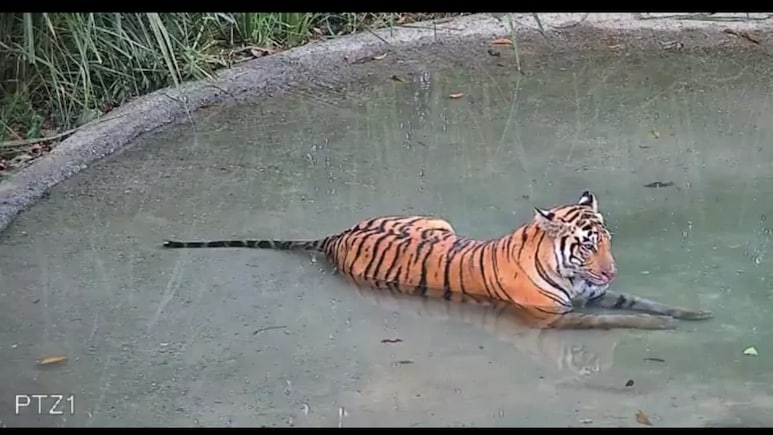
A three-year-old tigress introduced in North Bengal's Buxa Tiger Reserve on October 2 has crossed over to Assam. Environment Minister Bhupendra Yadav and West Bengal Chief Minister Suvendu Adhikari had released BTR-TF-1 (T-138) at the reserve three weeks ago in an attempt to revive the tiger population in the foothills of the Himalayas to boost tourism.
Speaking to NDTV, Bengal Forest Minister Manoj Oraon said, "The tigress is exploring its natural habitat with its basic instinct; it takes time to settle. When we released her, she was given 1km space; now she is exploring the larger territory. Assam isn't very far from where she was released. We are monitoring her every hour and checking her location."
For over a decade, the Buxa Tiger Reserve had no tiger population after a decline that began around 2009-2010. Declared a Tiger Reserve in 1983, Buxa forms part of a larger wildlife landscape with connectivity to forests and protected areas of Bhutan and Assam. Over the decades, however, habitat degradation and fragmentation, changes in land use and decline in prey availability affected the ecological conditions required to sustain a resident tiger population.
The tigress was airlifted aboard an Indian Air Force C-130J Super Hercules aircraft to Hasimara Air Force Base and then translocated to Buxa to mark India's Wildlife Week.
However, the Bengal government isn't in a hurry to bring back the wildcat.
"It isn't a case of the tigress escaping the tiger reserve; this is a tiger corridor, and the entire area is a forested area. The National Tiger Conservation Authority is also aware of this. At the moment, we have no plans to tranquillize and bring her back here; we want her to explore the territory before settling. The tigress is healthy and has been photographed. She has also killed a wild boar," said Oraon.
While the State government plans to introduce more tigers at Buxa to breed and establish a tiger population in North Bengal, for now, the wait for its new guest continues.
"Our team is in touch with the Assam counterparts. Our field director, DFO are monitoring as well; this is normal behaviour of wild cats to explore her territory for at least three months before settling down," said Oraon.
Track Latest News Live on NDTV.com and get news updates from India and around the world

