





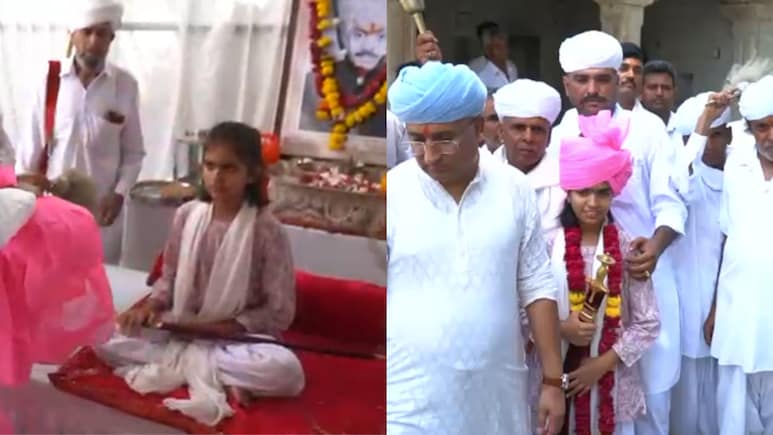
- Tejaswi Kumari Jodha became the first female heir in Kherwagarh's 400-year-old turban ritual
- The "Paag Ka Dastoor" ceremony marked the transfer of royal legacy after 65 years without a male heir
- Local elders chose Tejaswi to succeed her father, breaking a centuries-old male-only tradition
A centuries-old royal custom became a symbol of change in a small village in Rajasthan's Pali district when 13-year-old Tejaswi Kumari Jodha became the inheritor of the legacy of Kherwagarh. She was formally invested with the turban of the former royal family of Kherwagarh after her father's death, and her forehead was anointed with a 'tilak' in blood as the Rajpurohit of the village nicked his finger on the blade of a sword to carry out the centuries-old custom.
The custom of the "Paag Ka Dastoor" dates back hundreds of years, but for the first time at its centre was a young girl, Tejaswi Kumari Jodha, who was recognised as the successor to her father in a tradition that had until now been reserved exclusively for male heirs.
As hundreds of villagers gathered at the historic Kherwa Fort, believed to date back to the 17th century, the 13-year-old sat upright while the ceremony was performed. Tejaswi remained composed throughout the elaborate rituals as Vedic chants echoed through the fort. She was made to wear a pink turban, signifying the end of mourning. The turban had been sent on behalf of the former King of Jodhpur-Marwar, Gaj Singh, through his representative.
In the villages of Pali that were once ruled by the Kingdom of Jodhpur, when the head of a family dies, the heir traditionally wears a turban signifying succession. Even today, the ceremonial turban is sent by the former royal family of Jodhpur as part of the ritual known as the "Paag Ka Dastoor". The ceremony has long marked the transfer of responsibility from one generation to the next.
For Rajput families, however, the ritual has historically been reserved for sons. That made Tejaswi's investiture exceptional. The Kherwagarh family had not held the ceremony for 65 years because there had been no male heir. Instead of allowing the tradition to lapse, community elders chose to recognise Harish Chandra Jodha's only child as his successor.
In traditional Rajput households, these customs have been observed for centuries. But for the first time, the ceremony was performed for a girl, who has been recognised as the custodian of her father's royal legacy. In the case of the Kherwagarh family, the occasion was particularly significant because the ceremony was held after a gap of 65 years, as the family had never had a male heir to inherit the legacy.
Local folklore adds another layer to the story.
According to Rajasthani folklore, the family of Kherwagarh was cursed by Jorji Champawat. Legend has it that Jorji Champawat was betrayed by the Thakur of Kherwagarh, who was also his maternal cousin. He was attacked and killed in Kherwagarh, and local people believe that before dying, he cursed the family, saying they would never have a male heir.
Oral traditions in the region still preserve songs describing the incident, believed to have taken place sometime between 1873 and 1895. According to these folk narratives, Jorji Champawat was killed through trickery, but before his death, he fought back, killed several of his attackers, and cursed the rulers of Kherwagarh, declaring that their kingdom would never again have a male successor.
Whether legend or coincidence, the rulers of Kherwagarh have not had a male successor since 1895.
Tejaswi Kumari Jodha was the only daughter of her father, Harish Chandra Jodha, who himself had been adopted into the Kherwagarh family because they did not have a male successor.
The decision to hold the turban ceremony with 13-year-old Tejaswi as the heir attracted widespread attention across the region, with hundreds of people turning up to witness the Raj Tilak of a girl in what many described as a revolutionary break from tradition.
Speaking to NDTV, Pushpendra Singh from the neighbouring village of Auwa said: "The late Thakur saab died at the age of 78. He had no male heir, so all the elders of the community got together and decided that his daughter should become the next heir. In Rajasthan, a turban ceremony is held, and the ceremonial turban comes from the royal family of Jodhpur. A tilak is then performed by cutting a finger and applying blood to the forehead, and that was done for Tejaswi. Today, in modern India, there is no difference between men and women, so everyone decided it was time to take a step forward, break from tradition, and perform this traditional ceremony for his daughter."
In traditional Rajput families in this part of Marwar, this has been a major break from tradition, said Dhan Singh Ranawat, a local resident who attended the ceremony.
"Thakur saab had no male child, so the villagers decided that Tejaswi would be the heir. Her father, Harish Chandra Jodha, was himself a social reformer and did a great deal of work for the village. He served twice as sarpanch, and we felt it would honour his memory if we promoted women's empowerment by recognising his daughter as the inheritor of this 400-year-old legacy," he said.
"There were hundreds of people who came to witness the Raj Tilak," said Kanhiya Lal, a former sarpanch of Kherwa village. "It is the first time that a daughter has become the Sirdar of this area. It is a moment of pride for all of us."
For Tejaswi herself, who now finds herself at the centre of public attention, the moment remains deeply personal.
"I am studying in Class 7. My focus is on my studies, and I will try to live up to people's expectations and fulfil the dreams of development that my father had for his village," she told NDTV.
Track Latest News Live on NDTV.com and get news updates from India and around the world

