





The festive season in India, which starts from late October and continues till November end, is a time for workers employed in factories, construction sites, restaurants and other informal job sectors to travel home. It is an occasion to meet family members and celebrate festivals with them. But this great Indian return journey also gives an interesting picture when it comes to economics. These migrant workers don't just spend on new clothes, sweets or other equipment but a large chunk of their earnings goes to travel.
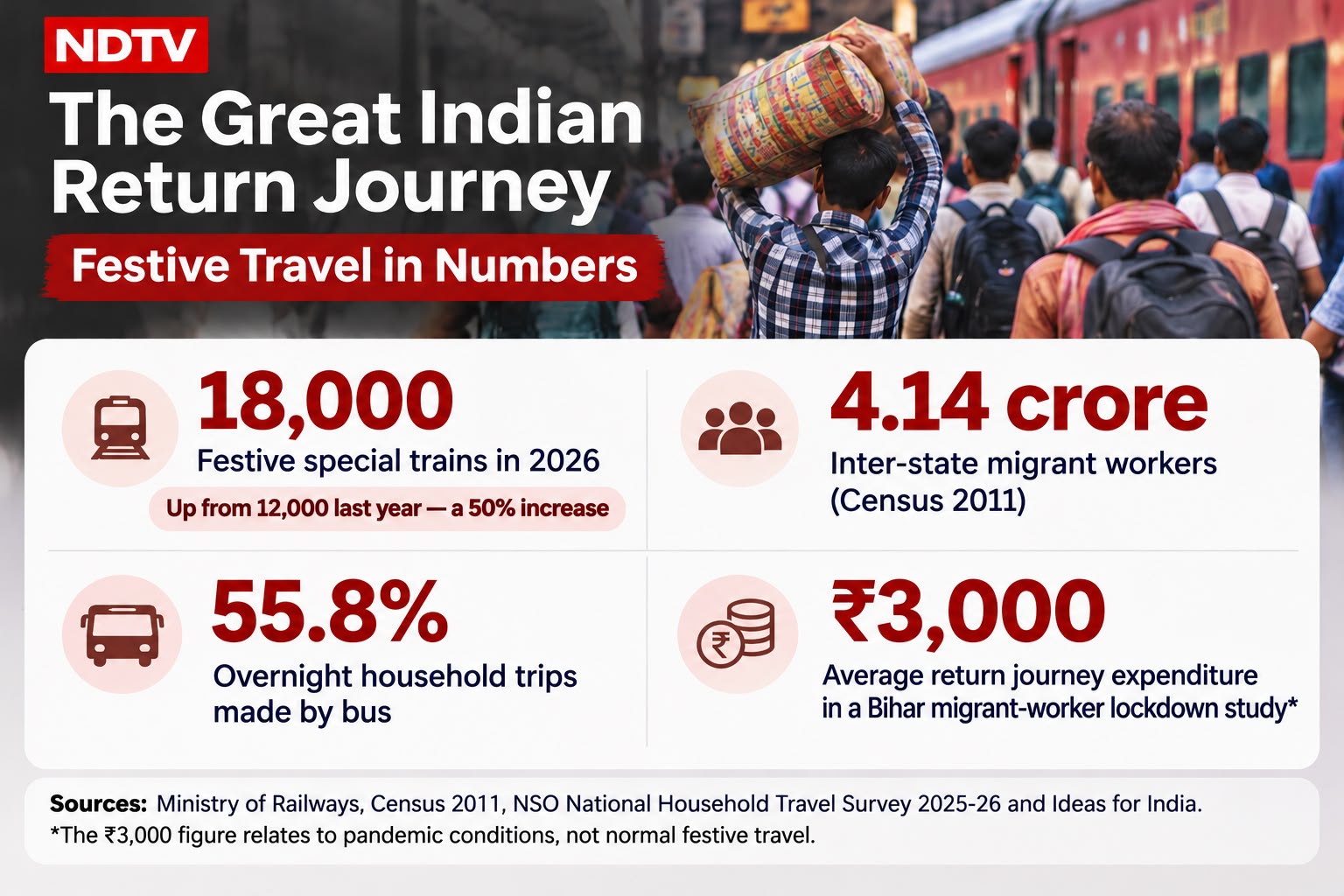
The scale of India's festive travel movement is reflected in the arrangements made by Indian Railways. For the 2026 festive season, which covers Durga Puja, Diwali and Chhath, Union Railways minister Ashwini Vaishnaw said on Thursday that the national transporter is running 18,000 special trains compared to 12,000 last year - an increase of 50 per cent.
Every year, as Diwali and Chhath approach, railway stations in cities such as Delhi, Mumbai, Surat and Ahmedabad witness a familiar rush. Trains heading towards Bihar, Uttar Pradesh, Jharkhand and West Bengal fill up, and buses run packed.
A Country On The Move
India has a vast migrant workforce, although the precise number of people who travel home specifically for festivals is not officially recorded.
The only official data available is from the 2011 Census in which the Union Labour Ministry said that India has 4.14 crore inter-state migrant workers. It also released a report on migration that said the total migration rate in India was 28.9 per cent and in rural was 26.5 per cent.
The latest National Household Travel Survey, conducted by the National Statistics Office between July 2025 and June 2026, offers another insight into why Indians travel. Social and religious activities accounted for 70.2 per cent of household overnight trips. Buses were the preferred mode for 55.8 per cent of overnight journeys, while inter-city railways accounted for another 17.7 per cent.
How Much Does It Cost A Migrant Worker To Go Home?
For a worker earning a modest monthly wage, a journey home can be a significant financial commitment. And it came to the fore during the Covid-19 lockdown.
A rapid assessment of migrant workers from Bihar, published by researchers and reported by Ideas for India, found that the average worker spent around Rs 3,000 on the return journey during the lockdown. About 87 per cent of the workers surveyed incurred travel expenses, with reported amounts ranging from Rs 1,200 to Rs 7,600.
A separate assessment cited in a World Bank document, drawing on a Caritas India survey of migrant workers in Maharashtra, found that 23 per cent of respondents spent more than Rs 5,000 on their return journey. Another 16 per cent spent between Rs 3,000 and Rs 5,000, while 14.4 per cent spent between Rs 2,000 and Rs 3,000.
These were exceptional pandemic-era journeys, when transport options were severely restricted. They cannot be treated as estimates of what workers spend during an ordinary Diwali or Chhath journey. But they underline how expensive returning home can become when there is rush or affordable transport is not available.
The expense is not limited to the ticket. Workers may also have to pay for local transport to railway stations, food during long journeys, luggage, last-mile travel and, in some cases, higher-priced alternative transport when regular trains are unavailable.
Going Home Also Means Lost Wages
For daily-wage workers and those employed in informal establishments, taking a few days off can mean losing several days of earnings.
A worker who is paid according to the number of days worked may have to account for both the return fare and the income lost while travelling and staying with family. The longer the distance, the greater the potential financial burden.
Research by economists Clement Imbert and John Papp on seasonal migration in India has also highlighted the economic trade-offs involved in leaving one's village for work. Their study found that the costs of migration extend beyond money, with higher living expenses, income uncertainty and the non-monetary cost of being away from home influencing workers' decisions.
The festive rush, therefore, is more than a seasonal transportation challenge. It is a reminder that behind India's urban workforce is a vast network of families, villages and hometowns - and that, for millions of workers, the most important journey of the year is the one that takes them home.
Track Latest News Live on NDTV.com and get news updates from India and around the world

