





India and the United Kingdom have announced that their landmark Comprehensive Economic and Trade Agreement (CETA) and the accompanying social security pact will come into force on July 15, marking the operational launch of one of the most ambitious bilateral economic partnerships negotiated by India and a major milestone in the country's push towards the Viksit Bharat 2047 vision.
The announcement was made jointly by the two governments after completing all domestic ratification and implementation procedures, setting the stage for a significant expansion in bilateral trade, investment, services exports and professional mobility between the world's fifth and sixth-largest economies.
The Ministry of Commerce and Industry described the twin agreements as the foundation of a "next generation economic corridor" that will transform policy commitments into daily commercial activity. Simultaneously, the Agreement on Social Security Contributions, known as the Double Contribution Convention (DCC), will also come into effect on July 15, providing relief to thousands of Indian professionals working temporarily in the United Kingdom.
Under the social security arrangement, the exemption period from making dual social security contributions has been extended from three to five years. The government said the provision is expected to benefit more than 75,000 Indian professionals and over 900 companies by reducing employment costs and improving the competitiveness of Indian service providers operating in the UK.
PM Modi Welcomes Development
Prime Minister Narendra Modi welcomed the development, calling it "a historic milestone for India-UK relations."
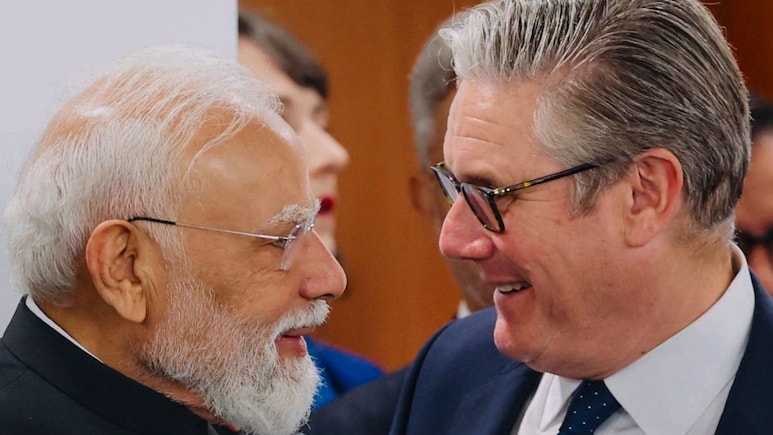
In a post on X, PM Modi said the agreement would significantly boost bilateral trade and investment while creating opportunities for Indian farmers, workers, micro, small and medium enterprises (MSMEs), startups and innovators. He said the pact would contribute meaningfully to the realisation of the Viksit Bharat 2047 vision, noting that both he and British Prime Minister Keir Starmer - who are attending the G7 Summit in Evian - were pleased with the momentum being added to economic ties.
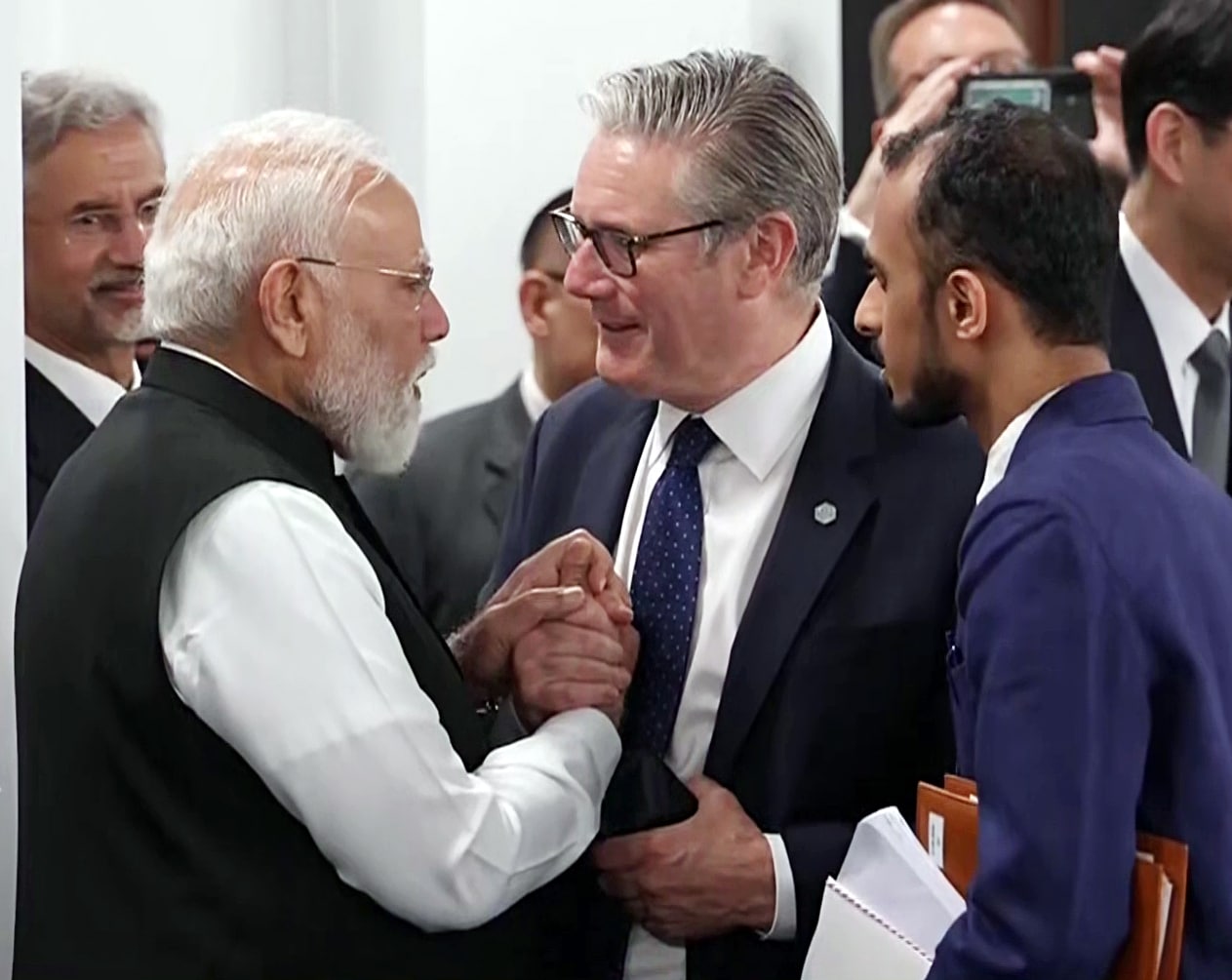
Prime Minister Narendra Modi with his British counterpart Keir Starmer on the sidelines of the G7 Summit.
Photo Credit: ANI
Echoing the sentiment, UK High Commissioner to India Lindy Cameron wrote on X that "the countdown begins," describing the July 15 implementation as "an historic moment for the modern UK-India partnership" that would unlock a new era of growth for both economies.
The trade pact represents the culmination of a process that began in May 2021 with the India-UK Enhanced Trade Partnership and the adoption of the Roadmap 2030 framework. Negotiations stretched across 14 rounds before the agreement was concluded on May 6, 2025. It was formally signed in London on July 24, 2025, by Commerce and Industry Minister Piyush Goyal and UK Secretary of State for Business and Trade Jonathan Reynolds in the presence of the two prime ministers. The companion social security agreement was signed in February this year.
According to the Commerce Ministry, CETA provides zero-duty access on nearly 99 per cent of India's exports to the UK, covering almost the entire value of bilateral trade. The agreement comprises 30 chapters and extends beyond conventional tariff reduction commitments to include provisions on digital trade, telecommunications, financial services, intellectual property, government procurement, innovation, sustainability and support for small and medium enterprises.
Indian exporters are expected to gain immediate tariff-free access in several sectors that have traditionally faced significant duties in the British market. Tariffs of up to 70 per cent on processed food products, 21.5 per cent on marine products, 18 per cent on engineering goods and auto components, 16 per cent on leather and footwear products, 12 per cent on textiles and clothing, and 8 per cent on chemicals and pharmaceutical products will be eliminated.
The government said the tariff reductions would enhance the competitiveness of Indian products in the UK market, generate opportunities for farmers, fishermen, workers and manufacturers, and strengthen India's integration into global value chains.
At the same time, New Delhi emphasised that sensitive sectors such as dairy products, cereals, millets, edible oils, oilseeds, apples and several vegetable products have been protected through exclusion mechanisms designed to shield domestic producers from import volatility.
Also read: India, European Union Push To Seal Landmark Trade Pact By Year-End
Commerce and Industry Minister Piyush Goyal said the simultaneous enforcement of CETA and the DCC would open substantial new opportunities for Indian exporters while protecting domestic interests.
"By securing immediate duty-free access on 99 per cent of our tariff lines, we have systematically dismantled long-standing tariff walls," Goyal said, adding that sectors such as textiles, leather, marine products, engineering goods and processed food would be able to compete in the UK market without tariff disadvantages.
A major feature of the agreement is its services package. The UK has offered commitments covering all major services sectors and 137 sub-sectors of export interest to India. Industries expected to benefit include information technology and IT-enabled services, financial services, healthcare, education, engineering, telecommunications, consultancy and professional services.
The pact also creates predictable mobility pathways for business visitors, intra-corporate transferees, contractual service suppliers, independent professionals and investors. In a first-of-its-kind arrangement, 1,800 Indian chefs, yoga instructors and classical musicians will be eligible annually for dedicated mobility opportunities under the agreement.
The two countries have also reached a separate understanding to safeguard bilateral steel trade ahead of the UK's new steel measures coming into effect from July 1. The Commerce Ministry said around 85 per cent of India's steel exports would remain outside the scope of the measures, while interests on affected product lines would be protected through quotas and authorised-use provisions.
Also read: 'Soggy Poppadums' vs 'Fine Tandoori': UK MPs Debate Benefits Of India Trade Deal
Scale Of Economic Gains
The UK government highlighted the scale of the economic gains expected from the deal, stating that it could increase UK GDP by $4.8 billion and Indian GDP by $5.1 billion in the long term while boosting bilateral trade by $25.5 billion annually. British officials described the agreement as the most comprehensive trade deal India has ever brought into force and one that would provide significant commercial opportunities for businesses on both sides.
For India, the July 15 implementation date marks the beginning of a new phase in economic diplomacy. Beyond expanding market access, the agreement is expected to deepen strategic cooperation, strengthen supply chains, promote technology collaboration and create a rules-based framework for future economic engagement.
As the countdown to implementation begins, governments and businesses in both countries are preparing to activate a trade architecture that officials believe will redefine the India-UK economic relationship and accelerate growth, investment and job creation for years to come.
Track Latest News Live on NDTV.com and get news updates from India and around the world

