





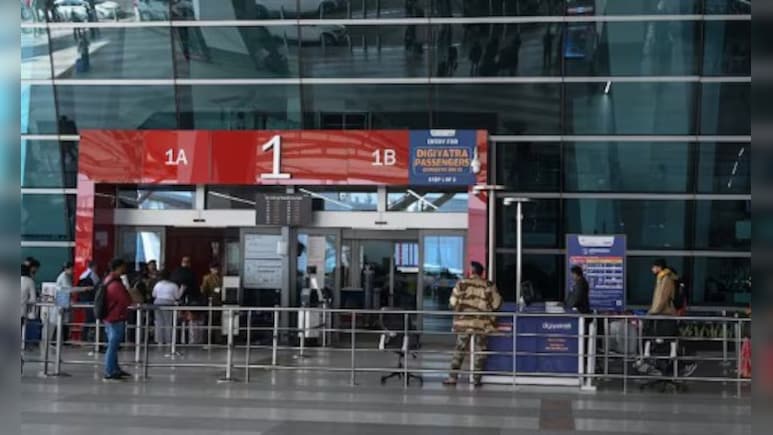
The Central Industrial Security Force (CISF) personnel deployment at airports is likely to come down as the government is bringing in private security staff to take over non-armed duties, sources have told NDTV.
According to a senior official in the Ministry of Civil Aviation, the number of CISF personnel deployed at Indian airports is likely to decrease under revised airport security guidelines issued by the Bureau of Civil Aviation Security (BCAS).
Private security agencies will gradually take over non-armed duties, including certain routine security functions.
CISF, however, will continue to handle critical security responsibilities, including armed protection, airport perimeter security, mobile patrolling, surveillance, intelligence operations and quick response teams.
Currently, CISF guards 74 of India's 119 airports, while state police personnel are deployed at the remaining 45.
The official emphasised that CISF will continue to carry out the major security responsibility at airports, adding that private security is being roped in only for non-armed duties.
Airport Operators Seek Reduction
According to reports, airport operators across the country have suggested to the CISF and the Ministry of Civil Aviation that the deployment of security personnel be reduced. The operators argue that the deployment of a large number of CISF personnel places an additional financial burden on them, as the costs associated with the deployment and maintenance of these central security force personnel are high. The operators have cited several reasons for this request:
There have been changes in passenger numbers and movement patterns at airports.
Passengers have become more aware and now have a better understanding of airport security checks and other procedures compared to the past.
There have been advancements in airport security systems and technology.
The cost of deploying a central security force like the CISF is higher than that of employing private security guards.
Airport operators believe that certain responsibilities could be entrusted to private security agencies while still maintaining robust security arrangements. This would help alleviate the financial burden on airport operations.
How Did The Move Come About?
Following the proposal from the airport operators, the CISF reviewed the matter. Subsequently, a committee was formed under the Ministry of Civil Aviation, comprising officials from the CISF, the Ministry of Civil Aviation, the Airports Authority of India (AAI), airport operators, and the Bureau of Civil Aviation Security (BCAS). The committee evaluated CISF deployment levels by taking into account factors such as the airport's category, passenger volume, and specific security requirements.
According to sources, the BCAS assessed the need for CISF personnel by categorizing airports into three groups. Based on this, a new manpower arrangement was proposed, which has since been advanced at the ministry level.
Airport Operators To Provide Staff For Certain Functions
The revised framework also places responsibilities on airport operators.
Where motorised vehicle access gates are not available, airport operators will have to provide staff to open the gates. The order also says that additional gates in the perimeter wall should generally be avoided, except in exceptional circumstances.
Biometric access is to be mandated for entry into baggage handling system (BHS) control rooms and conveyor belt areas.
The norms further state that passengers who leave the security hold area for Level 4 inline baggage identification must undergo screening again before re-entering. Escorting such passengers will be the responsibility of airline staff.
Airports Categorized Into Three Groups
According to an assessment by the BCAS, airports have been classified into 'small', 'medium', and 'major' categories based on passenger volume. The proposal entails reducing the number of CISF personnel deployed during a single shift across each of these categories.
Airport security was handed over to the CISF after an Indian Airlines flight was hijacked by Jaish-e-Mohammed terrorists in Kathmandu in December 1999, which resulted in Masood Azhar's release in Kandahar in exchange for Indian hostages.
Before the induction of the CISF, the state police handled the job.
The Central Industrial Security Force (CISF) is a Central Armed Police Force under Ministry of Home Affairs that guards critical industrial, infrastructural, and aviation installations.
Track Latest News Live on NDTV.com and get news updates from India and around the world

