





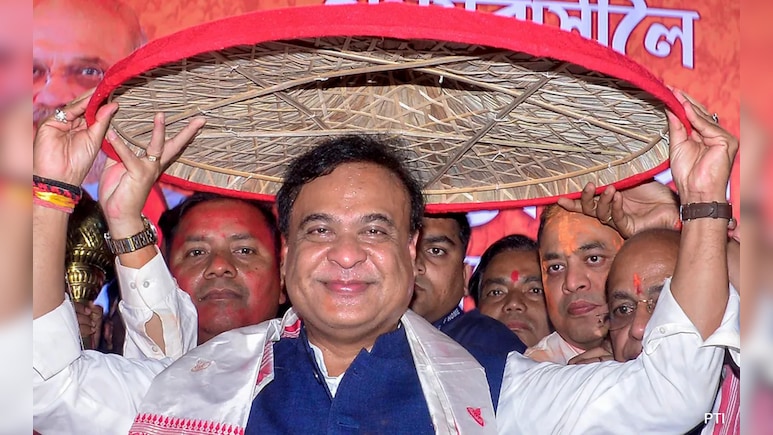
Himanta Biswa Sarma on Tuesday will begin his second straight term as Assam Chief Minister, this time with much bigger expectations.
Sarma has himself said that the BJP has moved from the expansion mode to the execution mode. Post-election results, he made it clear that the next phase of his government would not be about big announcements, but execution of what began in his first tenure in 2021.
From starting out in the Congress and holding several important portfolios at the time the party held power to making a major political shift to the BJP about a decade back, Sarma has come a long way.
Chief Minister Himanta Biswa Sarma's political journey began through student politics. His first association with the Congress was in the 1990s, and in 2001, he won the Jalukbari seat.
Under then chief minister Tarun Gogoi's government, he handled several major portfolios, including health, finance, education and public works. These significant portfolios resulted in Sarma gaining prominence as one of the most powerful ministers in Assam.
His influence within the party also grew. By the early 2010s, political circles in Guwahati had already started discussing him as the political successor of Tarun Gogoi.
Tarun Gogoi's son Gaurav Gogoi returned from the US and discussions around favouritism towards him grew in the party circles. Following long-standing dissidence and what many believed to be political stagnation within the congress, Sarma jumped ship and joined the BJP in 2015. Congress insiders say the party never fully recovered from that split and his absence was felt strongly within the organisation.
Within the BJP, Sarma quickly grew from a regional face to one of the key strategists in the region. The party leadership also relied on him to strengthen the party's position beyond Assam. He gradually became a trusted face during difficult election moments and political negotiations because his voice had become too significant to ignore.
In 2021, Sarma became the Assam chief minister for the first time. He came to be known for his constant public visibility and welfare outreach through schemes like Orunodoi and Nijut Moina. This helped the BJP build a strong support base among lower-income households and women.
He faced criticism for his government's aggressive stance towards eviction drives, policing methods and illegal immigrants. Controversies often triggered national debate. BJP supporters argue that Sarma spoke directly on issues they consider crucial to Assam, especially migration and land pressure. Critics accused him of polarisation and targeting certain minorities.
As he becomes the only non-Congress chief minister to hold a second term in the state, Sarma's tenure will be closely watched for the execution of sensitive promises regarding illegal immigration and the Citizenship Amendment Act (CAA). These issues have shaped Assam's politics for years and remain emotionally charged across communities.
Track Latest News Live on NDTV.com and get news updates from India and around the world

