





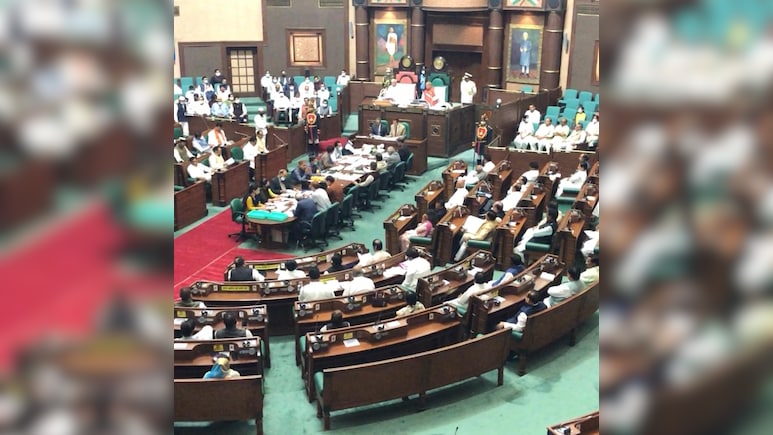
- Madhya Pradesh assembly may expand from 230 to 345 seats after delimitation exercise
- The number of women MLAs could rise from 27 to 114, a nearly fourfold increase
- Lok Sabha seats from Madhya Pradesh may increase from 29 to 43 with 14 reserved for women
Madhya Pradesh, in tandem with a nationwide shift, now stands on the brink of its most significant transformation -- one that could redefine not just numbers, but the very division of power. The 'Nari Shakti Vandan Adhiniyam' is no longer just a legislative promise, it is emerging as a force that could fundamentally alter the DNA of politics and ultimately governance in the state.
Inside the Madhya Pradesh Legislative Assembly, the scale of change is already being mapped. The House, which currently operates with 230 seats and a majority mark of 116, could expand dramatically to 345 seats following delimitation. Of these, 114 seats are expected to be reserved for women -- an almost fourfold jump from the current 27 women MLAs.
The assembly, which has a capacity of 350 members, is now poised to run almost at full strength. This expansion will not just change representation but will rewrite the arithmetic of power itself, pushing the majority mark up to 174. The ripple effect will extend further into governance, with the size of the Council of Ministers expected to increase from 34 to as many as 52.
The transformation is not confined to Bhopal. From the corridors of the state assembly to the national stage in Delhi, the political map of Madhya Pradesh is set to expand.
Read: Explained: Big Push For Women's Quota, Move To Redraw Lok Sabha Map
The state's representation in the Lok Sabha is projected to rise from 29 seats to 43, driven by the delimitation exercise. Currently, only six of these seats are held by women. Under the new framework, 14 seats will be reserved for women, significantly increasing their presence in Parliament. While a simple 33 per cent increase would have taken the number to around 39, the combined impact of delimitation has pushed the figure higher, reshaping Madhya Pradesh's national political footprint.
Chief Minister Dr. Mohan Yadav has termed this shift historic, emphasizing that the state is moving to translate the vision of women's empowerment into reality.
"Carrying forward Dr. Ambedkar's vision regarding women's empowerment, Prime Minister Narendra Modi is set to grant women a 33 per cent reservation in both Lok Sabha and the state legislative assemblies. This will ensure adequate representation for half the population within these legislative bodies," he said, as the government marked a 'Nari Shakti Vandan Fortnight' across the state.
Yet, even as the structural shift gathers momentum, the political battle around it has intensified.
The BJP has positioned the move as a long-overdue correction in India's democratic framework, while the Congress has questioned both its timing and intent.
BJP MLA Archana Chitnis launched a sharp attack, saying, "The Congress party has consistently worked to hinder women's political representation... they have always viewed women merely as a vote bank. Be it the Shah Bano case or this bill, while they introduced it in the Rajya Sabha, they failed to even table it in the Lok Sabha. This is not just an Act. It is a major step toward women's empowerment. Since becoming Prime Minister, Narendra Modi has launched several initiatives from Beti Bachao Beti Padhao to creating Lakhpati Didis, ensuring women are moving ahead in every field."
Read: Why Such Great Hurry: Congress Vs BJP In Parliament Over Women's Quota Bill
The Congress, however, has dismissed the exercise as premature and politically motivated. Party leader JP Dhanopia said, "This is a far-fetched idea. It will take a long time to actually implement. What we are seeing right now is nothing but a staged political exercise".
Beyond the political rhetoric, the deeper shift is unmistakable. This is no longer just about increasing seats or adjusting quotas. It is about redefining who holds power and how it is distributed -- candidate selection, party strategies, and electoral dynamics are all set to change as parties scramble to adapt to a new reality.
Track Latest News Live on NDTV.com and get news updates from India and around the world

