





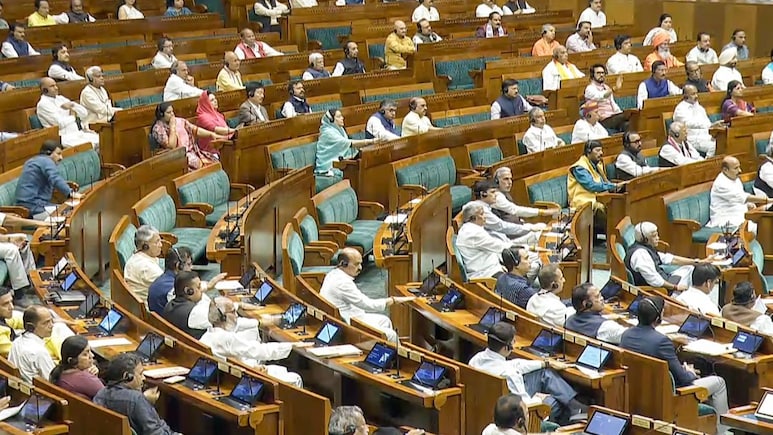
- Women's reservation will increase Lok Sabha and assembly seats by 50 per cent
- South Indian states are opposing delimitation fearing reduced representation
- Government sources said southern states will gain seats despite lower population
The implementation of women's reservation will result in benefits, rather than disadvantages, for the South Indian states, high-ranking government sources have asserted. They contend that the apprehensions harbored by South Indian states -which have successfully controlled their populations - regarding potential losses relative to north Indian states due to delimitation are entirely unfounded.
The Constitutional Amendment Bills regarding women's reservation, which were circulated to Members of Parliament today, include a provision stipulating a 50 per cent increase in the total number of seats in both Lok Sabha and the state legislative assemblies.
The south Indian states are vehemently opposing this move. Tamil Nadu Chief Minister MK Stalin has been the most vocal critic.
Read: Big Push For Women's Quota, Move To Redraw Lok Sabha Map
He maintains that while he is a staunch proponent of providing reservation for women, the manner in which the Central government is linking this initiative to delimitation constitutes a political conspiracy - one designed to diminish the representation of south Indian states while conferring advantages upon their north Indian counterparts.
He has also issued a warning regarding the possibility of a large-scale protest movement.
Telangana Chief Minister Revanth Reddy has similarly denounced the move as an act of injustice.
Today, high-ranking government sources clarified that conducting the delimitation exercise based on the 2011 census data will, in fact, benefit the south Indian states.
This, they said, is because when viewed against the baseline of the 1971 census, the population growth in south Indian states has not kept pace with the proportional growth observed in north Indian states. But despite this demographic reality, the proposed provisions ensure a 50 per cent increase in the number of Lok Sabha seats allocated to these states. This implies that, on a proportional basis, these states will stand to gain, as they will secure increased parliamentary representation despite having smaller populations.
Union Minister of Parliamentary Affairs Kiren Rijiju also dismissed the apprehensions voiced by the southern states. He said certain individuals are attempting to propagate a misconception that the south Indian states would suffer adverse consequences as a result of their successful family planning policies.
According to Rijiju, the south Indian states are, in fact, fortunate, as they are poised to receive a proportionally higher number of seats despite their lower population figures. Rijiju further said the delimitation process would be conducted in a manner that ensures fairness and justice for all states.
Government sources have clarified that to implement women's reservation, the number of seats in the Lok Sabha and state legislative assemblies will be increased by 50 per cent.
On basis of this calculation, the maximum number of seats in the Lok Sabha could reach 850. Under this provision, a maximum of 815 seats are being allocated for the states, and 35 for the Union Territories.
Track Latest News Live on NDTV.com and get news updates from India and around the world

