

When I took my mother-in-law to the doctor recently, we discovered that she had osteopenia. She is an active woman, and the diagnosis made me pause. It was a reminder that looking after yourself and feeling well do not necessarily mean that your bones are healthy.
It also raised a question: if an active woman can have lower-than-normal bone density without realising it, how many others could be living with the same problem?
Some women may never have undergone a bone-density test. Others may see no reason to visit a doctor when nothing hurts. And many may believe osteoporosis is something to worry about only in old age.
Yet the years around menopause can be particularly important for bone health.
We have become more open about the symptoms associated with menopause, from hot flashes and night sweats to mood changes and disrupted sleep. But the conversation is incomplete if we overlook what happens to a woman's bones during this transition.
Unlike a hot flash, bone loss does not announce itself. A woman may continue with her daily routine, go for walks and exercise regularly without knowing that her bone density is declining. In some cases, the first indication of osteoporosis is a fracture.
That is what makes bone health an important part of menopause care, rather than a concern to be addressed much later in life.
What happens to bones when estrogen falls?
Bone is living tissue. It is continuously broken down and rebuilt, a process that helps maintain its strength. Estrogen plays an important role in regulating this cycle by limiting the activity of cells responsible for breaking down bone.
As estrogen levels decline around menopause, this balance can shift. Bone breakdown may begin to outpace the formation of new bone, resulting in a loss of bone density.
"Falling estrogen removes the natural brake on bone breakdown, causing rapid bone loss during the early years of menopause. Because this process is entirely silent, a woman can experience significantly reduced bone density without feeling any symptoms. Consequently, the condition often goes unnoticed until a sudden fracture occurs," says Dr Anoop Misra, Chairman, Fortis-CDOC Center of Excellence for Diabetes, Metabolic Diseases.
The Indian Menopause Society's 2026 clinical practice guidelines indicate that bone loss may reach around 1-2% annually, and up to 5% annually in some cases, during the first five to seven years after menopause. These figures describe potential rates of bone loss; the actual rate varies from woman to woman.
Ageing affects bone health in men as well. However, the hormonal changes associated with menopause create an additional period of vulnerability for women. Genetics, nutrition, body weight, physical activity, medical conditions and certain medications can also influence how much bone a person loses.
The challenge is that there may be no obvious indication that anything is wrong. Feeling energetic, walking every day or having no pain cannot tell a woman whether her bone density is within the normal range.
Osteoporosis vs Osteopenia: What a diagnosis can mean
Osteopenia is a warning to pay attention, not a reason to panic. My mother-in-law's diagnosis brought the issue closer to home. Osteopenia describes bone mineral density that is lower than normal but does not meet the diagnostic threshold for osteoporosis. It does not mean that osteoporosis is inevitable, nor does every woman with osteopenia require medication.
What matters is understanding the result and assessing what it means for the individual's future fracture risk.
A DEXA scan, also known as a dual-energy X-ray absorptiometry scan, is commonly used to measure bone mineral density. In postmenopausal women, a T-score between -1.0 and -2.5 indicates osteopenia. A T-score of -2.5 or below meets the bone-density criterion for osteoporosis at an accepted diagnostic site.
However, a scan result is not the whole story. Doctors also consider factors such as age, family history, previous fractures, body weight, medical conditions and medications when assessing fracture risk. Depending on the findings, a woman may need lifestyle changes, follow-up assessments or treatment.
Not every woman needs a scan at the same age or at the same interval. The decision should be based on individual risk and appropriate clinical guidance.
READ | Osteoporosis Is Showing Up Earlier Than Ever: Expert On How Young Adults Can Prevent It
Just a fall or something deeper in the bones?
Why a fracture should never be dismissed as just a fall. Osteoporosis weakens bones, sometimes to the point that a relatively minor fall or impact can result in a fracture. The hip, spine and wrist are among the sites commonly affected.
Spinal fractures may go unnoticed. In some cases, they cause persistent back pain, a loss of height or changes in posture. Hip fractures can be particularly devastating for older adults, affecting mobility, independence and quality of life.
"Fragility fractures have major consequences on patients' quality of life as they cause substantial pain and disability, which results in a loss of independence, and increased risk of morbidity and mortality", says Dr JBS Jaggi, Principal Director & Unit Head, Department of Orthopaedics & Joint Replacement, Max Hospital.
A fracture can be treated, but its consequences may extend well beyond the initial injury. Recovery can be difficult, particularly for older adults, and some people may not regain their previous level of independence.
This is why identifying osteoporosis and assessing fracture risk before a break occurs is so important.
Nutrition plays a huge role
Dr Jaggi also highlights the role of calcium and vitamin D after a fragility fracture, "The use of calcium and vitamin D are generally recommended after fragility fracture to reduce the risk of recurrent fractures. Current guidance from the Royal Osteoporosis Society advises that calcium intake should be from dietary sources where possible but may require supplementation. Vitamin D and corrected serum calcium levels should be taken as a minimum in patients with fragility fractures, and dietary calcium intake and urinary calcium excretion may also be assessed if deemed appropriate".
Calcium and vitamin D support bone health, but supplementation alone is not a substitute for a complete assessment or osteoporosis treatment when indicated. A doctor can determine what is appropriate based on dietary intake, test results, medical history and fracture risk.
A fracture following a minor fall should therefore prompt a medical assessment, rather than automatically being attributed to an accident.
The Indian Menopause Society's 2026 guidelines also report that hip fractures in Indian populations tend to occur about a decade earlier than in many Western populations. This evidence includes men as well as women, but it underscores the importance of taking bone health seriously in India.
Is osteoporosis only a women's disease?
No. Men can develop osteoporosis too, particularly as they grow older, and their condition can also go undetected.
What makes menopause especially relevant is the accelerated bone loss that can accompany declining oestrogen levels. This creates an important opportunity to discuss bone health during midlife, rather than waiting until an older woman experiences a fracture.
The good news is that osteoporosis can be treated. Depending on the diagnosis and an individual's risk, medication can help reduce the likelihood of fractures. Early identification also gives women and their doctors an opportunity to address modifiable risk factors and make an appropriate care plan.
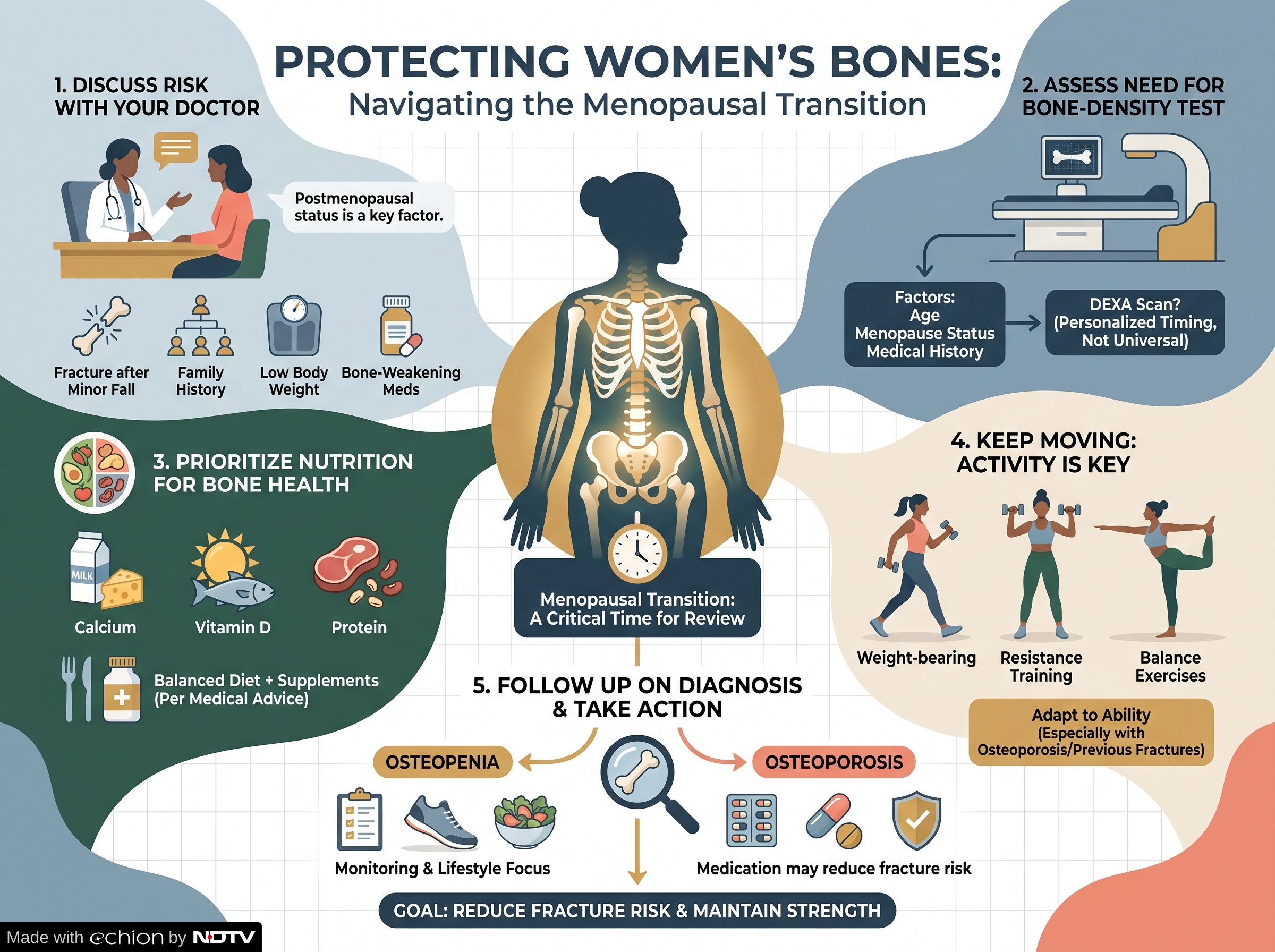
What can women do to protect their bones?
Bone health deserves attention throughout life, but the menopausal transition is a particularly useful time to review individual risk.
- Discuss your risk with your doctor. This is especially important if you are postmenopausal, have experienced a fracture after a minor fall, have a family history of osteoporosis, have low body weight or take medicines that may weaken bones.
- Ask whether you need a bone-density test. A DEXA scan is not necessary for every woman at the same age or frequency. Your age, menopausal status, medical history and other risk factors help determine when testing is appropriate.
- Pay attention to nutrition. Adequate calcium, vitamin D and protein support bone health. A balanced diet is a useful starting point, while supplements should be considered according to individual needs and medical advice.
- Keep moving. Weight-bearing activities, resistance training and balance exercises can support bone strength, muscle function and stability. Exercise should be adapted to individual ability, especially for women with osteoporosis or previous fractures.
- Follow up on a diagnosis. Osteopenia and osteoporosis call for different approaches, but both deserve attention. Some women may need monitoring and lifestyle changes; others may benefit from medication to reduce their risk of fractures.
READ | Early Menopause Is A Growing Indian Problem: What Working Women Are Missing
The menopause conversation must include bones. My mother-in-law's diagnosis left me thinking about how easily bone health can escape our attention. We often associate good health with being active, eating well and feeling fine. But bone loss can progress even when none of these things appears to be a problem.
How many women are entering menopause without knowing that declining estrogen can affect their bones? And how many will discover the problem only after a fracture?
We need to talk about this without creating unnecessary fear. Menopause does not mean that every woman will develop osteoporosis, and osteopenia is not a guarantee of future fractures. But the possibility of bone loss deserves the same attention we give to other changes during midlife.
Doctors have an important role in identifying women who may need screening, assess fracture risk and recommending appropriate prevention or treatment.
On World Osteoporosis Day, the message is simple; please do not wait for pain or a fracture to start thinking about your bones. Ask questions, understand your risk and seek medical advice when appropriate.
We prepare women for the hot flashes, sleepless nights and other symptoms of menopause. We must also help them understand what happens beneath the surface, while there is still an opportunity to act. Because when it comes to bone health, the warning may come far too late if we wait for a fracture to hear it.
Disclaimer: This content including advice provides generic information only. It is in no way a substitute for a qualified medical opinion. Always consult a specialist or your own doctor for more information. NDTV does not claim responsibility for this information.