

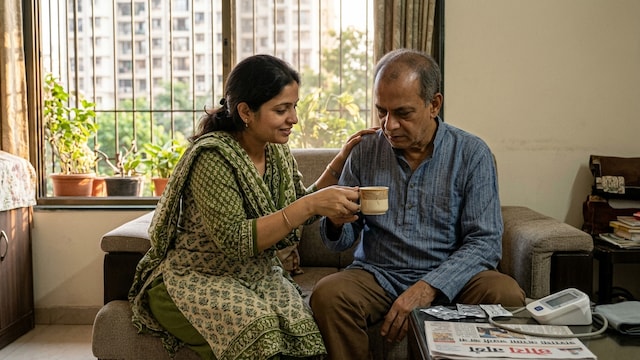
When a person gets old and frail and becomes unable to care for themselves, to be looked after by a relative is considered fortunate. In India, with limited geriatric care infrastructure, families still take up most of the responsibility of caring for older relatives. Complaints are sometimes heard about older people not being adequately cared for by family members or caregivers. Unfortunately, it is true that neglect, abandonment and, occasionally, abuse of older people occurs in certain households. Measures are being taken to protect their rights.
This is a story on the other side of the coin: the caregiver.
The other side of the story
Every problem has two sides. To ensure good outcomes, it is also important to talk with the caregiver to understand what their perspectives and experiences are.
Caregivers in India are generally women because there is a distinct gender bias about the person in the household designated to look after the older relative. This is usually a daughter or daughter-in-law, and sometimes a son or son-in-law. Many give up their jobs, in India or abroad, to come and stay with their aging parents.
The silent toll on the caregiver
The burden of caregiving falls disproportionately on women. They often spend a substantial portion of their young and productive years in the caregiver's role. A daughter who spends years looking after an older parent may herself develop sleep deprivation, anxiety, and depression. She is also at risk for physical health problems such as shoulder injury, back pain or slipped disc from lifting a bedridden person. She may sacrifice professional opportunities, financial independence and even her social life - for instance not being able to go for a holiday break with her friends or relatives. Sometimes, the caregiver herself or himself may be approaching old age.
Family caregivers work 24/7
Unlike professional nurses or attendants who work fixed shifts and go home, family caregivers have to stay on duty all the time out of love and obligation. The only way they get any rest is if other relatives step in periodically to give them a break.
Rights and responsibilities
There is much discussion about the rights of older people and the responsibilities of those who care for them. These discussions help improve the well-being of older people and prevent neglect and abuse. By the same token, those who receive care also need to understand their responsibilities. While most people who receive care are gracious and kind, there are exceptions too. Greater awareness of their responsibilities will help seniors avoid common conflicts with family members and also receive better care in the long term.
Consider this example: a 79-year-old woman complains that her grandson is avoiding her, and prefers to spend time with his friends. Before impulsively taking sides, we must pause and ask why. In this hypothetical example, imagine that the grandparent was condescending and repeatedly scolded the grandson - to such an extent that he felt that avoiding a conversation was a safer alternative. From her standpoint, she may have done it with good intentions, but it might not have been received well at the other end. Unless we ask the grandson, the reason for his silence will not be known. In other words, looking only at the grandparent's perspective and squarely blaming the grandson, we may come up with the wrong solutions - or not find a solution at all.
Likewise, there are numerous issues that older people (and younger people, as they will get old someday) need to acknowledge while living with family caregivers.
READ | Dementia Cases In India Projected To Nearly Double By 2036
Entitlement and control
One problem that can arise is a sense of entitlement. While those without a caregiver often yearn for one, the majority of those with a caregiver may soon adapt graciously to the situation. However, a few among them may go on to consider it an automatic entitlement. And this entitlement can turn into conflict if the older person assumes that they should be the sole decision-maker in the household. For instance if an 85-year-old woman decides to call all the shots at home, it may not go well with family members of multiple generations. (By the same token, her age should not automatically deprive her of a say in matters that affect her).
Instead of continuing to control the household, seniors need to acknowledge that they are at a different stage in their life, and that several generations have appeared since. Each one of these generations, especially adults, has a newer set of skills, experience and decision-making capacity.
Without acknowledging this, a handful of older citizens still treat the younger generations as though they are still in kindergarten, even when they are 65 years old. For example, an 80-year-old man might insist that his middle-aged son and daughter-in-law must get home by 6 pm.
As the saying goes, you can catch more bees using honey than vinegar - being kind is a better way to build relationships than constantly criticising others.
READ | Lara Dutta On The Invisible Burden Of Alzheimer's Care: 'It's Exhausting Physically And Mentally'
The cost of avoidable crises
Financial setbacks frequently complicate human relationships. Catastrophic health expenses are a major contributor. With many families being in some sort of debt, with loans to be paid back every month, an additional health expense - especially one that could have been avoided with reasonable precautions - can be upsetting.
For instance, a frail senior may refuse to use a walking stick despite repeated reminders, perhaps out of embarrassment or ego. If she then suffers a fall that needs extended hospital care, the family may have to spend lakhs of rupees. This is an expense that could easily have been avoided. A family already struggling with money may see this very differently from an unavoidable expense, such as treatment for a heart problem.
Empathy, words and memory
Lack of empathy is a major cause of alienation of family members. People without empathy sometimes make impulsive, casual remarks - without realising that these comments appear rude or offensive to the other person. What was considered acceptable in an older generation may be deeply hurtful to someone from a younger generation. For instance, body-shaming (which was tolerated in the seventies, but is taboo for newer generations) can be emotionally upsetting to younger people. Another common habit relating to lack of empathy is the tendency to compare between people, ranging from sons, daughters and siblings to daughters-in-law.
Complaining about the care they receive when other relatives visit is yet another example. "Nobody talks to me". "Nobody looks after me". "I am all alone". Passing such remarks, especially in the presence of a dedicated caregiver, can create a negative vibe, serving only to widen gaps. On the contrary, a polite and empathetic request regarding personal preferences is often all that's needed to make positive changes happen in the caregiver-senior relationship. Attempting to understand the caregiver's preferences also helps build mutual respect.
Fading memory is yet another problem. Certain individuals might not remember the innumerable acts of kindness from their caregiver and may complain that "nobody did anything for me". They may also have underlying anxiety, depression or early dementia which could manifest with such disruptions. It is true that some seniors experience a sense of loneliness even in a multimember household - but not recognising a medical cause, when there is one, can make the situation worse for everyone concerned.
Caregiving cannot rest on one person
Caregiving cannot be left entirely to individual family members. Day-care facilities, home nursing and better geriatric services need to become part of the broader discussion. With shrinking household size, migration of young adults to other countries and increasing longevity, the responsibility for elder care cannot rest indefinitely on one family member - especially as the level of dependency tends to increase over time. Assisted living facilities with professional staff become necessary to ensure safety and dignity when the level of dependency exceeds what can be provided at home.
READ | Brain Fog vs Burnout: Expert Explains The Key Difference
Planning ahead: creating a roadmap
Often, older people fail to write an advance directive (living will), a document that indicates their preferences in case they are hospitalised with a terminal illness. (A living will is prepared in advance, when a person is mentally fit and able to make decisions). Without a living will, or at least an earlier discussion to communicate their specific end-of-life care wishes, family members may become confused and divided when it comes to major decisions in the ICU - when the patient herself is unable to communicate. This may lead to unnecessary and unwarranted interventions which the person might not have wanted. Unlike a property will that is implemented after death, a living will protects the person's wishes while they are still alive.
These are a few areas where extensive awareness building is required, especially among the senior citizen community.
Empathy: The key that opens most locks
Empathy, the ability to see the world from the other person's perspective, helps make all relationships better.
(By Dr Rajeev Jayadevan, M.D, DNB, MRCP(UK), ABIM (American Board Certification in Medicine), ABIM (American Board Certification in Internal Medicine), Fellowship in Gastroenterology (New York Medical College))
Disclaimer: The opinions expressed within this article are the personal opinions of the author. NDTV is not responsible for the accuracy, completeness, suitability, or validity of any information on this article. All information is provided on an as-is basis. The information, facts or opinions appearing in the article do not reflect the views of NDTV and NDTV does not assume any responsibility or liability for the same.