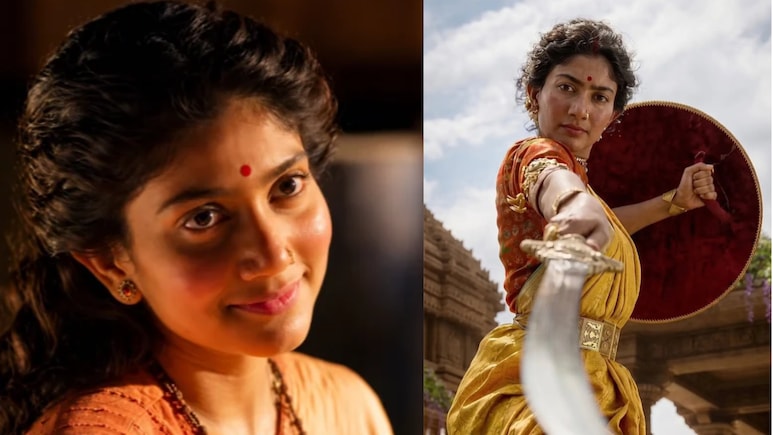
"Sita picked up the Lankan's quiver. It contained a few arrows. She quickly tied it around her back and shoulder. She lifted the bow. And ran, ran hard! Towards the temporary camp. She had to kill the other Lankan soldier before he reached his team and warned them."
Before the world saw Sai Pallavi as a warrior Sita in Nitesh Tiwari's Ramayana, Amish Tripathi had painted a picture of her with these words in the opening chapter of his book, Sita: Warrior of Mithila (2017) almost a decade ago.
It was Tripathi's second book in the Ram Chandra Series that released after Ram: Scion of Ikshvaku (2015).
The depiction of a warrior Sita was uncommon in pop culture until Nitesh Tiwari's Ramayana made it mainstream.
Mythologists have read about her; authors have reimagined her in fiction.
The idea of a warrior Sita has perhaps been analysed and dissected in literary circles by those with expertise in the epic Ramayana and its many interpretations.
But the Rs 4,000-crore Ramayana, which has been dominating the pop culture conversation for more than a year now, made 'warrior Sita' a topic of discussion on social media, a subject to make reels, a premise to exchange heated ideas about who Sita is, what she stands for.
From Valmiki's Ramayan to Tulsidas's Ramcharitamanas to Adbhut Ramayan (ascribed to Valmiki), to the fictions by Amish Tripathi and Chitra Banerjee Divakaruni, Sita has come a long way, just like her readers and viewers.
An emblem of courage, endurance, and resilience, Sita is more often celebrated for her inner spirit in various adaptations of Ramayan. But was she ever a warrior who fought on the battlefield? Physical or mental prowess, what does Sita really stand for?
There's, perhaps, no singular answer to these questions.
"Warrior Sita Is Not A Problem"
"As I send The Forest Of Enchantments out into the world, I ask for the benediction of Sita, goddess, daughter, sister, lover, warrior, mother - and a role model for women all over the world. I pray that the novel lodges deep in the hearts of readers regardless of their gender; for Sita's story has much in it to inspire and console us all." Indian-American author Chitra Banerjee Divakaruni called Sita a 'warrior' in the prologue of her fiction The Forest Of Enchantments (2019).
When Divakaruni called Sita a warrior, what did she actually mean?
"A warrior is a person who is courageous both physically and mentally. A warrior can stand up against wrong as Sita did. As a result, Ravan does not touch her. He respects her enormous mental strength. Her warrior strength allows Sita to bring up two babies (Luv and Kush) alone in the forest without her husband or family. She is strong physically also (as shown in Adbhuta Ramayan)" Divakaruni tells NDTV.
Divakaruni hasn't watched the Ranbir Kapoor-Sai Pallavi film yet. Her observation is based on the film's trailer, which has glimpses of Sai Pallavi wielding a sword.
Asked if the depiction of a warrior Sita robs the character of her dignity, Divakaruni firmly said "no".
But in her opinion, Sita's physical prowess and mental strength are not mutually exclusive.
"Since I have not seen the movie yet, I cannot comment on this particular depiction. But in order for this to work well, one needs to show her mental strength and values while she is fighting," Divakaruni tells us.
Citing sources from Valmiki Ramayan, Adbhuta Ramayan, Kamba Ramayana, and Bengali Krittibasi Ramayan, Divakaruni's perception of Sita was based on these ideas in her book: Sita is a human being with human failings, Sita's quiet courage can be mistaken for meekness.
Warrior Sita may irk a large section of the Internet and academia, but Divakaruni has no objection to this depiction.
"I don't agree that warrior Sita in herself is a problem at all," she adds.
"Worst Case Of Women Empowerment"
While a large section of the Internet embraced Sai Pallavi's warrior Sita, Indologist Nrisingha Prasad Bhaduri called this depiction "a worst case of women empowerment".
Bhaduri, who has authored books such as Balmikir Ram O Ramayan and Ramayani, said there's no depiction of a warrior Sita in Valmiki's Ramayan or Tulsidas's Ramcharitamanas.
On the other hand, he argued that according to Valmiki's version, Sita forbade Ram to keep weapons with him while they were in exile in the forest of Panchavati.
"There is no reference to a warrior Sita in Ramayan; neither in Valmiki's nor in Tulsidas's. In Valmiki's Ramayan, Sita even forbade Ram to fight. When they first left Ayodhya and faced the rakshasas in the forest, Sita asked Ram not to keep weapons with him. She argued that people tend to react strongly if they see a person with weapons. So, it was Sita's discretion or pragmatism that she dissuaded Ram from fighting," Bhaduri tells us.
The depiction of a warrior Sita is a "distortion of the epic" in Bhaduri's opinion.
"There are many interpretations of Ramayan. In an Indonesian adaptation, Sita is Ram's sister. But our reference point should be the core Ramayan by Valmiki," Bhaduri says when asked about the Adbhuta Ramayan, which mentions the warrior Sita.
What Adbhuta Ramayan Says About Sita?
From Amish Tripathi to Divakaruni to director Nitesh Tiwari, all three referred to the Adbhuta Ramayan as the source material for imagining Sita as a warrior.
Ascribed to Valmiki, and considerably less popular than both Valmiki's Ramayan and Tulsidas's Awadhi version, the Adbhuta Ramayan is composed in 27 sargas (chapters) of various metres and only briefly recounts the traditional narrative around Ram.
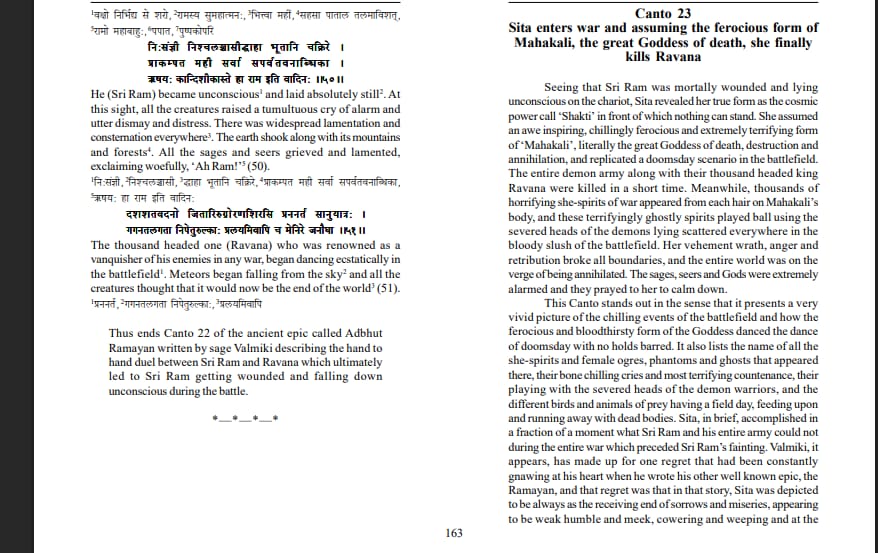
In this version of Adbhuta Ramayan, Sita is depicted assuming the ferocious and horrifying form of Mahakali and killing a 1,000-headed Ravan (Chapter 23, compiled and translated by Ajai Kumar Chhawchharia).
"In this Canto, Valmiki has wiped out that one single regret or burden that he had upon his heart, and it was to show that Sita was not meek and weak but extremely powerful, potent, valiant, effective and strong as she should have been, being the manifestation of the cosmic divine power called Shakti, that she indeed was," read the translation.
Alluding to the destructive image of Mahakali, Sita's portrayal in this version shows her as the goddess of death, creating havoc on the battlefield when Ram's army is failing.
"Seeing that Sri Ram was mortally wounded and lying unconscious on the chariot, Sita revealed her true form as the cosmic power called 'Shakti', in front of which nothing can stand. She assumed an awe-inspiring, chillingly ferocious and extremely terrifying form of 'Mahakali', literally the great Goddess of death, destruction and annihilation, and replicated a doomsday scenario in the battlefield. The entire demon army along with their thousand-headed king Ravana were killed in a short time. Meanwhile, thousands of horrifying she-spirits of war appeared from each hair on Mahakali's body, and these terrifyingly ghostly spirits played ball using the severed heads of the demons lying scattered everywhere in the bloody slush of the battlefield. Her vehement wrath, anger and retribution broke all boundaries, and the entire world was on the verge of being annihilated," read the depiction.
Presumably, this version inspired creative writers and directors to paint an unconventional picture of Sita in their respective work.
"Sita Embodies Grace Under Pressure"
While cultural experts differ over the depiction of warrior Sita, no one doubts her intelligence and strength under any circumstances.
"Sita embodies grace under pressure," says Divakaruni.
Reluctant to acknowledge Sita's warrior (physical) portrayal, Bhaduri says her mental strength alone makes her a strong woman.
The words "warrior" and "fighter" traditionally describe an image of warfare. However, they can't be comprehended fully without realising the intended connotations in specific contexts.
Sita was always a warrior in the truest sense of the term. She will always be one.
Also Read | Sai Pallavi As Ramayana's Sita: Why Is Internet Divided Over Her Casting?
