






- Urban women spend significantly more time than men on e-commerce and entertainment apps
- Women aged 18-24 show 47% higher engagement on commerce apps than men in the same group
- AI app usage among affluent urban Indians grew over 100% between April 2025 and March 2026
Women across urban India are now spending significantly more time than men on entertainment, messaging and e-commerce platforms, while AI apps are emerging as a new daily digital habit among affluent young users, according to the India's Digital Behaviour Report 2025-26 released by Internet And Mobile Association of India and consumer intelligence platform VTION.
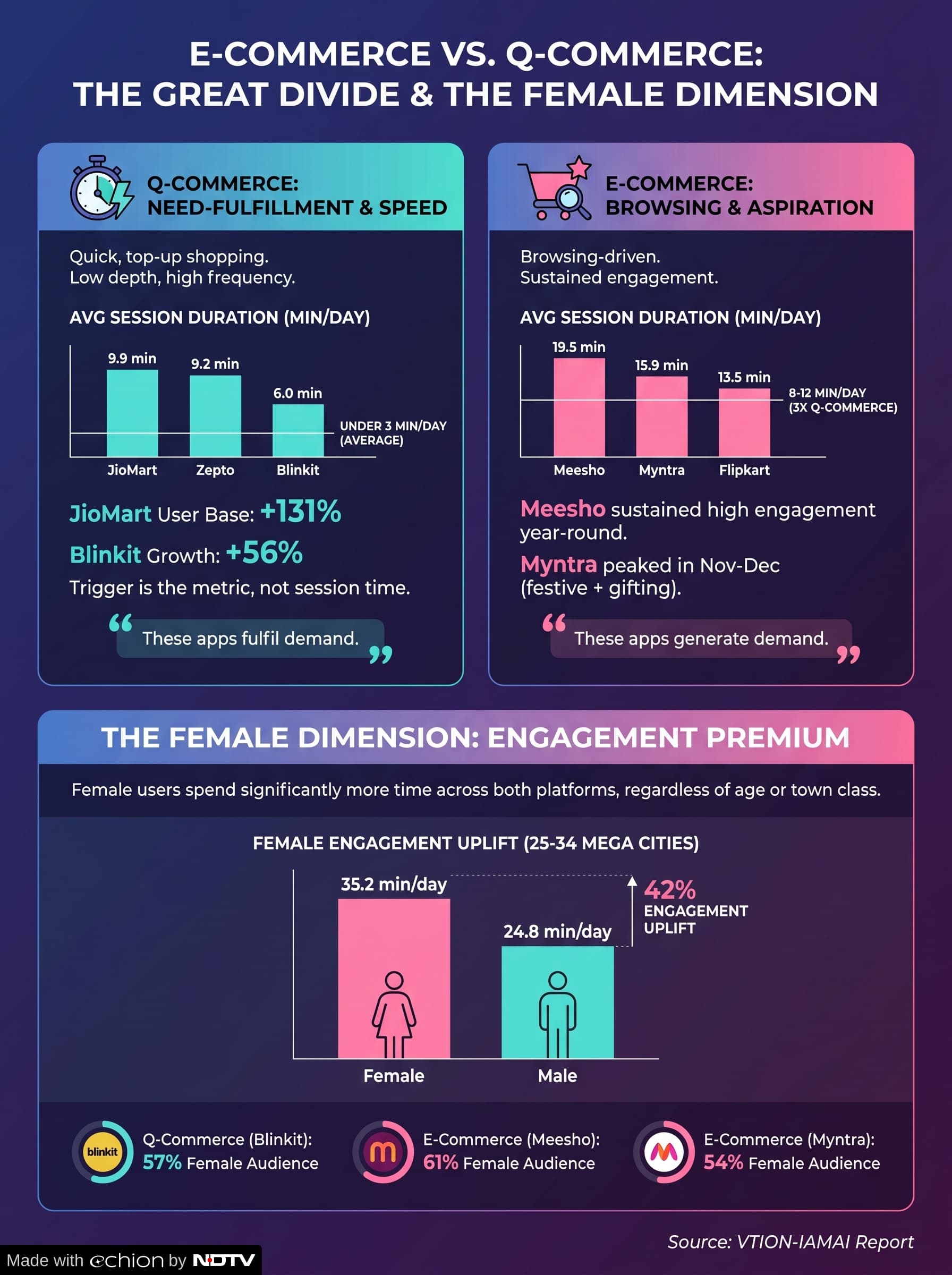
Urban women aged 25-34 in mega cities spend 35.2 minutes daily on e-commerce and quick commerce apps, compared to 24.8 minutes for men -- a 42 per cent higher engagement level.
The gap becomes even wider among younger users. Women in the 18-24 age bracket spend up to 47 per cent more time on commerce apps than men, making them one of the most valuable user groups in India's digital economy.
Entertainment platforms are seeing a similar trend. Urban women spend 82.4 minutes a day on entertainment apps on average, with the 25-34 female cohort touching 86.3 minutes daily.
'Women Driving Attention Economy'
The report describes women as the "silent majority of attention" across India's highest-engagement digital categories.
For fintech firms, this behavioural shift signals something larger than just higher screen time.
Gurjodhpal Singh, CEO of Tide India, said the findings reflect growing digital confidence among women users, especially entrepreneurs and professionals. "The report reflects a significant shift in India's digital landscape, with women increasingly driving engagement across platforms and digital services," Singh said.
"As more women adopt digital-first lifestyles, we are also witnessing stronger adoption of digital banking, payments, and business management tools. This presents a meaningful opportunity to deepen financial inclusion," he added.
The findings also suggest that women are becoming central to India's consumption economy online.
Rashneen Anand, a Mumbai-based professional quoted in the report, said digital platforms are now deeply embedded in how young women manage their lifestyle and purchasing decisions. "The strong engagement among women aged 18-24 signals a broader cultural shift," Anand said.
"Young women are no longer just consumers of digital content; they are trendsetters, key purchase influencers, and a powerful force driving India's digital economy."
Rise Of AI Apps
As per the report, which studied app usage behaviour across more than 100,000 consented smartphones representing over 407 million urban Indians, affluent urban consumers are increasingly relying on AI before making purchase decisions.
AI apps recorded more than 100 per cent growth between April 2025 and March 2026, with urban Indians spending an average 11.3 minutes per active day on AI tools. The strongest adoption is currently concentrated among users aged 18-34, higher-income households and North Indian cities.
The report argues that AI is beginning to fundamentally reshape online discovery behaviour. Consumers are increasingly turning to AI tools before opening search engines or shopping apps, especially for high-consideration purchases like financial products, travel planning and smartphones.
"Brands invisible in AI are invisible at first intent," the report noted. Divyata Kalhans, a communications professional based in Delhi, said the rise of AI reflects a more discovery-led consumer mindset among urban Indians. "Women today are not just participating in India's digital economy, they are increasingly defining it," Kalhans said. "At the same time, the rapid rise of AI adoption points to a sharper, more discovery-led consumer mindset, where users are turning to intelligent platforms to make faster and more informed decisions online."
Among AI platforms, ChatGPT continues to dominate with a 70.8 per cent category share, followed by Google Gemini and Perplexity. The report also highlights how sharply India's internet behaviour now differs across age groups.
Urban users aged 18-24 spend over 120 minutes daily on social media, far higher than the category average of 97.9 minutes. "The change in the nature of digital purchases is becoming much more experience-based as opposed to in the past when they used to be digital, one-off, and transactional. The future of digital commerce will not be about how much discount is offered or the traffic drawn to a given e-commerce platform, but rather how confident the consumers are about their purchase decisions based on the focus of their attention, and how they spend their time," said Raghunandan Saraf, Founder and CEO, Saraf Furniture.
GenZ On Social Media, Millennials On Entertainment Apps
The report also reveals how different demographics are shaping completely different digital ecosystems. It finds that Gen Z users spend two hours daily on social media. Meanwhile, users aged 35 and above dominate entertainment consumption, averaging nearly 78 minutes a day on streaming and entertainment platforms.
The study also draws a clear distinction between quick commerce and traditional e-commerce behaviour.
Apps like Blinkit and Zepto are built around speed and urgency, with users typically spending under 10 minutes a day. In contrast, shoppers on Meesho and Myntra spend 15-20 minutes browsing, signalling a more aspirational shopping journey.
Payments, however, appear to have become a universal habit.
UPI usage patterns are now almost identical across income groups, suggesting digital payments have moved beyond adoption into everyday infrastructure.
India processed 241.6 billion UPI transactions in FY26, up 30 per cent from the previous year, with UPI accounting for 84 per cent of all retail digital payment volumes in the country.
Track Latest News Live on NDTV.com and get news updates from India and around the world

