






Most people delay life insurance. Not because it is complex. But because it feels distant. You are healthy. You are earning. There are no dependents yet. So the decision moves to "later".
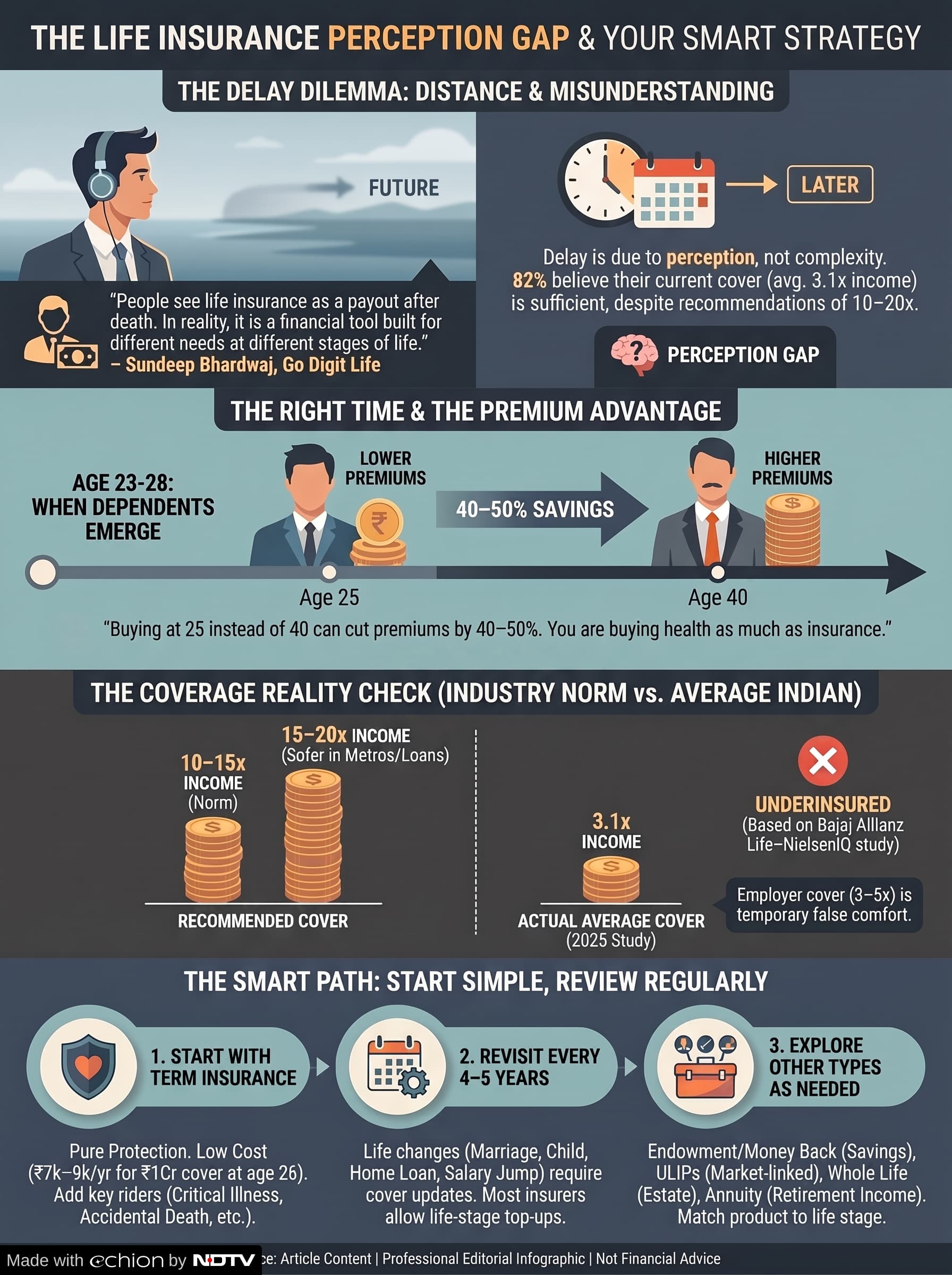
Sundeep Bhardwaj, Chief Business Officer Retail at Go Digit Life Insurance, says this delay comes from a basic misunderstanding. People see life insurance as a payout after death. In reality, it is a financial tool built for different needs at different stages of life. Follow Live Updates
Some plans offer pure protection. Others mix savings. Some link to markets. The real question is not whether to buy. It is which product fits your life stage.
Also Read | Layoffs Are Rising In Tech, But These Skills Are Helping People Unlock Better Pay
Start With The Simplest: Term Insurance
Term insurance is pure protection. You pay a small premium. Your family gets a large lump sum if you die during the policy term. No maturity benefit. No investment angle.
A healthy 26-year-old can get Rs 1 crore cover for roughly Rs 7,000-Rs 9,000 a year. This is why most experts say: start here.
Then understand the other types -- like the "endowment and money back plans". These combine insurance with savings. You get a maturity amount if you survive the term. Returns are typically 4-6 per cent, but guaranteed. Money back policies pay portions during the term for liquidity.
ULIPs (Market-linked): A part of your premium goes to life cover. The rest goes into market funds. Returns can be higher, but charges in early years can eat into gains.
Whole Life and Annuity Plans: Whole life plans cover you up to 99 or 100 and build cash value. Useful for estate planning. Annuity plans convert your money into steady retirement income.
Each serves a different purpose. Which is Bhardwaj's key point: life insurance must match your life, not a formula.
The Right Age To Buy
The correct time is simple. The moment someone depends on your income. For many Indians, that is between 23 and 28. Parents. Spouse. Siblings.
Pranav Koomar, Founder and CEO of PlusCash, points to studies showing that buying at 25 instead of 40 can cut premiums by 40-50 per cent.
You are buying health as much as insurance. The earlier you buy, the cheaper it stays.
How Much Cover Do You Need?
Rules of thumb work well here.
- 10-15 times annual income (industry norm)
- 15-20 times annual income (safer in metros, with loans)
- If you earn Rs 10 lakh, your cover should be Rs 1-1.5 crore at least. Often more if you have a home loan.
Yet, most Indians are severely underinsured.
Vibhore Goyal, Founder at OneBanc, cites a 2025 Bajaj Allianz Life-NielsenIQ study. The average Indian holds cover worth just 3.1 times annual income. While 82 per cent believe this is sufficient. This is not a knowledge gap. It is a perception gap. Employer group cover of 3-5 times salary adds to this false comfort. It disappears when you switch jobs.
How Much Income Should Go To Premiums?
Financial planners suggest 3-5 per cent of annual income towards life insurance premiums. For most young earners, a correctly sized term plan will fall well within this limit.
Spending Rs 12,000- Rs 18,000 a year on a term plan does not feel rewarding. There is no visible return. That is why people postpone it, as Goyal explains. A mutual fund SIP shows growth. Insurance shows nothing - unless something goes wrong. But that is the point.
Review And Top Up As Life Changes
Your life at 35 is very different from 27. Marriage. Child. Home loan. Salary jump.
Revisit your cover every 4-5 years. Most insurers allow life-stage top-ups without fresh medical tests. You can also buy an additional term plan later.
It is also important to note that a plain term plan covers death. But most financial shocks come from illness or disability.
Four riders deserve attention:
- Critical illness rider (Rs 5-30 lakh treatments are common)
- Accidental death benefit rider
- Waiver of premium rider (policy continues if you are disabled)
- Income benefit rider (monthly income instead of lump sum)
These cost little but change the usefulness of the policy.
Is Life Insurance An Investment?
This is the wrong question. Insurance is a tool.
- For a 27-year-old supporting parents, term insurance is protection.
- For a parent planning children's education, an endowment plan offers certainty.
- For someone self-employed, money-back plans offer liquidity.
- For market participants, ULIPs offer dual exposure.
But for a first-time buyer, the clean approach remains: Buy a correctly sized term plan. Add key riders. Invest the rest elsewhere.
Track Latest News Live on NDTV.com and get news updates from India and around the world

