






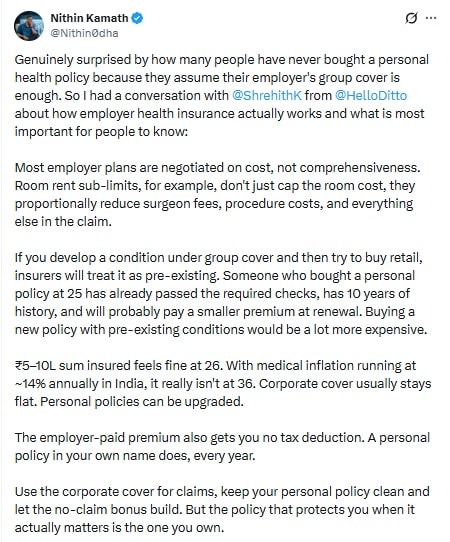
Recently Zerodha's co-founder Nithin Kamath cautioned that corporate health insurance may not be enough. And his post struck a chord with thousands of salaried employees. For many, the group health policy provided by an employer is the only medical cover they have. The assumption is simple: I'm insured because my company has got me covered.
However, insurance and healthcare professionals say that this assumption often breaks down at the worst possible time: during a serious illness, a job change, or after retirement.
How Corporate Health Insurance In India Is Typically Structured
Most medium and large employers offer a group mediclaim policy negotiated with an insurer. While specifics vary, the design is usually similar:
| Feature | What usually happens in corporate cover |
| Sum insured | Rs 2-5 lakh per family is common; sometimes higher for senior roles |
| Pre-existing diseases | Covered from Day 1 (big advantage) |
| Family cover | Spouse, children; parents sometimes optional/top-up |
| Room rent limits | Capped (e.g. 1% of sum insured per day) |
| Co-pay | Employee pays a portion in some cases |
| Exclusions | Certain procedures, consumables, or treatments excluded |
| OPD / dental / vision | Rare, unless company opts for add-ons |
| Continuity | Ends when you leave the job (unless ported quickly) |
| Customisation | Designed for group cost efficiency, not individual risk |
This works well for routine hospitalisations. The trouble begins when treatment costs exceed caps, exclusions kick in, or employment status changes.
'A group benefit, not a financial safety net'
Siddharth Maurya, Managing Director, Vibhavangal Anukulkara, says the concerns raised reflect a reality the industry now accepts.
"While corporate health insurance can be a good starting point, its scope, benefits, and continuity are limited. From a market perspective, corporate health insurance can be viewed more as a group benefit rather than a financial safety net for individuals or families."
He points to situations where employees realise the gaps only in emergencies. "These policies may not be sufficient in critical medical conditions or during job changes at the worst possible time. Further, conditions like room rent limits, co-pay, or exclusions reduce the claim amount, making the insured understand the futility only in emergency situations."
'It's Not Corporate Versus Personal, It's Both'
Sanchit Malik, Founder & CEO, Pazcare, offers a counter-balance. Corporate cover, he says, remains one of India's strongest healthcare safety nets.
"Corporate health insurance is far from ineffective. It has been one of the most important healthcare safety nets in India, especially because it covers pre-existing diseases from day one. For many families, particularly senior citizens, it is often the only accessible form of health insurance."
But relying on it alone is risky. "The real answer is not corporate versus personal insurance. It is having both. Corporate cover ensures immediate access to care, while a personal policy builds long-term continuity, higher coverage, and financial security."
What Insurance Can't Solve
Dr. Noel Coutinho, Chief Business Officer and Co-Founder, ekincare, shifts the lens from insurance to health itself. "About 41 per cent of employees have at least one underlying health issue. Around 61 per cent of employees aged 45 and above are at risk. And even young professionals between 26 and 30 are crossing 22 per cent."
He argues the design itself is reactive. "Corporate health insurance was built to reimburse illness, not prevent it. It activates only after damage is done, after the diagnosis, after the hospitalisation, after the claim."
The real question for companies, he says, is different. "The real question for every CHRO and CEO today is not 'Are our employees covered through insurance?' It is 'Are our employees healthy?'"
'Where Policy Design, Underwriting Fall Short'
Tejas Jain, Founder and CEO of BimaKavach, says many policies are optimised for cost, not relevance. "There is a growing gap between how corporate health insurance is designed and what employees actually need. Most policies today are built with a strong focus on cost efficiency, which means they don't always reflect real-world health risks."
He flags underwriting as the core issue. "When underwriting does not account for these differences, the gaps only become visible at the time of a claim. That is when companies realise that what looked sufficient on paper does not hold up in practice."
What Hospitals See When Claims Arrive
Dr. Bharat Mody, Founder, Welcare Hospital, sees the problem from the treatment end. "From a hospital perspective, we frequently see gaps-be it coverage limits, exclusions, or delays in approvals-that can impact timely and comprehensive care."
He urges individuals to treat employer cover as a base layer. "It is important for individuals to view employer-provided insurance as a foundation, and supplement it with personal health cover and preventive care planning."
Vibhore Goyal, founder at Onebanc, said, "Employees do not think about health insurance until they actually need it, and that is exactly when the gaps show... The middle ground is simple. Keep the base corporate cover strong and relevant, and give employees the option to take small top-ups, around Rs 3 lakh, at a few hundred rupees a month."
What This Means For Employees
| Situation | What corporate cover may not handle well |
| Major surgery in a metro hospital | Room rent cap reduces full claim eligibility |
| Critical illness | Sum insured exhausted quickly |
| Job switch during illness | Cover disruption risk |
| Retirement | No cover continuity |
| Ageing parents | Often under-covered or optional |
| Lifestyle diseases | Covered only after hospitalisation, not detected early |
Track Latest News Live on NDTV.com and get news updates from India and around the world

