Bangladesh Election Result 2026 Highlights: Steered by a leader back to the country after a 17-year exile, Tarique Rahman-led Bangladesh Nationalist Party (BNP) raced towards a decisive win in the crucial national election held on Thursday. The party called for nationwide prayers, instead of joyous processions, as it returns to power 20 years since Khaleda Zia's tenure ended in 2006.
While the Jamaat-e-Islami conceded defeat, its ally National Citizen Party alleged tampering of Bangladesh election results and an audit before the final declaration.
Among those who congratulated Tarique Rahman were Prime Minister Modi, Pakistan Asif Ali Zardari and Shahbas Sharif, and the US Ambassador to Bangladesh.
This is the first election since the July 2024 uprising that ended former Prime Minister Sheikh Hasina's 15 years of iron-fisted rule. The Bangladesh election on Thursday involved more than 127 million eligible voters in the nation of around 170 million people, with 1,981 candidates contesting across 299 parliamentary seats nationwide, according to the Election Commission of Bangladesh (ECB). Voting was cancelled in one constituency due to the death of a candidate.
The country's political landscape has for decades revolved around two rival dynasties. On one side is the Awami League, headed by Hasina, and on the other is the Bangladesh Nationalist Party, now led by Tarique Rahman, son of former Prime Minister Khaleda Zia, who died in December. Challenging the BNP is a broad 11-party coalition spearheaded by the Islamist Jamaat-e-Islami, which is now emerging as the main opposition in the country.
Follow Highlights On Bangladesh Election Result 2026 Here:
Bangladesh's 'Bloodied' Elections: The Widespread Killings During 2014 Polls
Bangladesh Election 2026: The 2014 Bangladesh general election remains one of the most turbulent chapters in the nation's political history.
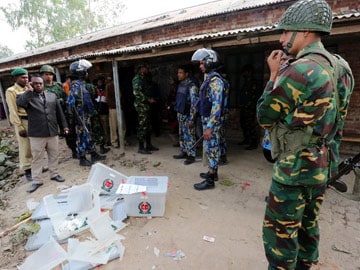
Bangladesh elections 2026: "Are They Alive?": Bangladesh Families' Wait For Missing Members Continues
With Sheikh Hasina's exit, families of the disappeared feel there may finally be a chance to speak openly and demand justice.
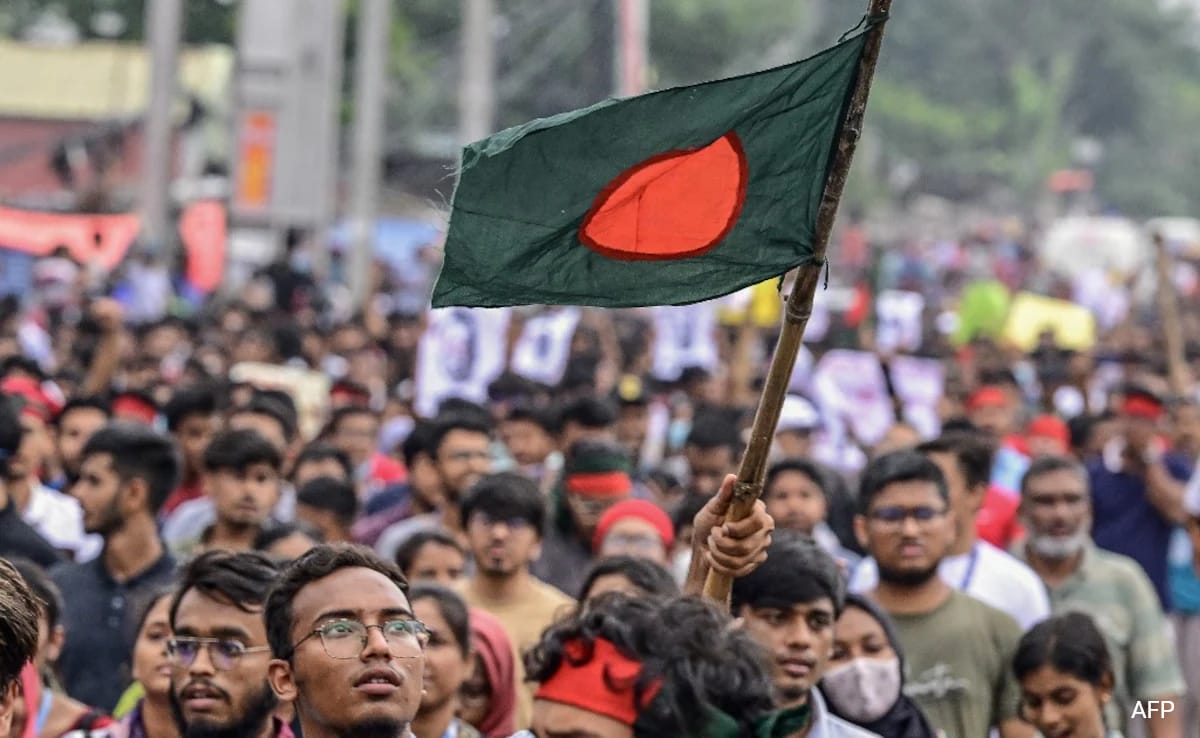
Bangladesh Election 2026: Bangladesh's 'Red Maulana': The Life And Legacy Of Abdul Hamid Khan Bhashani
Abdul Hamid Khan Bhashani began his political journey in the 1920s when he got involved in the Khilafat and non-cooperation movements in Bengal.
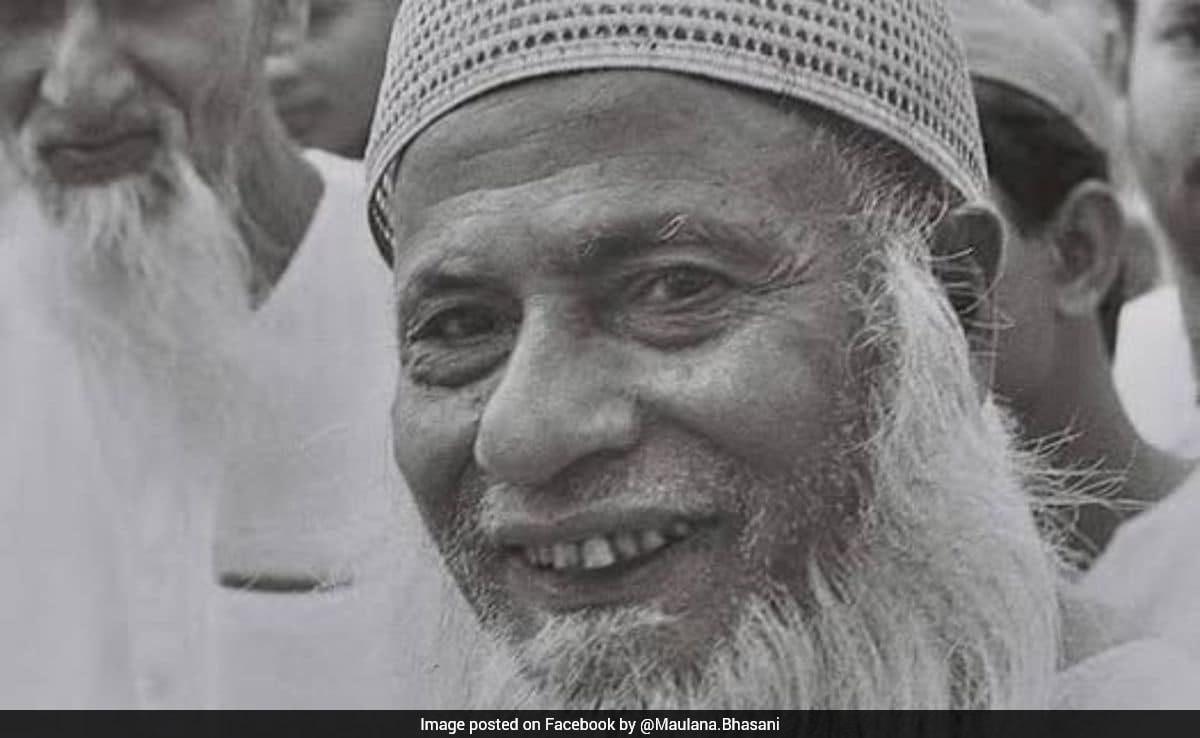
Bangladesh Election 2026 Tajuddin Ahmad Was Bangladesh's First PM. How He Was Killed Inside A Prison
Tajuddin Ahmad, the first Prime Minister of Bangladesh and one of the country's most important leaders during the Liberation War, was brutally killed inside Dhaka Central Jail on November 3, 1975.
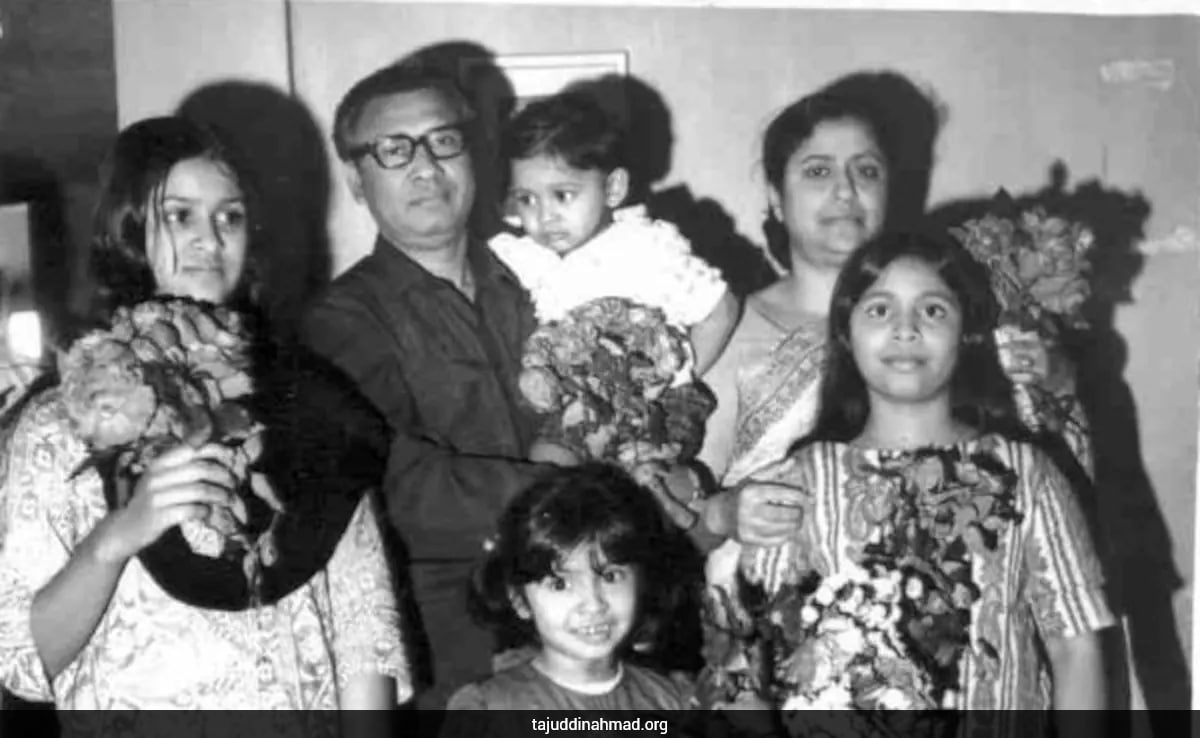
Bangladesh Election 2026: Bangladesh 1975: Sheikh Mujibur Rahman's Assassination And How Sheikh Hasina Survived
Bangladesh is heading into its first parliamentary election since the ouster of former Prime Minister Sheikh Hasina in August 2024.
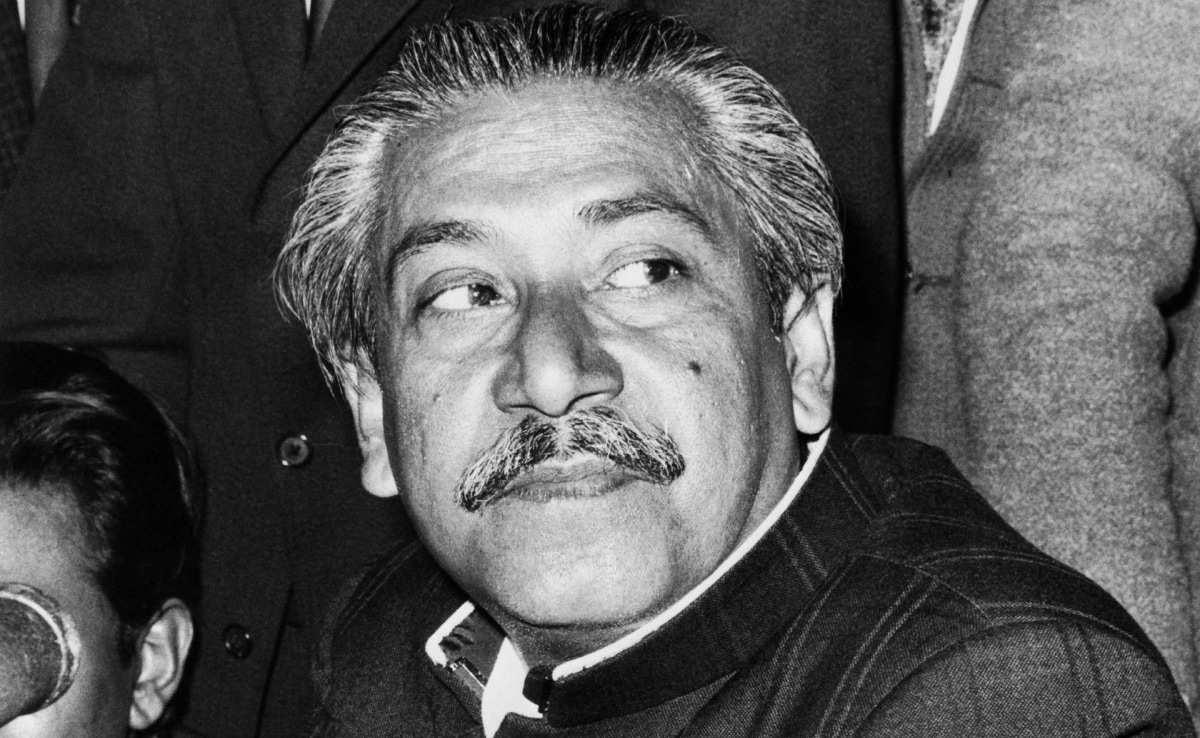
Bangladesh Election 2026 | The End Of Sheikh Hasina's Reign: July 2024 Bangladesh Uprising Revisited
Students in Bangladesh started protesting in early July 2024 and demanded reform in the job quota system that reserved more than half of government jobs.
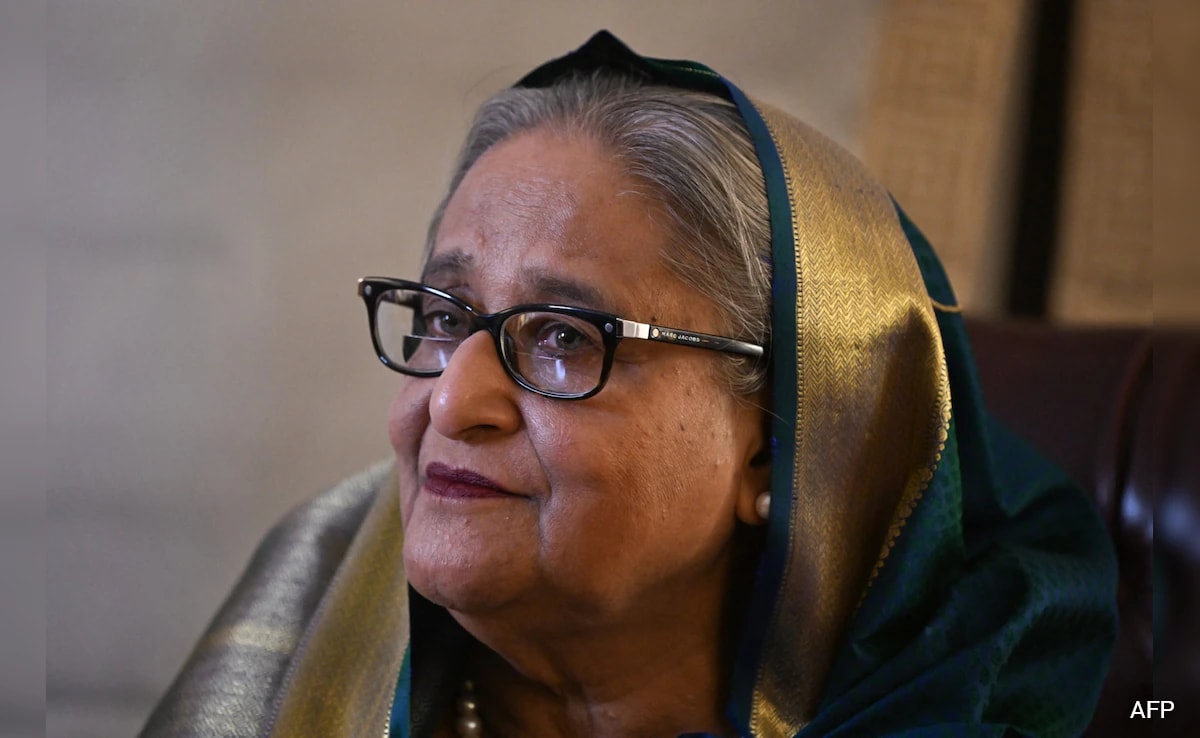
Bangladesh Election 2026: How Bangladesh Elections Could Redefine Regional, Global Ties
The Awami League has been the face of Bangladesh's pro-India politics for decades. Under former Prime Minister Sheikh Hasina, the party built strong ties with New Delhi, focusing on trade, transport, border security, and water-sharing agreements.
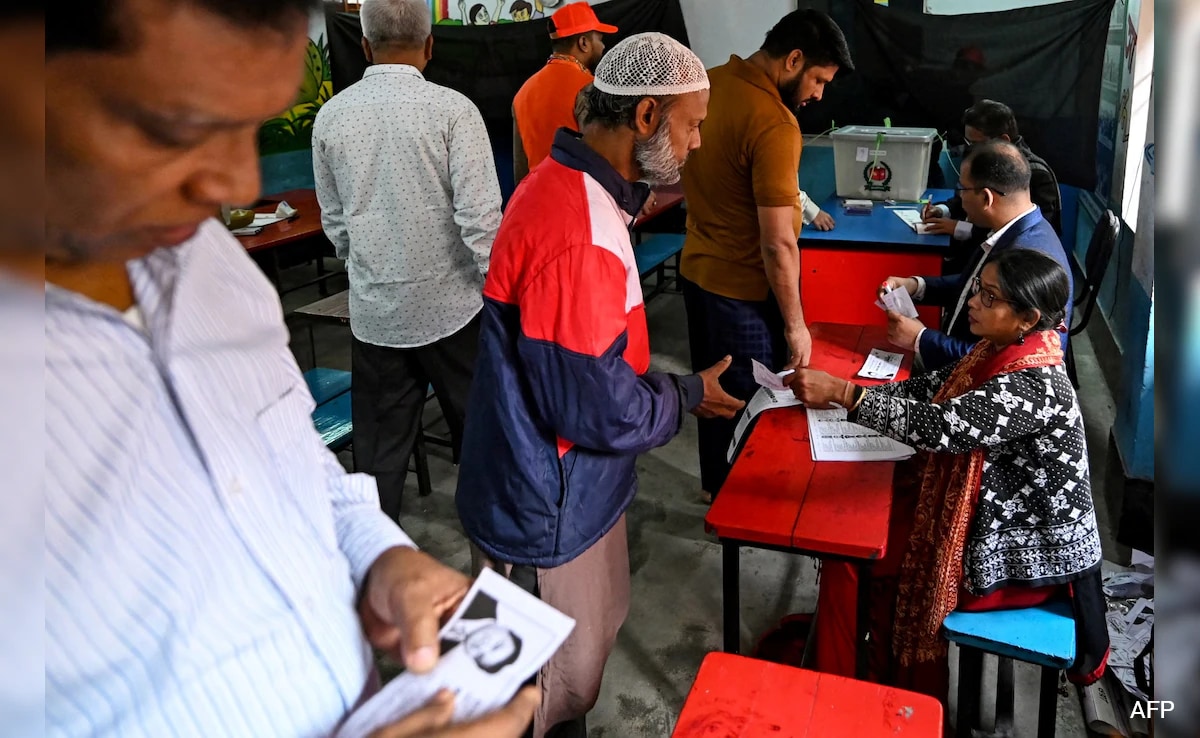
Election 2026 Results: Voters Praise Violence-Free Election As BNP Heads For Government Formation
Bangladesh witnessed what many described as one of its most peaceful and participative elections in recent years, as the Bangladesh Nationalist Party (BNP)-led alliance secured a decisive mandate in the 13th parliamentary polls, paving the way for Tarique Rahman to form the next government.
Speaking to IANS in Dhaka, local residents expressed satisfaction over the smooth conduct of polling. "It was a good election. The public participated well, and there was no violence, Alhamdulillah. We were expecting a lot of violence here, but thankfully it concluded peacefully without any violence. The election has been fair and free," said a resident.
Another voter, Misba Rehman, said the polls marked a significant moment for ordinary citizens. "This was a good election. As an ordinary citizen, I saw it as free and fair, with very little violence. Everyone was happy to cast their vote, especially young voters. They were enthusiastic about casting their vote, and there was no manipulation," he said.
(IANS)

Bangladesh Elections 2026: Tarique Rahman, BNP: What Went Wrong For Hardline Jamaat-E-Islami In Bangladesh Elections
In the weeks leading up to Bangladesh's general election on February 12, few parties projected confidence as assertively as the Bangladesh Jamaat-e-Islami.
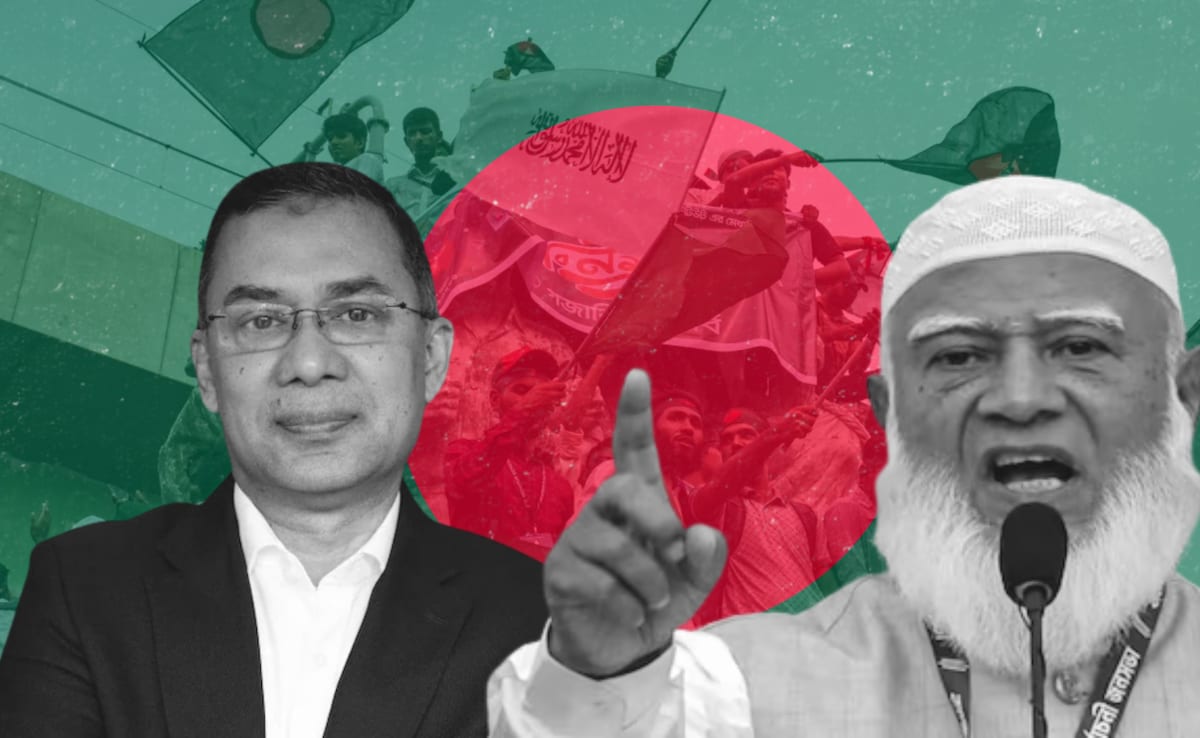
Bangladesh election results 2026: BNP Sweep, Jamaat-e-islami Snub, No Awami League: Key Takeways
Tarique Rahman won from both the seats he contested in Dhaka-17 and Bogura-6, per provisional results.
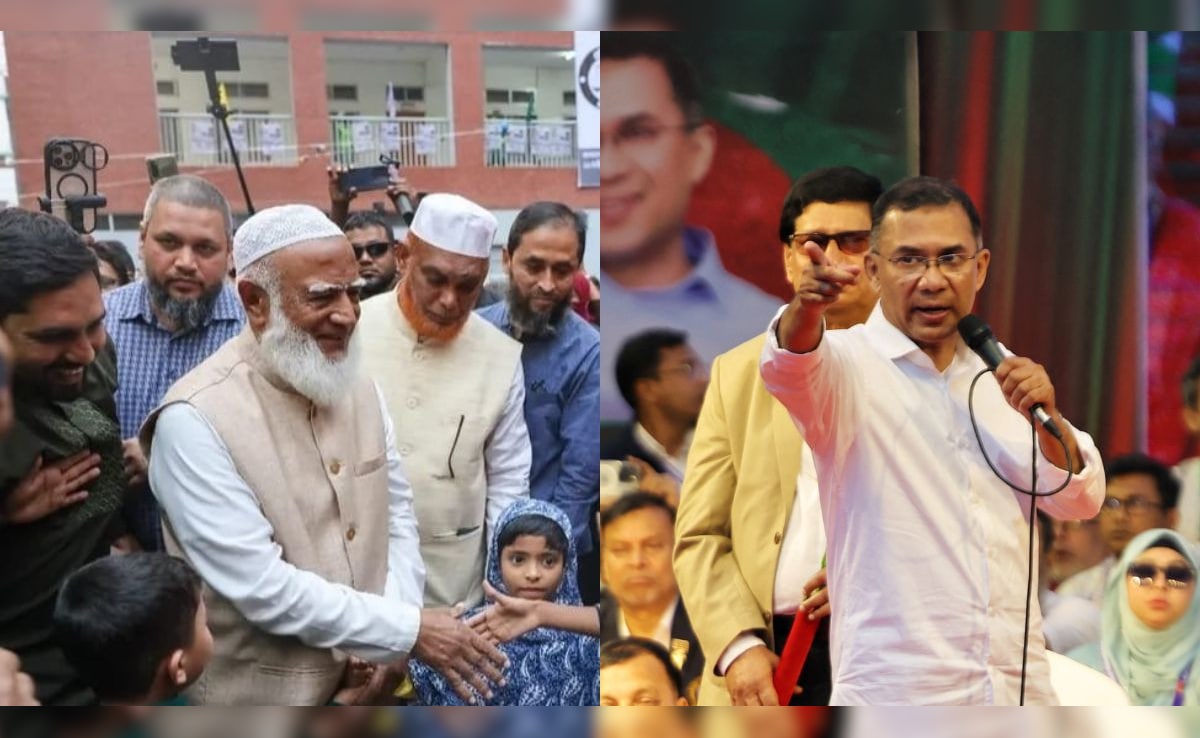
Election 2026 Results: Bangladesh Polls Seen As Test To Restore Democracy
The election was the first since a bloody student-led revolt in July 2024 led to Hasina's ouster. Many viewed it as a crucial test of Bangladesh's ability to restore trust in democracy and transform public protests into tangible political reform.
The vote was held alongside a referendum for political reforms that include prime ministerial term limits and stronger checks on executive power. The result of that referendum is yet to be announced, but it is likely to be endorsed by voters.
(AP)
Election 2026 Results: Bangladesh Nationalists Claim Big Election Win, Islamists Cry Foul
The Bangladesh Nationalist Party (BNP) claimed a thumping win on Friday in the first elections held since a deadly 2024 uprising, with leader Tarique Rahman poised to become prime minister.
But final official results are yet to come, and BNP's main rival, Jamaat-e-Islami—the largest Islamist party leading a wider coalition—said it had "serious questions about the integrity of the results process."
Rahman told AFP two days before polling he was "confident" that his party—crushed during the 15-year autocratic rule of ousted prime minister Sheikh Hasina—would regain power in the South Asian nation of 170 million people.
(AFP)
Election 2026 Results: PM Modi Speaks With Tarique Rahman Who Led BNP's Overwhelming Win
Delighted to speak with Mr. Tarique Rahman. I congratulated him on the remarkable victory in the Bangladesh elections.
— Narendra Modi (@narendramodi) February 13, 2026
I conveyed my best wishes and support in his endeavour to fulfil the aspirations of the people of Bangladesh.
As two close neighbours with deep-rooted…
Election 2026 Results: BNP Registers Landslide Win, Bags 212 Seats
The Bangladesh Nationalist Party (BNP) won a majority of more than two-thirds of the seats in parliamentary polls, the Election Commission said.
Election Commission figures said the BNP alliance had won 212 seats, compared with 77 for the Islamist-led Jamaat-e-Islami alliance, Commission senior secretary Akhtar Ahmed told reporters.
Turnout was 59 percent. A referendum on a sweeping democratic charter was endorsed by 60 percent of voters.
Election 2026 Results: BNP's Hindu Leader Wins From Dhaka Constituency
Gayeshwar Chandra Roy, a senior BNP leader from the minority Hindu community, won a Dhaka constituency.
Roy won the Dhaka-3 seat with 99,163 votes, defeating his nearest rival, Jamaat-e-Islami candidate Md Shahinur Islam, the state-run BSS news agency reported.
The former state minister's win from the Dhaka seat comes in the backdrop of alleged harassment of the minority Hindu community members in the country. The community has faced a series of attacks, some fatal, after the killing of radical youth leader Sharif Osman Hadi in December.
Election 2026 Results: Referendum Gets A Nod
With over 48 million 'yes' votes, the referendum that was voted for on Thursday was approved.
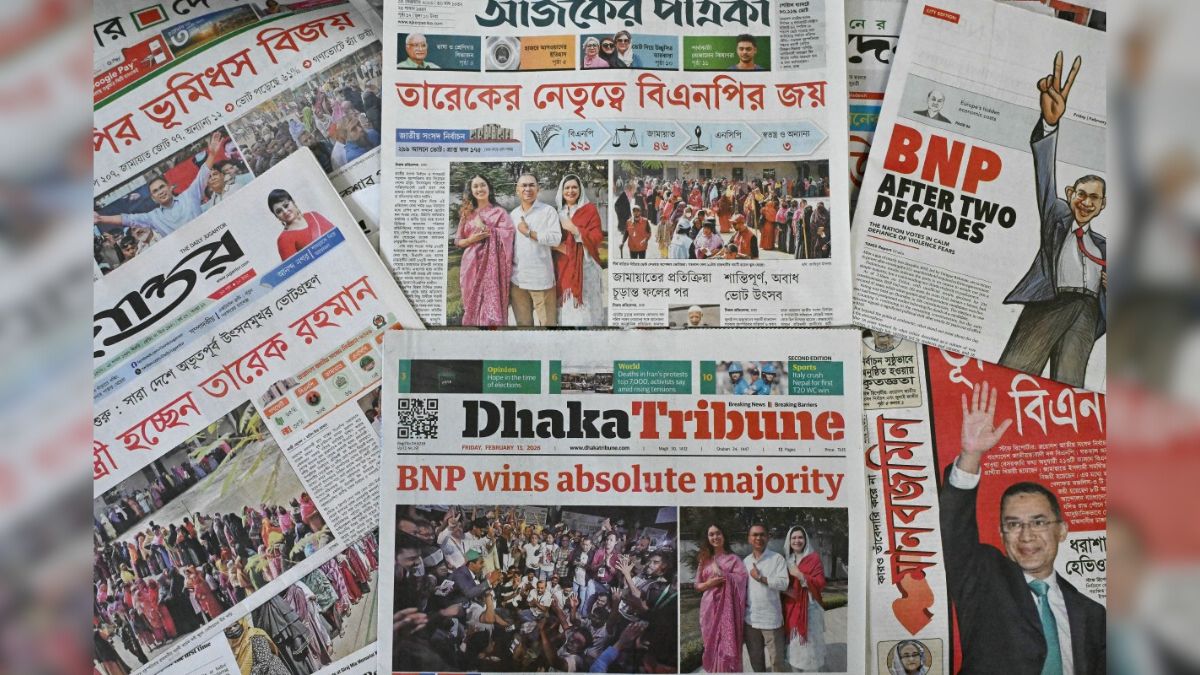
Election 2026 Results: How Bangladesh Newspapers Looked On Friday Morning
Tarique Rahman's 1st Speech In Bangladesh Was Ode To Martin Luther King's "I Have A Dream"
60-year-old leader Tarique Rahman, poised to be Bangladesh's prime minister, returned to the country after 17 years of exile in December last year. His first speech in Dhaka was delivered before a huge crowd and drew a reference from MArtin Luther King's famous "I have a dream" address.
"American civil rights activist Martin Luther King, in a public speech, said, 'I have a dream.' Like him, I want to say, I have a plan for Bangladesh," he had said.
Bangladesh Election Results LIVE: As BNP Registers Win, Its Key Priorities
The Bangladesh National Party in its election manifesto, with the motto 'Bangladesh before all', makes these key promises:
* To implement all points of the July Charter that seeks to create new constitutional bodies, introduce a bicameral parliament, along with broader changes in line with political parties' commitments
* To undertake initiatives to restart closed industries and diversify the export sector
* To undertake measures so that legally operating foreign businesses can repatriate their stipulated profits to home countries within 30 days
* To create nearly 1 million new jobs in the information and communication technology sector
* To ensure fair, price-index-based wages in line with inflation and a review system to be launched every two years
* To develop technical and language skills among the youth and ensure merit-based government recruitment
* To introduce international payment systems, establish regional e-commerce hubs and boost 'Make in Bangladesh'
* To launch a 'Family Card' for low-income families with monthly provisions to buy essential commodities
* To increase public spending on health to 5 per cent of GDP gradually
* To recruit 1,00,000 health workers across the country and expand preventive healthcare programmes
* To launch a mid-day meal program for students and a new, skills and values-based education policy for schools
* To build better sports infrastructure and training facilities
* To set up training-based welfare programs for religious leaders of all faiths at places of worship
Election 2026 Results: No Awami League In Poll A First In 3 Decades
The Awami League's "boat" symbol was not present on ballots for the first time in three decades. After the 2024 protests, the interim government led by Muhammad Yunus banned all activities of the Awami League and the poll body then suspended its registration. Hasina, who fled to Delhi after her ouster, called the elections "illegal".

Bangladesh Election 2026: Seven Women Candidates Win So Far
Seven women candidates have won their constituencies so far, Prothom Alo reported.
These include BNP candidates Afroza Khanam Rita in Manikganj-3, Tahsina Rushdir Luna in Sylhet-2, Farzana Sharmin in Natore-1, Shama Obaid Islam in Faridpur-2, and Nayab Yusuf Ahmed in Faridpur-3.
BNP alliance candidate Israt Sultana Elen Bhutto won in Jhalakati-2, while independent candidate Rumeen Farhana won in Brahmanbaria-2.
Bangladesh Election Results LIVE: Two BNP Candidates Win, But Await Court Hearing
Two BNP candidates - Sarwar Alamgir from Chittagong-2 and Aslam Chowdhury from Chittagong-4 - who have won unofficially will not be announced as winners till their appeal in a loan case in court is resolved, per BBC Bangla.
Bangladesh Election Results LIVE: Mamata Banerjee Congratulates Tarique Rahman
West Bengal Chief Minister Mamata Banerjee on Friday congratulated BNP leader Tarique Rahman on leading the party to a victory in Bangladesh's parliamentary elections.
My hearty congratulations, shubhonandan, to all my brothers and sisters, all the people, in Bangladesh. My advance Ramazan mubarak to all of them.
— Mamata Banerjee (@MamataOfficial) February 13, 2026
For this great victory, my congratulations to my Tarique-Bhai, his party, and all the parties. Pray, you all be well and happy.…
Live Election Results 2026: Tarique Rahman's Cat Congratulates 'Hooman'
Pak President Says Looking Forward To Trade, Defence Cooperation With Bangladesh
Pakistan's President Asif Ali Zardari in a statement congratulated the people of Bangladesh on the successful conduct of the polls across 299 seats with the participation of over 127 million registered voters, reported Radio Pakistan.
Reaffirming Islamabad's support for the sovereignty and democratic aspirations of Bangladesh, he said Pakistan "looks forward to working with the new government to strengthen cooperation in trade, defence, cultural exchanges and regional forums".
He expressed the hope that the new political environment in Dhaka would contribute to more balanced, independent and mutually respectful engagement across the region, offering his best wishes for the continued stability, progress and prosperity of Bangladesh.
🇵🇰🇧🇩 President Asif Ali Zardari felicitates Tarique Rahman on BNP’s landslide victory and congratulates the people of Bangladesh on their successful, peaceful polls. Pakistan reaffirms strong support for democratic partnership and shared progress ahead. @trahmanbnp @bdbnp78
— The President of Pakistan (@PresOfPakistan) February 13, 2026
What Went Wrong For Hardline Jamaat-E-Islami In Bangladesh Elections
In the weeks leading up to Bangladesh's general election on February 12, few parties projected confidence as assertively as the Bangladesh Jamaat-e-Islami.
Before the polls, political observers in Dhaka spoke openly of what could be its strongest electoral performance since independence. The party itself signalled that it was prepared not merely to participate, but to compete for central power.
Yet as the Tarique Rahman-led BNP declared victory and foreign governments issued congratulatory messages, Jamaat struck a markedly different tone.
Bangladesh General Elections Live: Tally As Of 11.30 am
The BNP and its allies have secured victories in 197 seats, while the Jamaat-e-Islami and its allies have won in 66 constituences, according to The Daily Star.
Counting of votes has been completed in 270 constituencies, while it is underway in 29 seats.
Election 2026 Results: Mallikarjun Kharge Congratulates BNP
Congress congratulates BNP for winning parliamentary elections in Bangladesh
The Congress congratulated the BNP for winning the parliamentary elections in Bangladesh, with party chief Mallikarjun Kharge saying a democratic, progressive and inclusive Bangladesh would always be supported by all Indians for the stability and peace of the region.
India and Bangladesh share deep rooted bonds of history, language, culture, and multitude of other commonalities, the Congress chief said.
On behalf of the Indian National Congress, I congratulate Mr. Tarique Rahman and the BNP for winning the Parliamentary elections in Bangladesh.
— Mallikarjun Kharge (@kharge) February 13, 2026
India and Bangladesh share deep rooted bonds of history, language, culture, and multitude of other commonalities.
A democratic,…
What Tarique Rahman's Win Means For India
The Bangladesh general election - the first since violence in July 2024 ended then-Prime Minister Sheikh Hasina's long tenure and forced her to flee - is set to deliver a big win for the Tarique Rahman-led BNP and script a fairytale ending for the man whose critics call him the 'dark prince'.
Rahman's return to power is a drama-packed story - political 'royalty' by any standard, the 60-year-old is the son of ex-President Ziaur Rahman and ex-Prime Minister Khaleda Zia. He left home in 2017 under a dark cloud after being arrested on corruption and money-laundering charges.
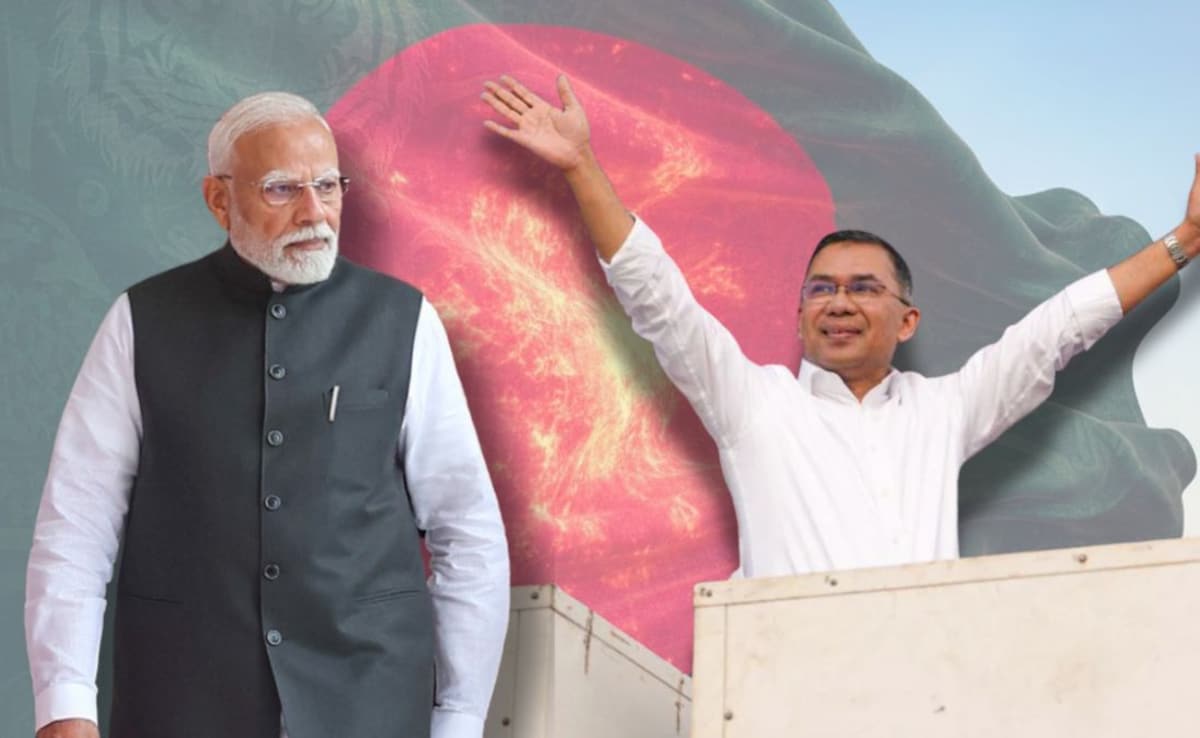
Election 2026 Results: BNP Responds To PM Modi's Message
BNP's polls coordination committee chief Nazrul Islam Khan thanked Prime Minister Narendra Modi on his congratulatory message for the party and its chief Tarique Rahman.
"We believe under the leadership of Tarique Rahman, relations between India and Bangladesh will strengthen," he said.
VIDEO | Bangladesh Elections 2026: Nazrul Islam Khan, BNP's polls coordination committee chief on PM Modi's congratulatory message BNP chief Tarique Rahman, says , "We also on behalf of our party thank him and we believe that under the leadership of our leader Tarique Rahman,… pic.twitter.com/ePNTIFLlxa
— Press Trust of India (@PTI_News) February 13, 2026
Video: Never Seen Such A Fair Election, Says Winning BNP Candidate
Dhaka, Bangladesh: Sheikh Rabiul Alam, winning candidate of the BNP, says, "I have never seen such a fair election in Bangladesh before. I have witnessed elections five to six times earlier, but I have never seen anything like this. This is a credible election. All parties… pic.twitter.com/EBqIrdc6yo
— IANS (@ians_india) February 13, 2026
Bangladesh Election Result 2026 LIVE: Tally As Of 10.20 am
The BNP and its allies have secured victories in 181 seats, while the Jamaat-e-Islami and its allies have won in 61 constituences, according to The Daily Star.
Counting of votes has been completed in 249 constituencies, while it is underway in 50 seats.
Bangladesh Election Result LIVE: Pakistan PM Congratulates BNP's Tarique Rahman
Pakistan's Prime Minister Shehbaz Sharif congratulated the leader of the Bangladesh Nationalist Party, Tarique Rahman, for his election win.
"I also congratulate the people of Bangladesh on the successful conduct of elections," the premier wrote on X, adding that he looked forward to working closely with the new leadership.
I extend my warmest felicitations to Mr. Tarique Rahman on leading the BNP to a resounding victory in the Parliamentary elections in Bangladesh. I also congratulate the people of Bangladesh on the successful conduct of the elections.
— Shehbaz Sharif (@CMShehbaz) February 13, 2026
I look forward to working closely with the…
17 Years' Exile, 2 Decades Since BNP Rule, Male PM After 35 Years
As the Bangladesh Nationalist Party (BNP) races towards a landslide win, the country is set to get a male prime minister after 35 years.
Rahman's mother Khaleda Zia and ousted prime minister Sheikh Hasina have held the office in eight separate terms.
Rahman returned to Bangladesh earlier this year after a 17-year exile in London. His victory brings the BNP back in the main seat 20 years after Khaleda Zia's 2001-2006 prime ministerial term.
Bangladesh Election Result 2026 LIVE: Jamaat Concedes Defeat, Ally NCP Alleges Tampering
Jamaat-e-Islami conceded defeat and vowed that his party would not engage in the "politics of opposition" just for the sake of doing so. "We will do positive politics," Shafiqur Rahman told reporters.
However, the National Citizen Party (NCP), led by activists who played a key role in toppling former prime minister Sheikh Hasina's government in 2024 and is a part of the Jamaat-led alliance, claimed tampering of results.
The NCP, which won just five of the 30 seats it contested, said at a press conference that it had clear evidence of tampering of results to target the 11-party alliance. Party spokesperson Asif Mahmud Shojib Bhuyain urged the poll body to audit the disputed constituencies before official results are declared.
Will Bangladesh Emerge As South Asia's New Power Player?
Bangladesh's election marks a welcome break from the past. The embrace of democracy is a hopeful sign, but the result also shows how deeply entrenched dynastic politics are in the nation of more than 170 million.
For India and China, two powers that have long competed for economic and security influence in the region, the outcome will bring profound changes.
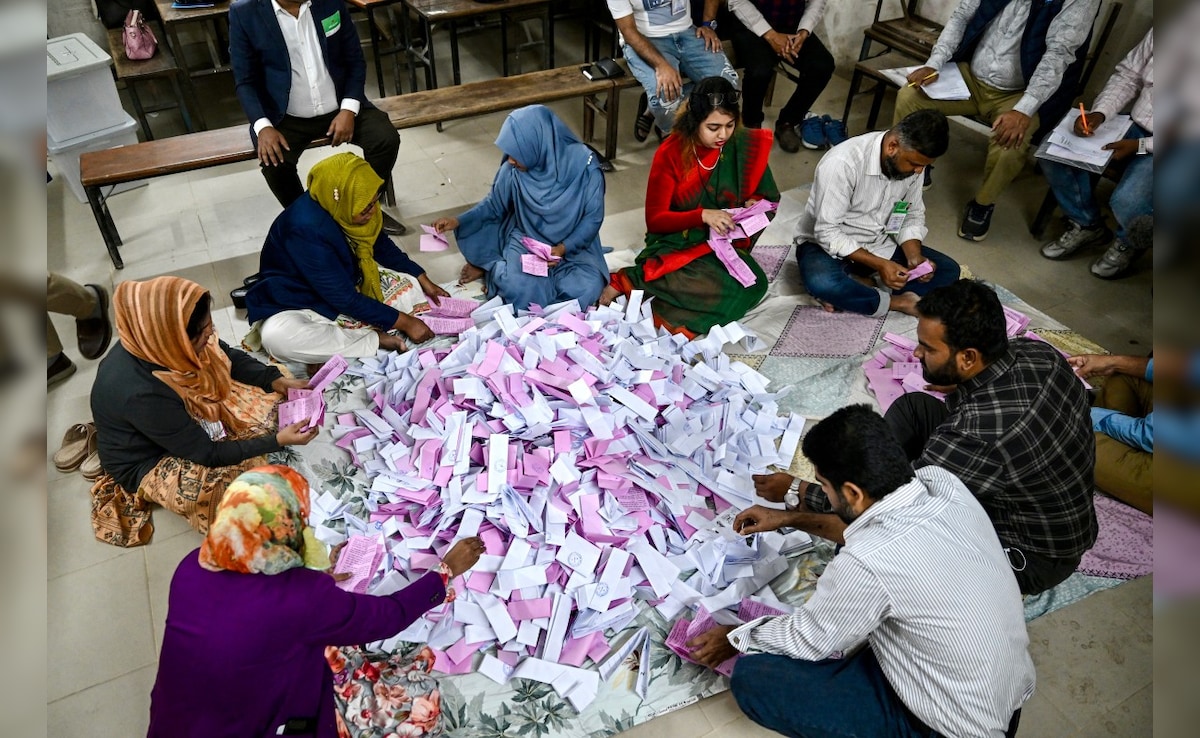
Bangladesh Election LIVE: Arrests, Clashes, Blasts On Voting Day
At least 72 people were injured in 14 separate incidents during voting across Bangladesh, The Daily Star reported. 31 people were injured when supporters of the BNP and the National Citizen Party clashed in Noakhali's Hatiya.
In Gopalganj, three persons, including a 13-year-old girl, were injured in an alleged hand bomb attack at a polling station, BDnews24 reported.
In a separate incident, a series of hand bomb explosions have took place outside a polling station in the Munshiganj-3 constituency, temporarily disrupting voting.
In Khulna, a BNP leader died during an alleged altercation with Jamaat-e-Islami activists outside a polling centre.
Bangladesh Election Result 2026 LIVE: Results In 3 Constituencies Postponed
The Election Commission of Bangladesh has postponed the results of three constituencies owing to legal issues, per Dhaka Tribune. The seats are Sherpur-2, Chittagong-2 and Chittagong-4.
Bangladesh Election Result 2026 LIVE: Jamaat Chief Heads Towards Win In Dhaka-15
Jamaat-e-Islami chief Shafiqur Rahman is heading towards a win in the election from Dhaka-15 constituency, per Prothom Alo.
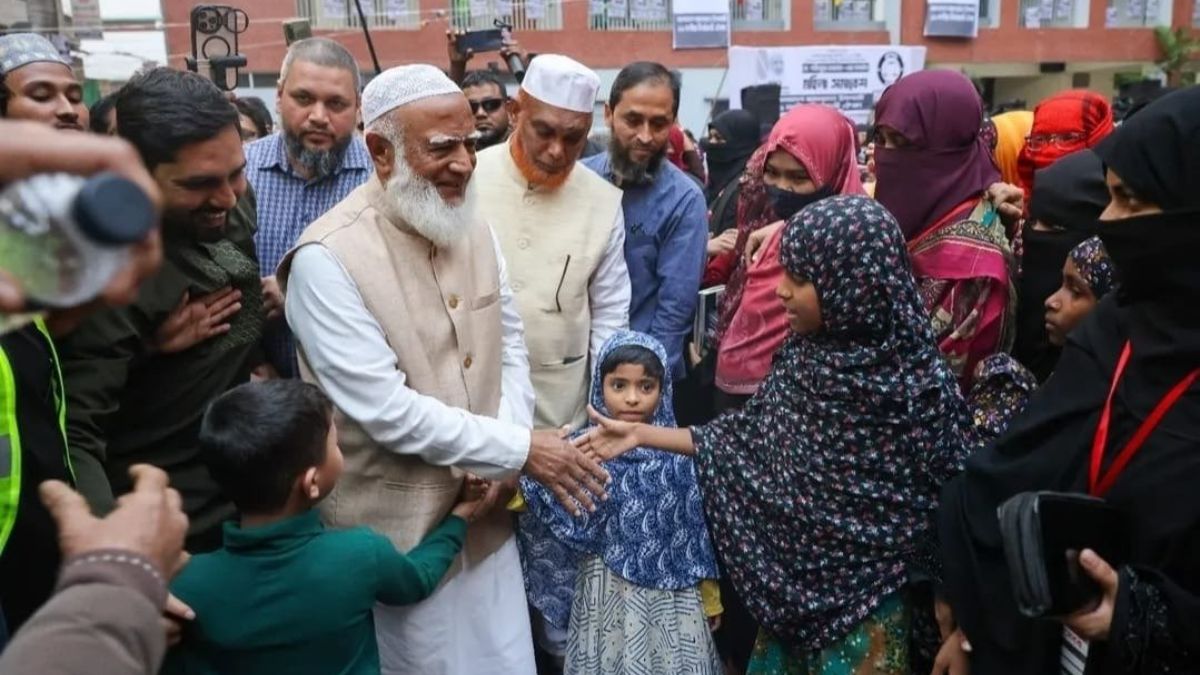
Bangladesh Election Result LIVE: PM Modi Congratulates Tarique Rahman
Prime Minister Narendra Modi congratulated BNP chief Tarique Rahman on leading the party to a decisive victory, adding that it reflects people's trust.
I convey my warm congratulations to Mr. Tarique Rahman on leading BNP to a decisive victory in the Parliamentary elections in Bangladesh.
— Narendra Modi (@narendramodi) February 13, 2026
This victory shows the trust of the people of Bangladesh in your leadership.
India will continue to stand in support of a democratic,…
Bangladesh Election Result LIVE: Tarique Rahman Wins Both Seats He Contested
BNP chief Tarique Rahman emerged victorious from Dhaka-17 and Bogura-6 constituencies, per Daily Star.
Rahman secured 72,699 votes in Dhaka-17, with his closest contender Khaleduzzaman of Jamaat-e-Islami receiving 68,300 votes.
In Bogura-6, Rahman secured 216,284 votes against his closest contender Abidur Rahman Sohel of Jamaat, who received 97,626 votes.
After 17 Years In Exile, Bangladesh's Tarique Rahman Set To Become PM
Tarique Rahman-led Bangladesh Nationalist Party (BNP) raced towards a decisive win in the crucial national election held on Thursday, setting the stage for Rahman, 60, to become Bangladesh's next prime minister.
Tarique, who returned to the country after 17 years in exile in the UK, has been elected from both Dhaka-17 and Bogura-6, according to unofficial results from the Election Commission (EC) and party sources, The Daily Star reported.
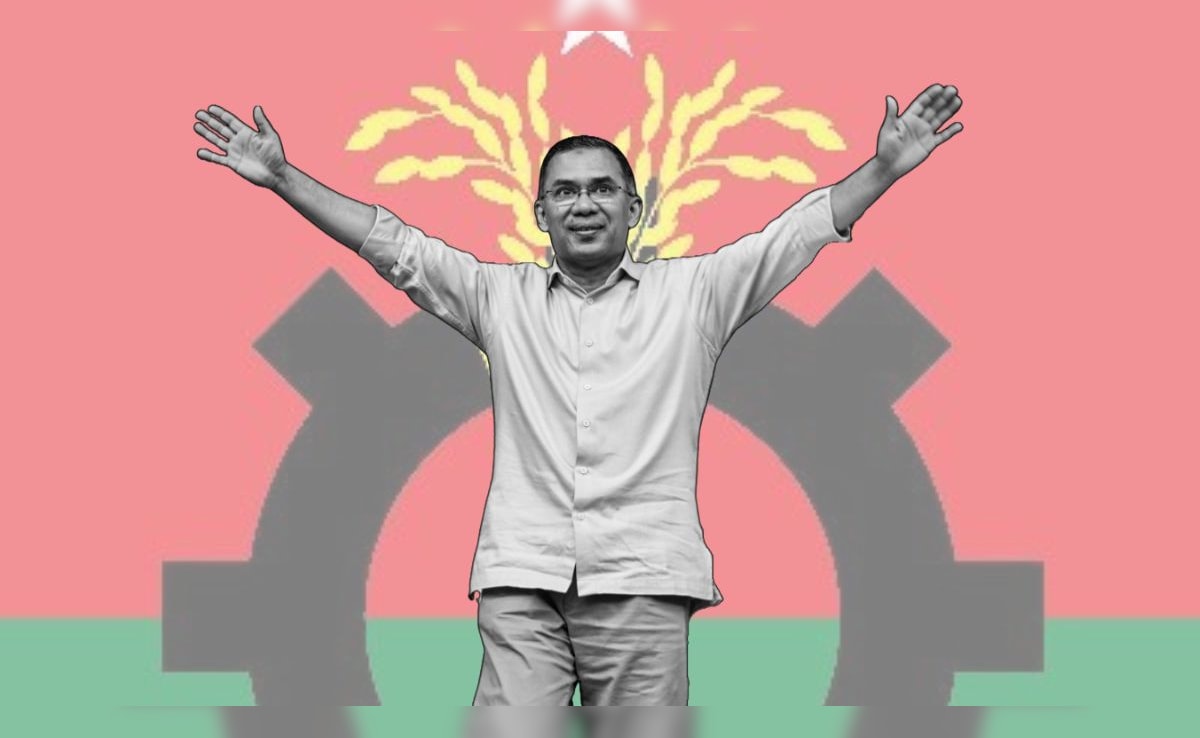
Bangladesh Election LIVE: Experts On Pakistan's View On Result
Experts told Al Jazeera that Pakistan would likely prefer a Jamaat-e-Islami government.
Michael Kugelman, a senior fellow for South Asia at the Atlantic Council said Islamabad will be the only regional player that would welcome a Jamaat victory.
Khandakar Tahmid Rejwan, a lecturer of global studies and governance at the Independent University, Bangladesh, said if Jamaat comes to power, they might try to forge ties with India rather than being confrontational.
Bangladesh Election LIVE: Voters Seek Peace As Nation Seeks to Leave Bloody History Behind
"Now is the time for something positive, 21-year-old Shithi Goswami told AFP as she reflected the sentiments of millions of young voters in Bangladesh. Another voter, 39-year-old Mohammed Jobair Hossain, said, "We are voting in a free manner after 17 years. Our votes will matter and have meaning."
The voters' excitement comes almost 45 years after Bangladesh's identity was forged in 1971 in a war that cost countless lives. Decades later came the 2024 student-led uprising, in which almost 300 people were killed and around 1,000 were arrested amid protests. This led to the ouster of Prime Minister Sheikh Hasina, who fled to India and was handed a death sentence in absentia a year later.
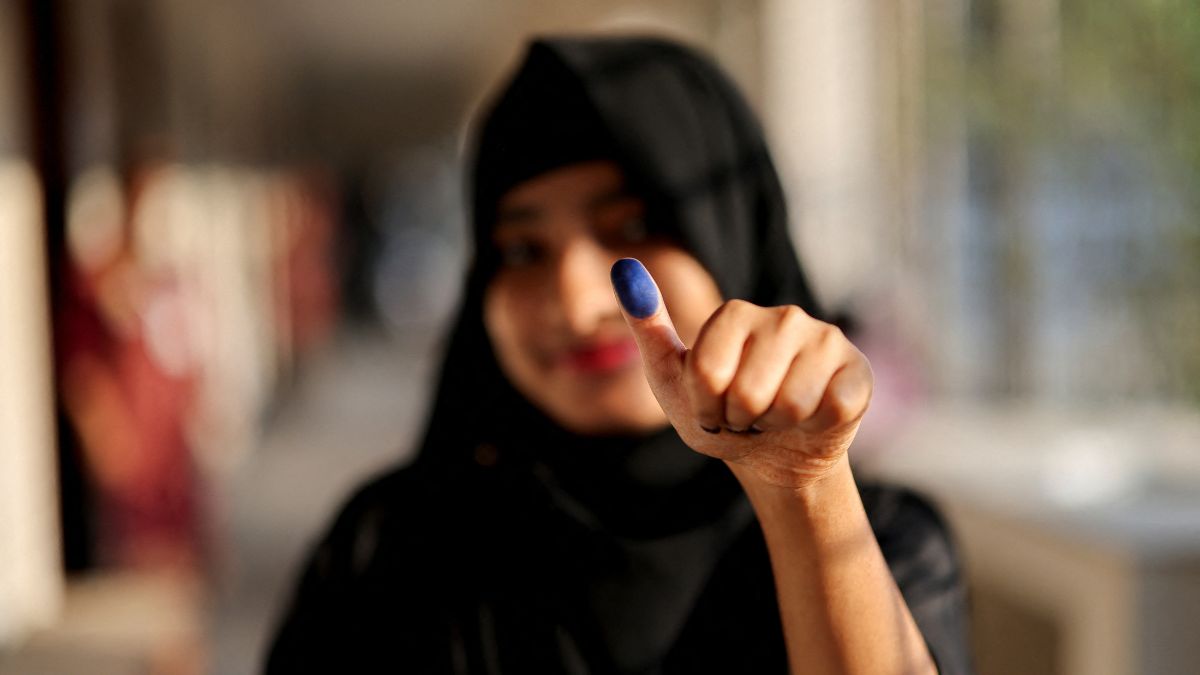
Bangladesh Election Result LIVE: What Is The Referendum That Was Voted For
Apart from picking the next government, electors also voted in a referendum on the July National Charter that has been agreed to by the Muhammad Yunus-led interim government and several political parties.
Among the points in the charter are limiting prime ministers to two terms (10 years), establishing an upper House of parliament, and restoring the caretaker system - having a caretaker government take charge for 90 days before an election to ensure polls are free and fair.
Bangladesh Election LIVE: Poll Chief Says Result Will Take Time, But No Scope For Manipulation
Bangladesh's Chief Election Commissioner AMM Nasiruddin said that since counting of referendum votes and postal ballots is underway, declaring official votes will take time.
Bdnews24 reported Nasiruddin as saying that there is no scope for manipulation or irregularities.
Bangladesh Election Result LIVE: Will Ensure People Feel Safe, Says Tarique Rahman
Shortly after polling closed on Thursday, BNP's Tarique Rahman said that if his party forms the government, steps will be taken from the very first day to "ensure ordinary people feel safe".
Bangladesh Election Result 2026 LIVE: US Congratulates BNP, Tarique Rahman
The United States congratulated the Bangladesh Nationalist Party led by Tarique Rahman on its "historic victory" in elections, its embassy in Dhaka said.
"Congratulations to the people of Bangladesh on a successful election and to the Bangladesh Nationalist Party and Tarique Rahman on your historic victory," the statement read.
"The United States looks forward to working with you to realise shared goals of prosperity and security."
Congratulations to the people of Bangladesh on a successful election and to the Bangladesh Nationalist Party and Tarique Rahman on your historic victory. The United States looks forward to working with you to realize shared goals of prosperity and security for both our countries.
— Ambassador Brent T. Christensen (@USAmbBangladesh) February 13, 2026
Why India Is Watching Bangladesh Election, The First Since 2024 Uprising
The February 12 general election in Bangladesh the first since a violent civil uprising in July 2024 forced then-PM Sheikh Hasina to flee will be monitored by India for shifts in regional geopolitics that could affect national security.
From India's perspective there are three inter-connected issues, the biggest of which is a potential Pakistan-China-Bangladesh axis - a possibility if the incoming administration is less kindly disposed to Delhi than Hasina. A Pak-China-Bangladesh nexus could weaken Delhi's hold on South Asia.
Bangladesh Election Result LIVE: How The Numbers Stack Up
The BNP entered the electoral race as the front-runner, contesting 292 out of 300 seats and sharing the rest with smaller partners. Tarique Rahman, 60, is the leading contender for prime minister.
Facing the BNP is an 11-party alliance led by Jamaat-e-Islami. Banned under the previous government and long controversial for its policies during the 1971 war, Jamaat has gained strength since last year's upheaval. It contested 224 seats, while its ally, the National Citizen Party, formed by youth activists involved in the uprising, contested 30.
Tarique Rahman-Led BNP Claims Victory
Chairman of the Bangladesh Nationalist Party (BNP) Tarique Rahman said that his party is set to secure a "historic victory" in the country's national parliament election, per local media.
BNP election committee spokesman Mahdi Amin told reporters the party was on track to win at least two-thirds of seats. He added that Rahman had won "both seats" he had run in.
Senior BNP leader Ruhul Kabir Rizvi, in a party statement, claimed a "sweeping victory", without giving figures, calling for followers to give thanks in prayer on Friday rather than celebrate on the streets
Party workers, however, spent the whole night in front of the BNP offices.
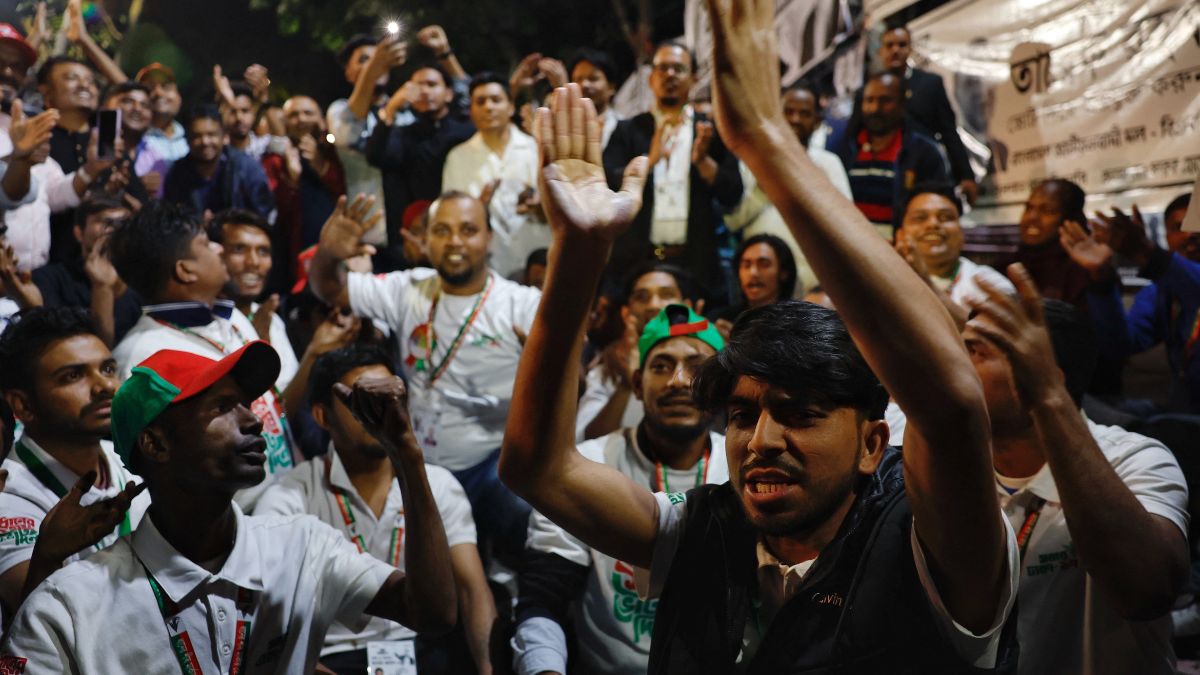
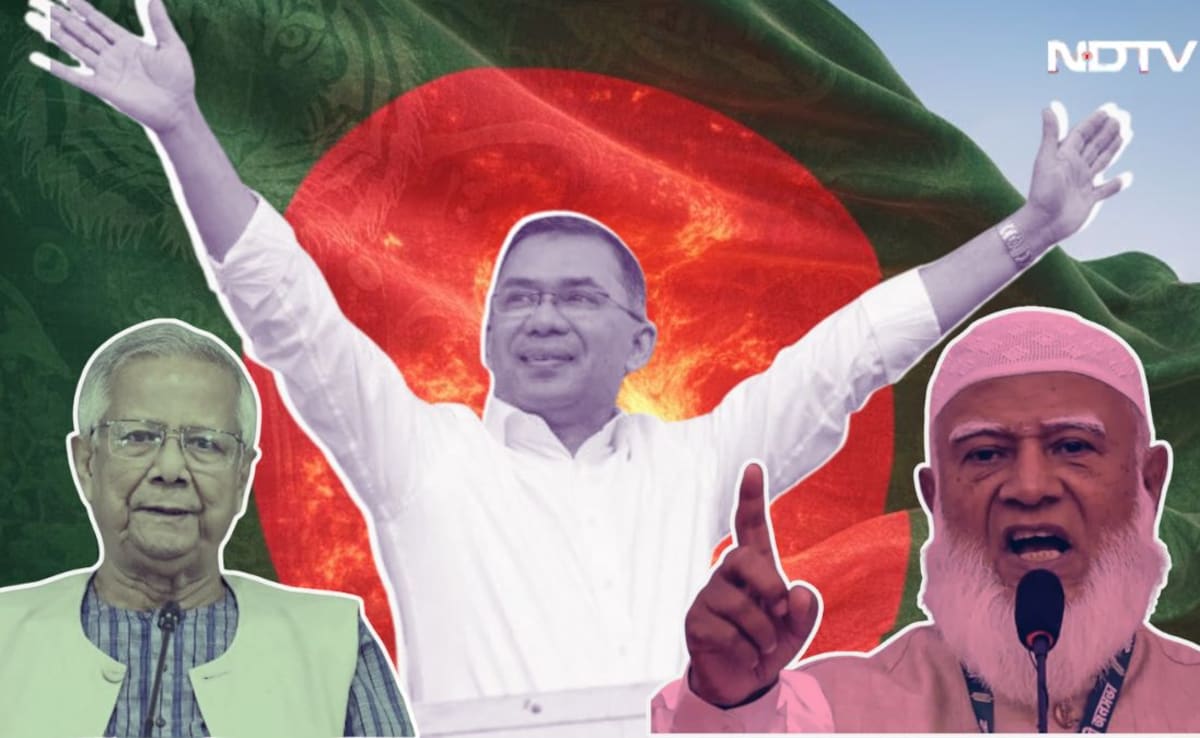
Bangladesh Election 2026 Result LIVE: What Top Leaders Said On Polling Day
Past Rejected
Chief Adviser Muhammad Yunus described the election as the “birth” of a new chapter. "Through today's process, people have rejected the past," Yunus said. "Whatever nightmarish past existed, we have completely discarded it. From today, at every step, we have gained the opportunity to build a new Bangladesh," he added.
15,000 Taka, Salvation
The radical Jamaat-e-Islami and its leader, Shafiqur Rahman has circulated pamphlets across the country promising 15,000 taka to voters for the party. The document said that if all members of a family vote for the party, their afterlife will be "free of sin," and the move will grant them "salvation from grave punishment".
Deceptive, Illegal
Ousted Prime Minister Sheikh Hasina has demanded the cancellation of the "voterless, illegal and unconstitutional" election in Bangladesh in her first statement after the polls concluded. Labelling the elections "deceptive", Hasina said that they were arranged without her party -- the Awami League -- and without voters.
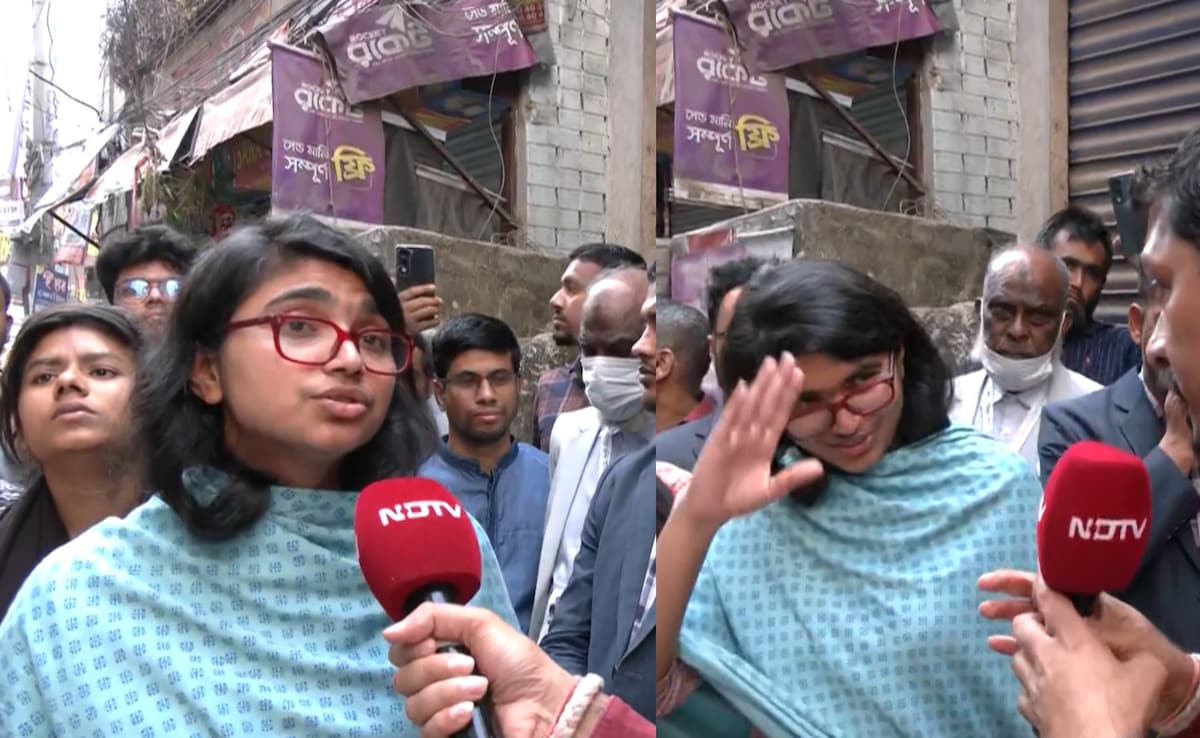
Why A UK-Based Doctor Returned Home To Contest Elections In Bangladesh
Tasnim Jara, a 31-year-old doctor, contested the parliamentary elections as an independent, driven by what she describes as a desire to build a "genuinely new political culture".
As of Friday, she is trailing in the third position in the Dhaka-9 constituency, with BNP's Habibur Rashid in the lead.
Why India Is Watching The Bangladesh Polls Closely
India is watching the election closely because of its potential impact on New Delhi's ties with Dhaka, and Bangladesh's perceived closeness with Pakistan and China after Hasina's ouster.
India has also condemned an uptick in attacks on minorities, including the killing of Hindus, in Bangladesh.
Asked about the elections, MEA Spokesperson Randhir Jaiswal said, "The election is going on in Bangladesh. We should wait for the outcome to see what sort of mandate has come...and thereafter, we will look at issues that are there."
BNP Has Edge Over Jamaat As Bangladesh Poll Results Trickle In: 10 Points
After largely peaceful polling in Bangladesh, all eyes are on who will win the elections, with the contest seen as largely one between Tarique Rahman's BNP and the coalition led by Shafiqur Rahman's Jamaat-e-Islami.
- Voters cast their ballots for 299 seats in the Jatiya Sangsad, or parliament, for which the majority mark is 150.
- The elections were the first without two former prime ministers Sheikh Hasina, who was deposed, and Khaleda Zia, who died in December last year.
- The BNP's main competitor is an 11-party alliance led by the Jamaat-e-Islami, which was allied with the BNP for many years.
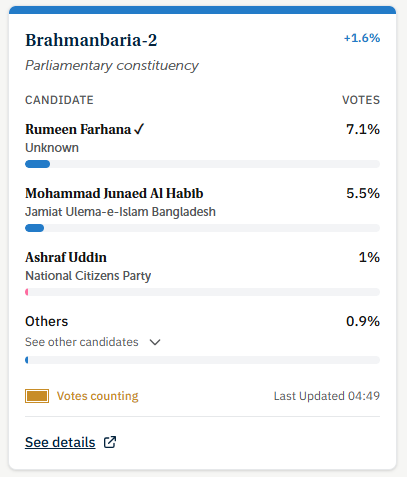
Bangladesh Election 2026 LIVE: Rumeen Farhana Leads In Brahmanbaria-2
Independent candidate Rumeen Farhana is leading in Brahmanbaria-2 (Sarail, Ashuganj and parts of Bijoynagar).
Bangladesh Election 2026 LIVE: BNP Chief Tarique Rahman Calls For Special Prayers Today, No Victory Rally
BNP Chairman Tarique Rahman has directed leaders and activists at all organisational tiers to offer special prayers across the country after Juma prayers today. He has also asked party leaders and supporters not to organise any victory rallies or gatherings anywhere in the country.
Bangladesh Election 2026 LIVE: BNP Wins Thakurgaon-1
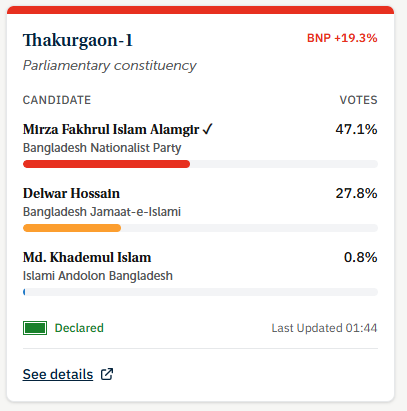
BNP candidate Mirza Fakhrul Islam Alamgir wins Thakurgaon-1 with 238,836 votes. His nearest rival Jamaat candidate Delwar Hossain got 141,017 votes. This constituency saw a 75.7% voter turnout.
Bangladesh Election 2026 LIVE: BNP Wins Sunamganj-1
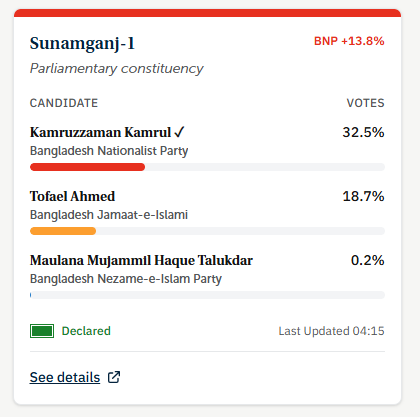
BNP candidate Kamruzzaman Kamrul wins Sunamganj-1 with 161,774 votes. His nearest rival Jamaat candidate Tofael Ahmed trails behind with 92,966 votes. This constituency saw a 51.4% voter turnout.
Bangladesh Election 2026 LIVE: Jamaat-e-Islami Alleges Delay In Results
Bangladesh Jamaat-e-Islami Assistant Secretary General Ahsanul Mahboob Zubair early Friday alleged that certain officials linked to the Election Commission were deliberately delaying the announcement of results in several constituencies.
“Counting for yesterday’s election and referendum results started from 5:00pm. It is now nearly 4:00am, yet we are witnessing unusual delays in the process by those involved with the Commission,” he said while speaking to reporters at the Election Commission in Dhaka's Agargaon, as reported by The Daily Star.
Bangladesh Election 2026 LIVE: BNP Chief Tarique Rahman Leads Bogura-6
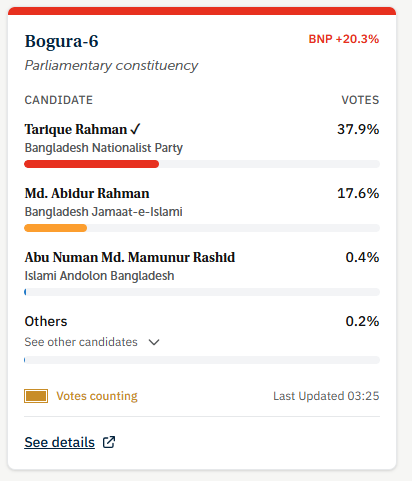
Tarique Rahman, contesting with the sheaf of paddy symbol, has secured 170,544 votes, according to News Netra. His closest contender, Abidur Rahman Sohel of Jamaat-e-Islami, who contested with the scales symbol, received 79,089 votes.
Bangladesh Election 2026 LIVE: BNP Wins Lakshmipur-1
BNP candidate Md Shahadat Hossain wins Lakshmipur-1 with 86,811 votes followed by NCP candidate Md Mahbub Alam securing 59,265 votes, as per Netra News.
Bangladesh Election 2026 LIVE: Vote Share Of 2 Key Parties
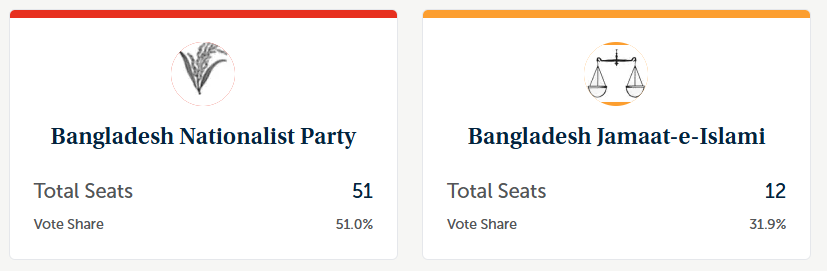
As counting is in progress, here is how the two key parties - BNP and Jamaat-e-Islami - are performing.
Bangladesh Election 2026 LIVE: BNP-Led Coalition Leads With 104 Seats
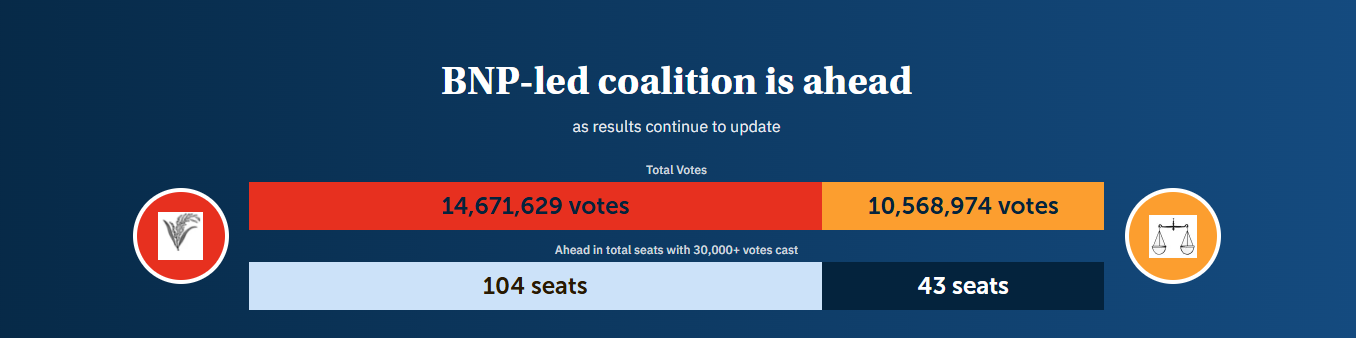
Bangladesh TV Channels Show BNP Leading As Vote Counting Continues
The Bangladesh Nationalist Party crossed the halfway mark to win the parliamentary election on Friday, a local TV station showed, as ballots were counted in a pivotal vote that is expected to restore political stability in the troubled South Asian country.
BNP had won 151 seats in the 300-member parliament, Ekattor TV showed, securing a simple majority.
Tarique Rahman's BNP Leads In Early Trends, Jamaat Faces Setback
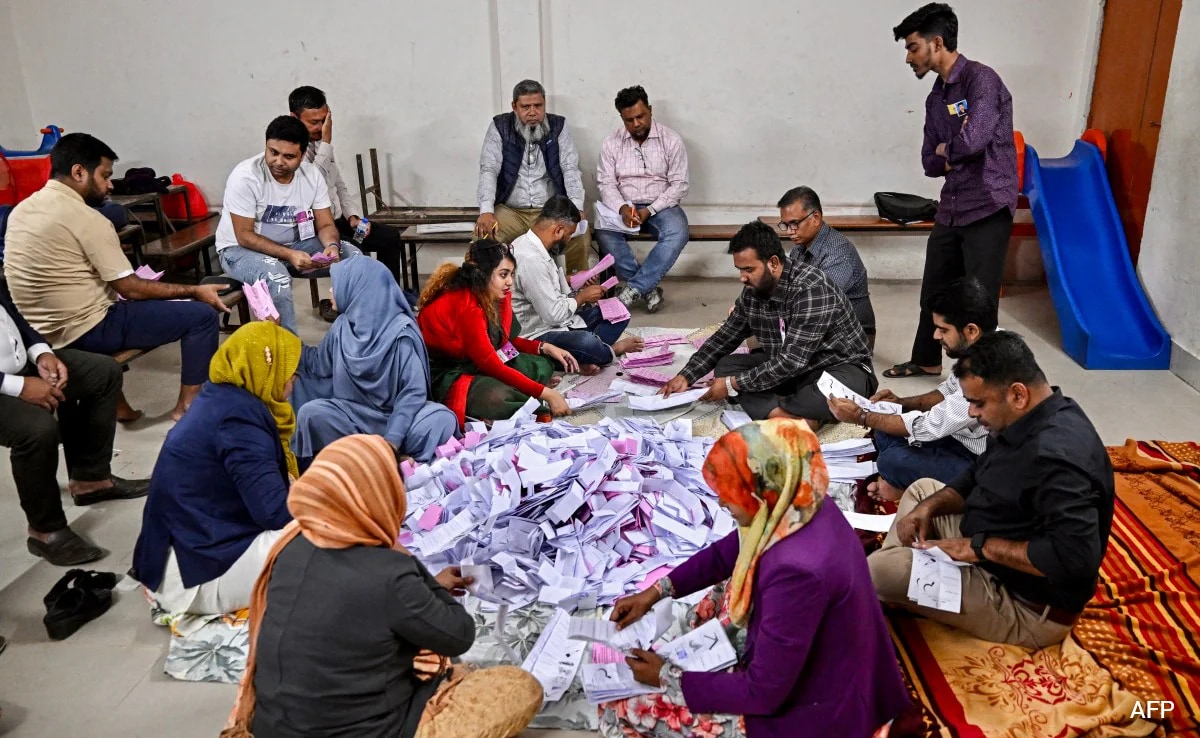
The election and referendum in Bangladesh saw over 55% voter turnout despite the Awami League missing from the electoral process. Some Awami League voters may have stayed away from the voting process, a study of the voter turnout suggests.
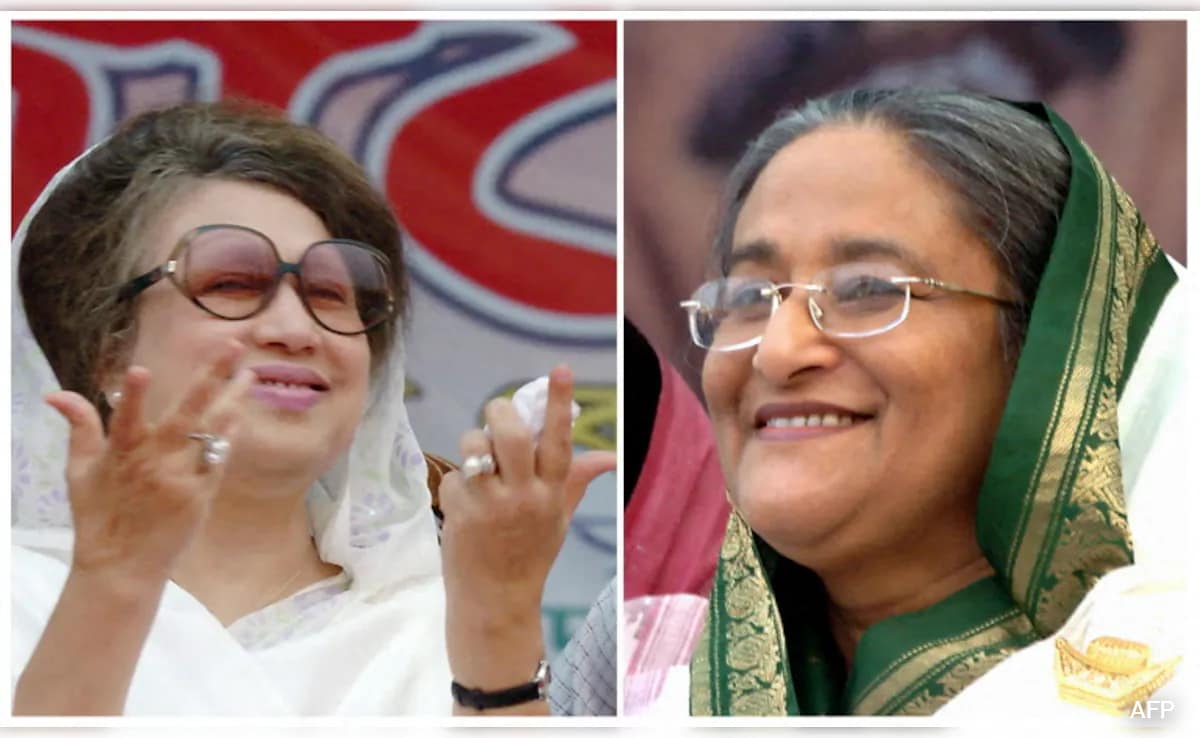
Bangladesh Election 2026: Begums Of Bangladesh: Khaleda Zia And Sheikh Hasina's Tryst With Power
Over the past few decades, the political history of Bangladesh has been profoundly shaped by the rivalry between two towering figures: Sheikh Hasina and Khaleda Zia, often called the "Battle of the Begums."
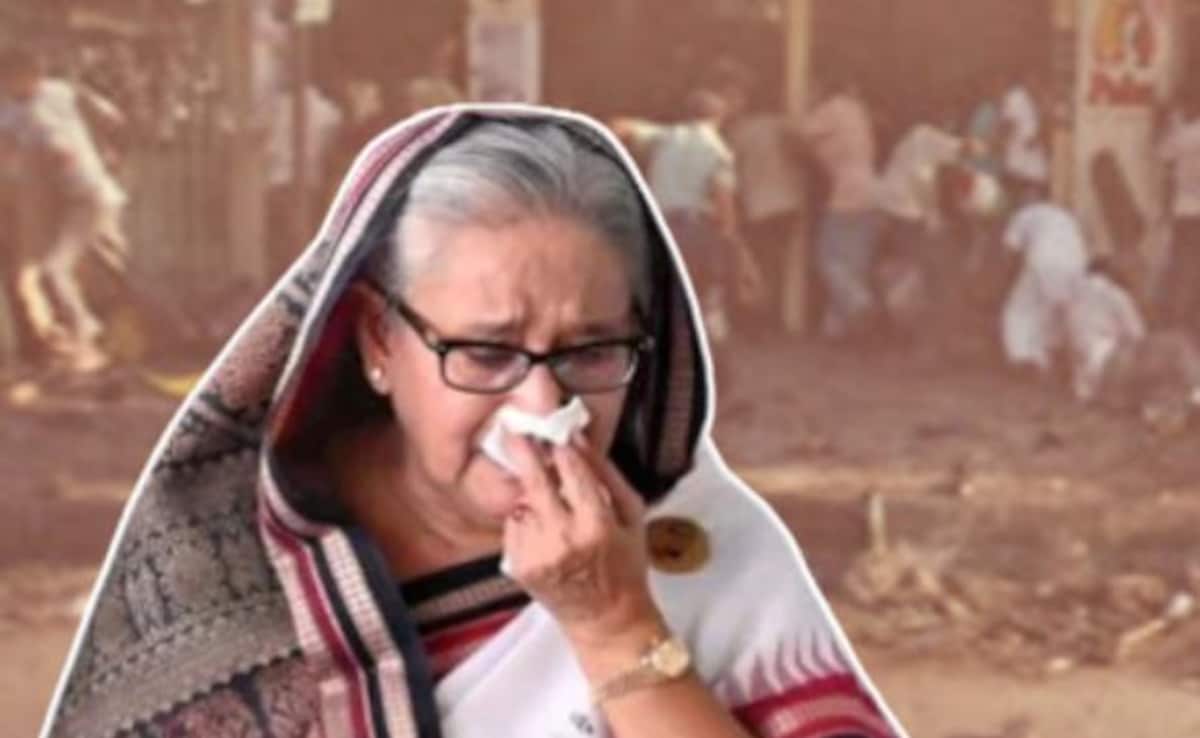
When Sheikh Hasina Was Addressing A Rally And Grenade Started Exploding
Dhaka witnessed one of the deadliest attacks in the history of Bangladesh on August 21, 2004. A major grenade assault on then opposition leader and future Prime Minister Sheikh Hasina's rally left 24 dead.
The Shahbagh Movement: How Execution Of A Jamaat Leader Paralysed Bangladesh
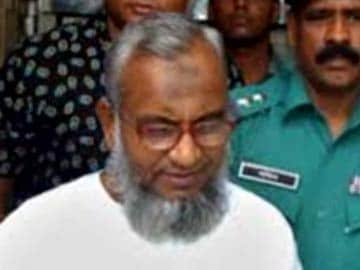
It was 2013. Ten months before Jamaat-e-Islami leader Abdul Quader Mollah, convicted of war crimes, was executed, thousands gathered in the Shahbagh area of Dhaka.
Bangladesh's Rohingya Crisis Amid Polls Highlights Humanitarian Challenges
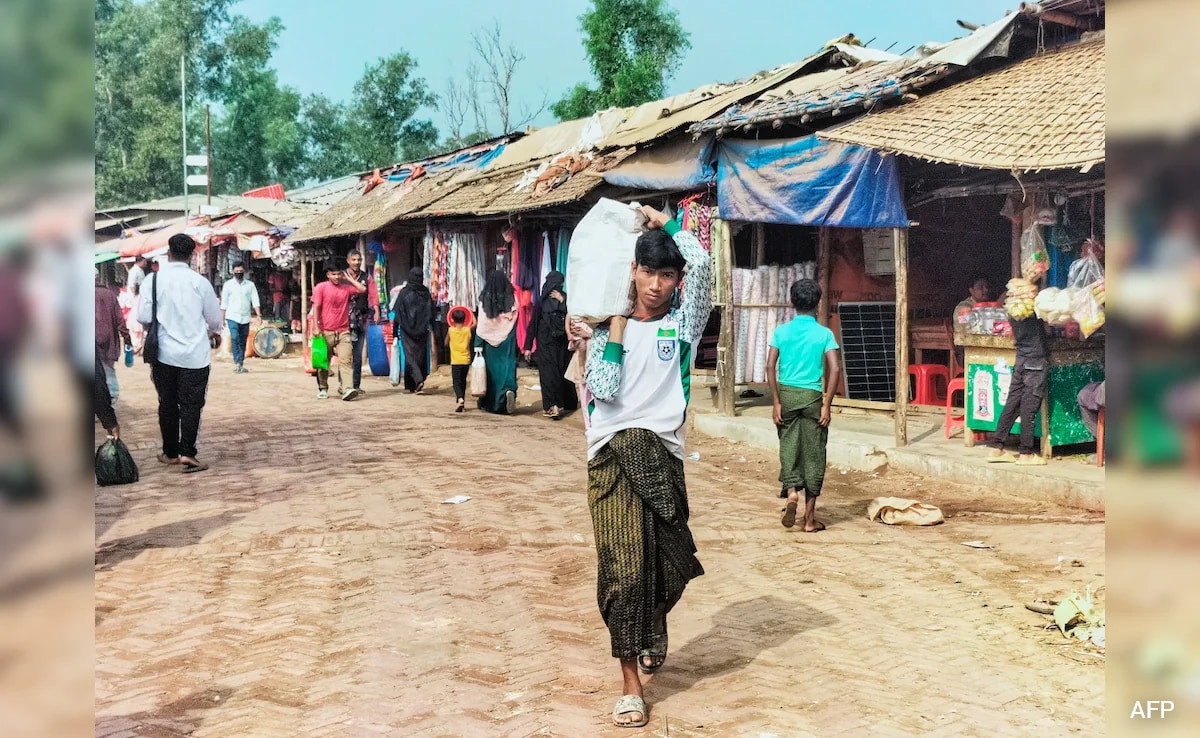
In the 1970s and 1990s, a few thousand Rohingyas fled Myanmar and crossed into Bangladesh to escape violence, discrimination, and military crackdowns. In 2017, the situation exploded when the Myanmar military launched a large-scale attack on Rohingya villages.
Bangladesh Election 2026 | Pilkhana Massacre: Inside 2009 Bangladesh Rifles Mutiny That Bleeded Dhaka
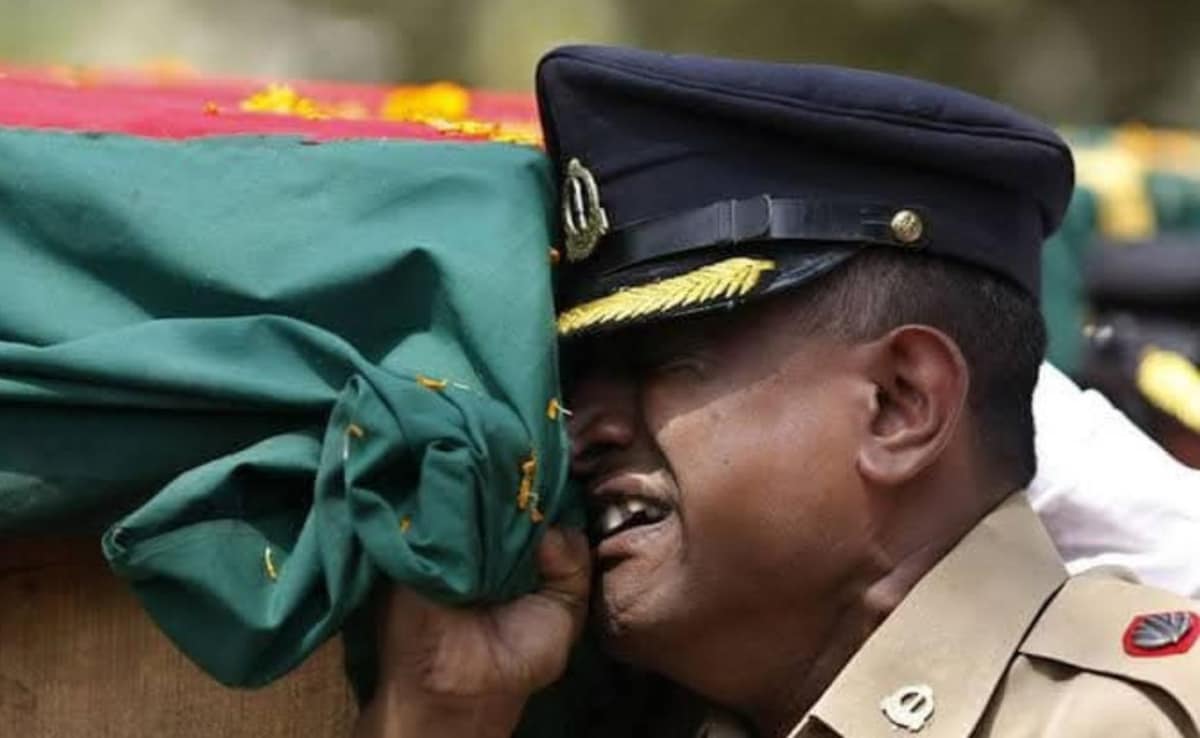
Bangladesh General Election 2026: As Bangladesh prepares for next week's general election on February 12, here's everything you need to know about the 2009 paramilitary mutiny.
Killing Of Sheikh Mujibur Rahman And Rise Of Military Politics In Bangladesh
Bangladesh was barely four years old when Sheikh Mujibur Rahman, the father of the nation, was assassinated on August 15, 1975.

East Pakistan First Mutiny: When Ethnic Bengalis Stood Up For Bangla
The early resistance in East Pakistan centred on the fight to preserve Bangla language identity, gradually evolving into a broader struggle for political dignity and recognition.
Bangladesh Election 2026: 1971 Revisited: A Bloody War And Birth Of Bangladesh
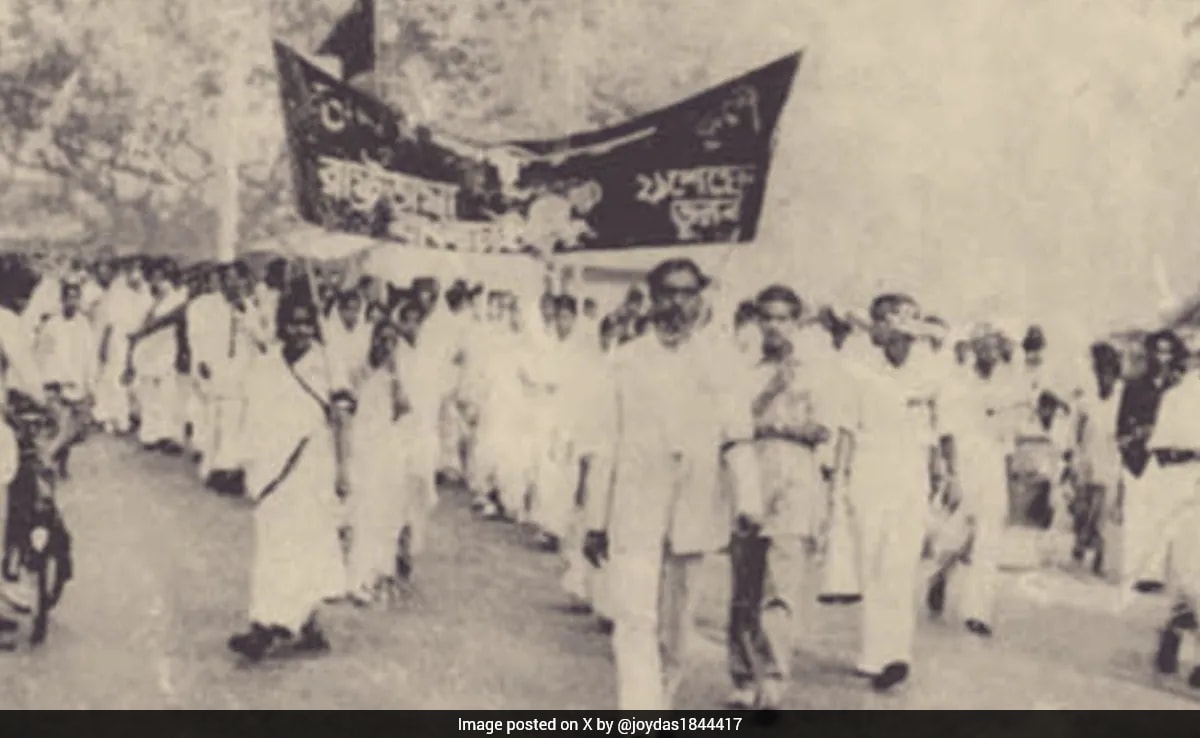
On the night of March 25, 1971, the Pakistan Army launched Operation Searchlight in Dhaka. Students, professors, and civilians were executed. Sheikh Mujibur Rahman, erstwhile East Pakistan's elected leader, was arrested.
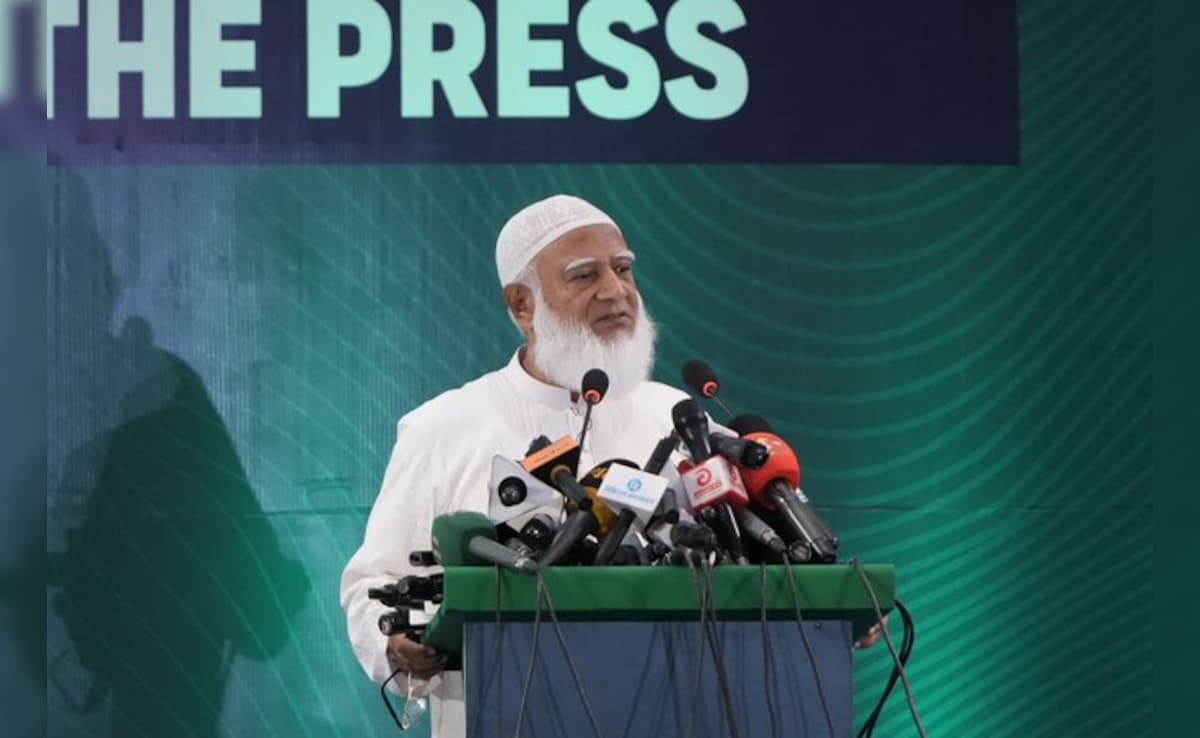
Who Is Shafiqur Rahman, Jamaat-e-Islami Head At Centre For Anti-Women Remarks
Shafiqur Rahman, the Ameer (chief) of Bangladesh JamaateIslami (JI), is at the centre of a national controversy ahead of the country's general election on February 12. The reason? A series of remarks against women.
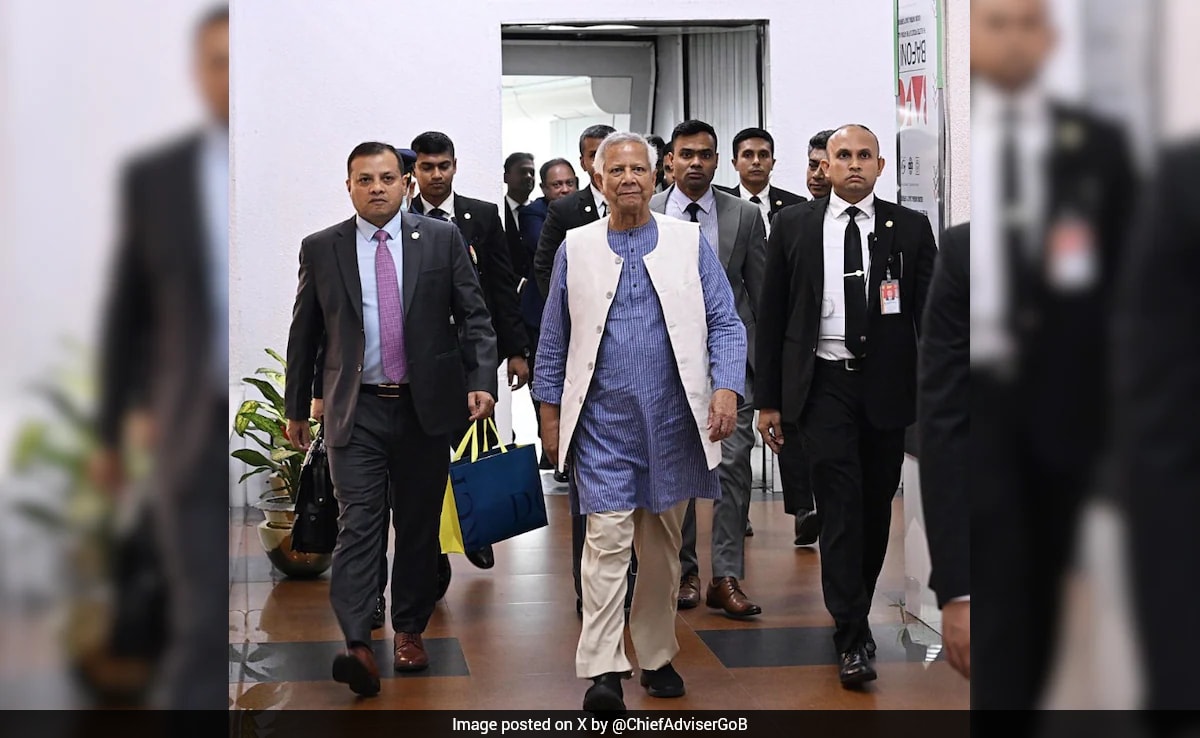
Bangladesh Election 2026: Mohammed Yunus' Watch: The Positives And Negatives Of A Turbulent Tenure
Bangladesh General Election 2026: On August 8, 2024, Yunus, Bangladesh's Nobel Peace Prize-winning economist, took office as the interim chief adviser of the country.

All About Muhammad Yunus, The Nobel Laureate Leading Bangladesh's Interim Government
He was awarded the Nobel Peace Prize in 2006 for his efforts to combat poverty and promote economic and social development from the grassroots.
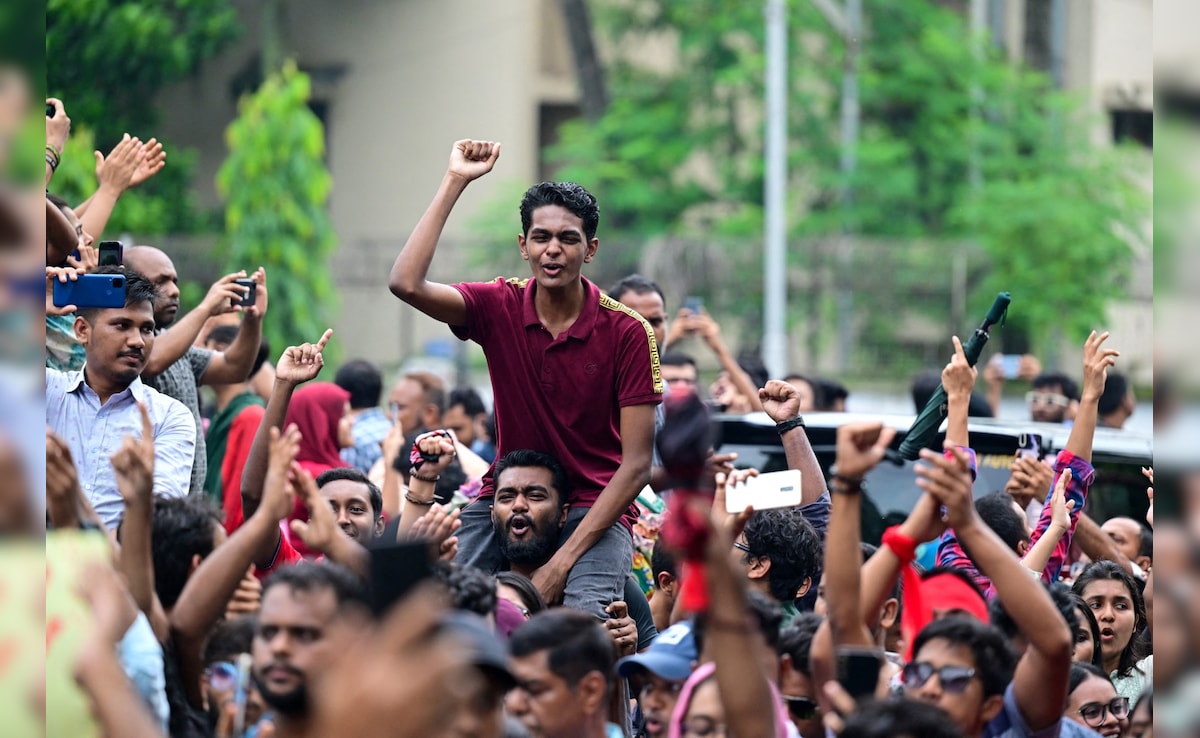
The Student Leaders That Forced Sheikh Hasina From Power, student uprising 2024
Bangladesh General Election 2026: Over a year-and-a-half ago, Bangladeshi students took to the streets over job quotas in the public sector. What began as campus protests quickly spread across the country and turned into a movement
Sheikh Hasina: The Rise, Rule And Downfall Of Bangladesh's 'Iron Lady'
Bangladesh General Election 2026: For nearly two decades, Sheikh Hasina stood as one of the most powerful faces in Bangladesh's politics. She was often described as the country's "Iron Lady."

NDTV Ground Report: Why A UK-Based Doctor Returned Home To Contest Elections In Bangladesh
Tasnim Jara, a 31-year-old doctor, is now contesting the parliamentary elections as an independent, driven by what she describes as a desire to build a "genuinely new political culture".
Bangladesh Elections 2026: Meet 'Dark Prince' Tarique Rahman, Likely Frontrunner For Bangladesh PM Post
Tarique Rahman is the son of former Bangladesh President Ziaur Rahman and three-time Prime Minister Khaleda Zia.
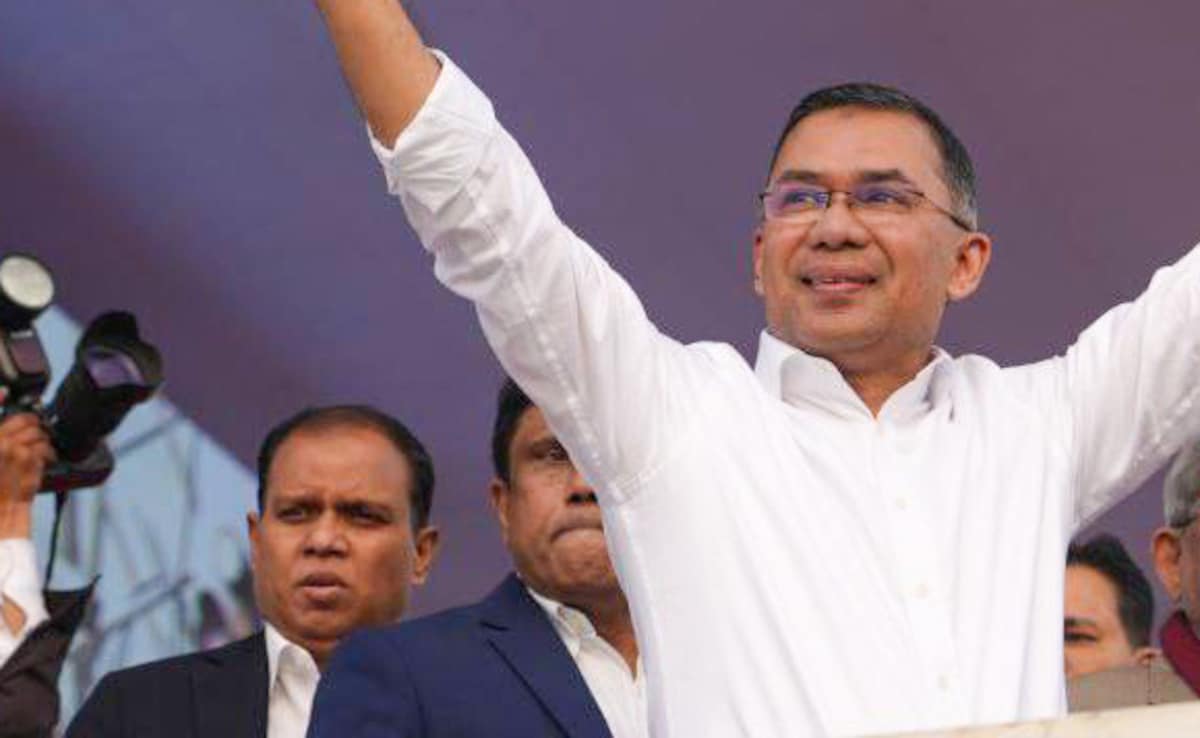
Bangladesh Elections All About Bangladesh's Student-Led Party That Toppled Sheikh Hasina
Bangladesh is heading into its first election after a student-led uprising forced former Prime Minister Sheikh Hasina to resign and flee the country a year-and-a-half ago.

Why Jamaat-e-Islami Remains Bangladesh Most Controversial Party
Bangladesh is preparing for a historic general election on February 12, and Jamaat-e-Islami (JI), a hardline Islamist party, is back in the spotlight. Once banned and politically weak, the party is now emerging as a strong contender.
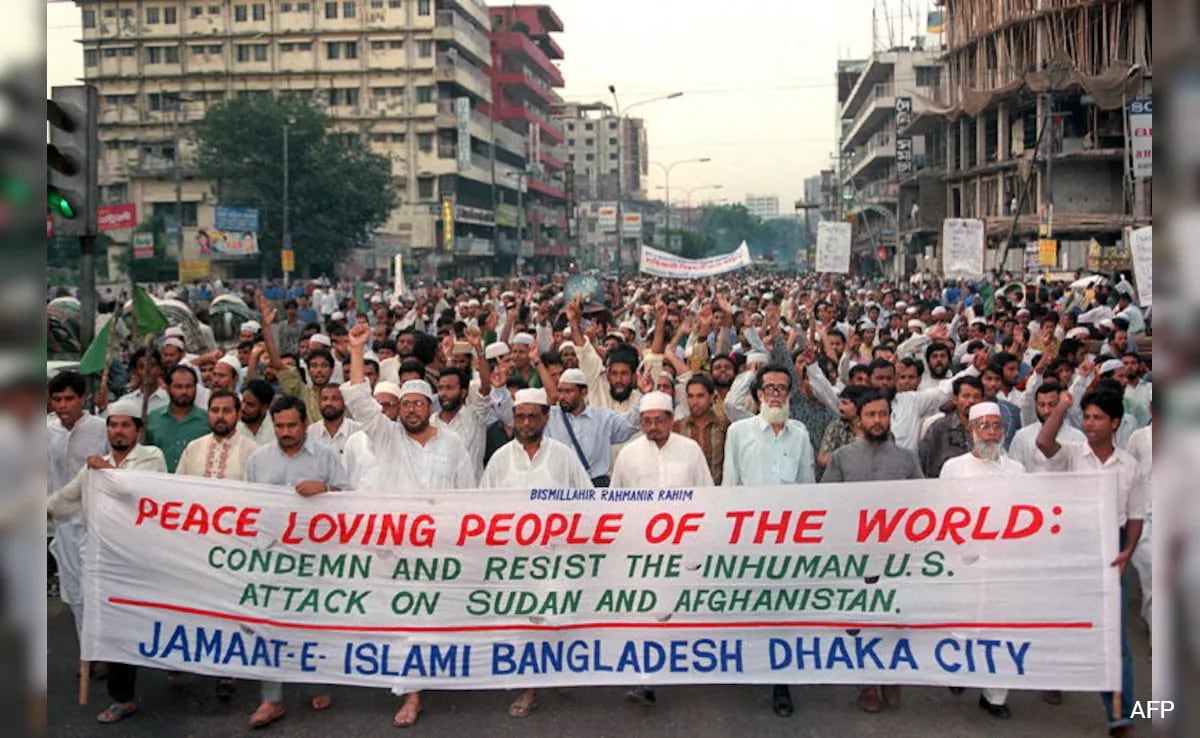
Bangladesh Election 2026: Bangladesh Votes In Its First Election Since The 2024 Gen Z Uprising That Ousted Hasina
Bangladesh on Thursday held its first election since the 2024 mass protests toppled Sheikh Hasina's government. The balloting was mostly peaceful in a vote seen as a critical test of the country's democracy after years of political turmoil.
After a slow start, crowds converged on polling stations in the capital, Dhaka, and elsewhere later in the day. By 2:00 p.m., over 47% voters had cast their ballots, the Election Commission said. The voting closed at 4:30 p.m. and the counting was to start immediately, with the results expected on Friday.
More than 127 million people are eligible to vote in what was the country's first election since Hasina's ouster after weeks of mass protests, dubbed by many as a Gen Z uprising. Hasina fled the country and is living in India in exile while her party has been banned from the polls.
(AP)
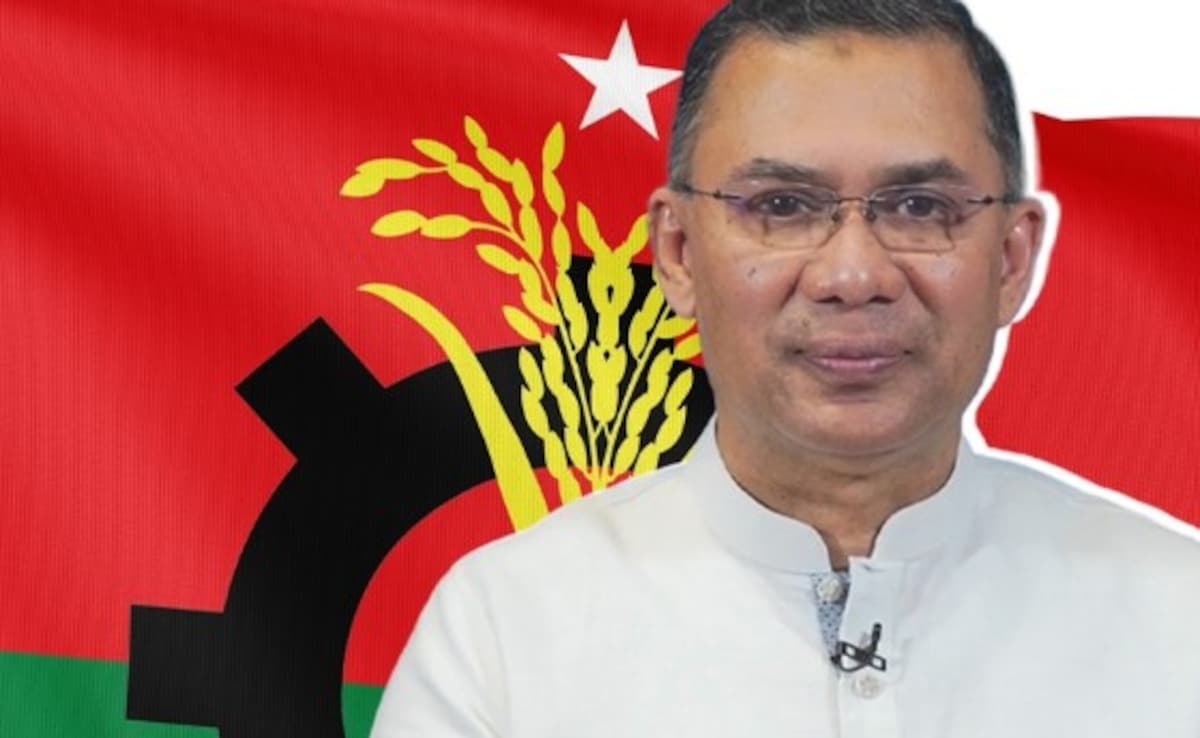
Bangladesh Elections 2026: Tarique Rahman, Bangladesh Nationalist Party: All About Bangladesh Nationalist Party And How It Was Founded
The BNP was founded by former Bangladesh President Ziaur Rahman on September 1, 1978. The party's ideology is rooted in 'Bangladeshi Nationalism,' recognising the right of people from all walks of life, irrespective of their ethnicity, gender or race
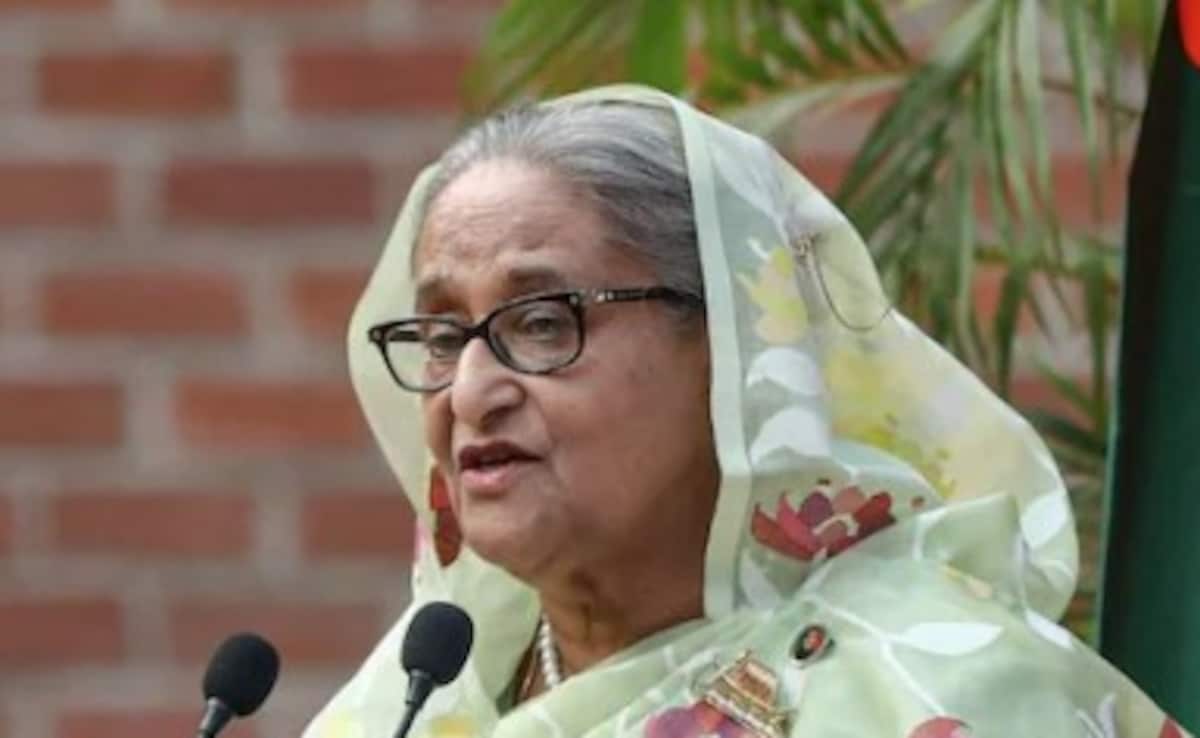
bangladesh-election 2026 general election on 12th feb Bangladesh Election 2026: The Rise And Fall Of Sheikh Hasina's Awami League
The Awami League is one of Bangladesh's oldest political parties, originally established as the East Pakistan Awami Muslim League on June 23, 1949, in Dhaka. It represented a secular and progressive voice for the Bengali population of then East Pakistan. Sheikh Mujibur Rahman, a young student activist at the time, became one of its central figures.
Bangladesh Elections 2026: From BNP To Jamaat-E-Islami: Key Parties Contesting 2026 Bangladesh Elections
With Sheikh Hasina’s Awami League barred from contesting, the political battlefield has opened to new contenders.
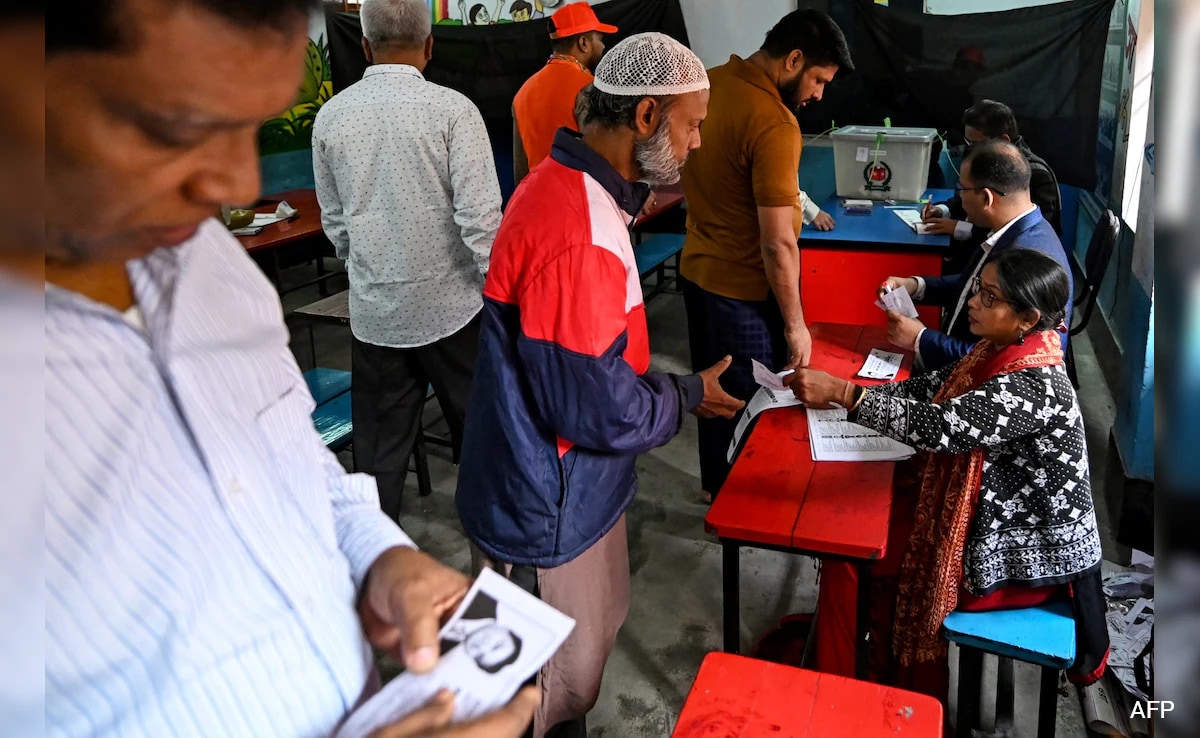
How Does Bangladesh Vote, How Are Votes Counted: All You Need To Know
Bangladesh will allow postal voting for the first time in its history in the February 12 national election, the Election Commission announced last month.
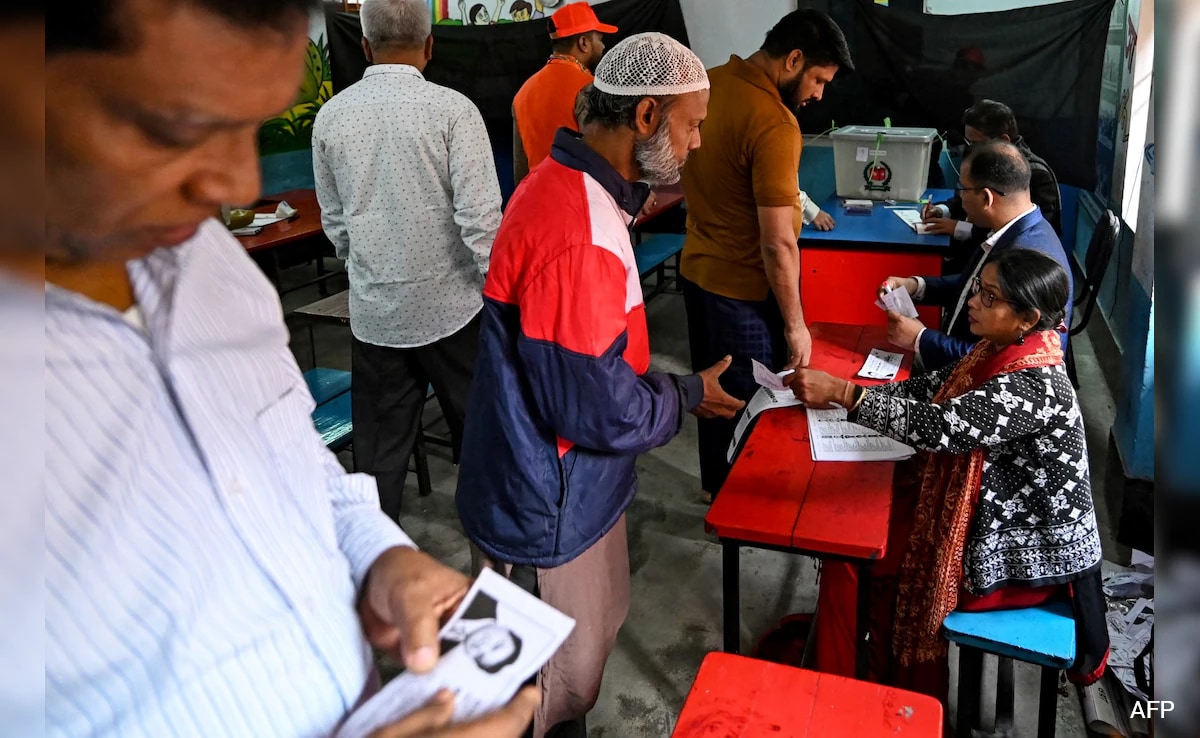
"Voterless, Illegal": Sheikh Hasina Wants Bangladesh Election Cancelled
Ousted Prime Minister Sheikh Hasina has demanded the cancellation of the "voterless, illegal and unconstitutional" election in Bangladesh in her first statement after the polls concluded.

Bangladesh Election 2026: First Statement Of Sheikh Hasina After Bangladesh Elections Conclude
For rejecting the sham election staged by the killer, fascist Yunus, who seized power illegally and unconstitutionally, the leader of the people, Sheikh Hasina, expresses her thanks and gratitude to the masses at all levels, including mothers, sisters, and minority communities.
Today's so-called election, organised by Yunus, who took power through illegal and unconstitutional means, was essentially a carefully planned farce. Disregarding the people's voting rights, democratic values, and the spirit of the constitution, a deceptive election was arranged without the Awami League and without voters.
Bangladesh's 'Bloodied' Elections: The Widespread Killings During 2014 Polls
The 2014 elections were held against the backdrop of violence related to the prosecution and sentencing of Jamaat leaders accused of war crimes and crimes against humanity during Bangladesh's 1971 struggle for independence.
At least 18 people were killed during polling on January 5, 2014, while dozens died in the run-up to the election, the BBC reported
Over 150 voting centres were burned, while the Election Commission stated that polls were held in only 147 districts after candidates from 153 other districts were elected unopposed, CNN reported. There were no opponents in these seats because of the boycott.
When protesters tried to take over a polling station in northern Rangpur district, police opened fire, leaving two dead. A similar incident was reported in Nilphamari district, where police fired on about two dozen protesters, killing two of them.
Before the voting, BNP started a nationwide 48-hour strike after Khaleda Zia urged supporters to "completely boycott" what she called a "scandalous farce" of a general election. She even accused the authorities of placing her under house arrest.
Amid low voter turnout of 39.8%, Awami League bagged 232 of the 300 seats - nearly half of the winners being elected unopposed.
Bangladesh Election 2026: BNP Leader Killed In "Scuffle" At Polling Station
A BNP leader named Mohibuzzaman Kochi died after a "scuffle" between two parties at the Alia Madrasa polling station in Bangladesh's Khulna Sadar, according to a BBC report.
Local BNP leaders have alleged that he fell ill after being pushed.
He was the former office secretary of Khulna Metropolitan BNP.
Why India Is Watching Bangladesh Election, The First Since 2024 Uprising
From India's perspective there are three major, and inter-connected, issues, the biggest of which is a potential Pakistan-China-Bangladesh axis that threatens to weaken Delhi's hold on South Asia.
Also in play are border and internal security implications arising from concerns like illegal migration (and the fallout on domestic politics) and continuing anti-Hindu sentiments.
Relations between Delhi and Dhaka, generally good with Hasina at the helm, have taken darker and more unpredictable turns since the July uprising. Political analysts agree Delhi would prefer to deal with a Bangladeshi government led by Sheikh Hasina and her 'India-friendly' Awami League, but also recognises the changing of the guard, if for the foreseeable future, in Dhaka.
Bangladesh Election 2026: "Cast Votes Without Fear," Urges Army Chief
“I urge all voters to go to polling centres and cast their votes without fear,” said Chief of Army Staff General Waker-Uz-Zaman after casting his vote at Adamjee Cantonment College polling station. "Today is a very important day for us," he added.
Bangladesh Election 2026: 32.88% Voter Turnout Recorded Tiill 12pm, Says EC Secretary
Voter turnout stood at 32.88 per cent across 32,789 polling centres as of 12:00 pm, Bangladeshi media reported, quoting election commission senior secretary Akhtar Ahmed.
Bangladesh Election 2026 LIVE: Crude Bomb Blast Reported At Munshiganj Polling Station
A crude bomb explosion followed by a chase and counter-chase incident took place at Makhati Gurucharan High School in Munshiganj Sadar upazila this morning. The clash took place between supporters of two rival candidates around 10 am, confirmed Officer-in-Charge (OC) of Sadar Police Station, Md Mominul Islam, as reported by The Daily Star.
Bangladesh Election 2026: Gen-Z, Women Voters Poised To Shape Bangladesh's Future, Says Report
As Bangladesh votes in its 13th National Parliament election, two voter blocs are increasingly being viewed as decisive forces in determining the political outcome -- Generation Z and women, according to a media report.
Combined, these groups form a numerical majority of the electorate and are emerging as an independent voting force capable of reshaping conventional party calculations and electoral strategies.
With over 40 million voters between the ages of 18 and 29 and more than 62 million registered female voters, political observers believe that the results of the election may depend less on traditional party machinery and more on generational aspirations and gender-driven voting trends, according to a report published in a leading Bangladeshi daily, The Dhaka Tribune.
Analysts argue that the choices made by these two segments could influence not only which party forms the next government but also the broader direction of Bangladesh's evolving democratic framework.
15,000 Taka, Promise Of Salvation: Jamaat's Open Bribe To Voters On Poll Day
As Bangladesh votes for its most crucial election on Thursday, the radical Jamaat-e-Islami and its leader, Shafiqur Rahman, are using religion and money to lure voters to elect the country's first Islamist-led government. The Jamaat coalition has circulated pamphlets across the country promising 15,000 taka to voters for the party. The document said that if all members of a family vote for the party, their afterlife will be "free of sin," and the move will grant them "salvation from grave punishment."
The pamphlet, accessed by NDTV, told voters to bring a camera phone to the polling booths to take a photo of their ballot papers after stamping them, as proof that they voted for 67-year-old doctor and Jamaat-e-Islami party chief Shafiqur Rahman.
Noor Hossain: The Iconic Bangladeshi Activist Who Took Down A Dictator
By early November 1987, President Hussain Muhammad Ershad had effectively sealed off Dhaka. Communications were cut. Educational institutions were shut. Political gatherings were banned. Emergency powers allowed mass arrests of opposition activists. Ershad, who had seized power in a 1982 military coup, was determined to crush a growing pro-democracy movement.
Yet opposition parties pressed ahead. On the morning of November 10, thousands attempted to march. Many never reached the rally as riot police intercepted protesters across the city. Some were beaten and detained, others were shot.
Among those detained that day was journalist Moazzem Hossain, who later recalled seeing a body dumped inside a police cell.
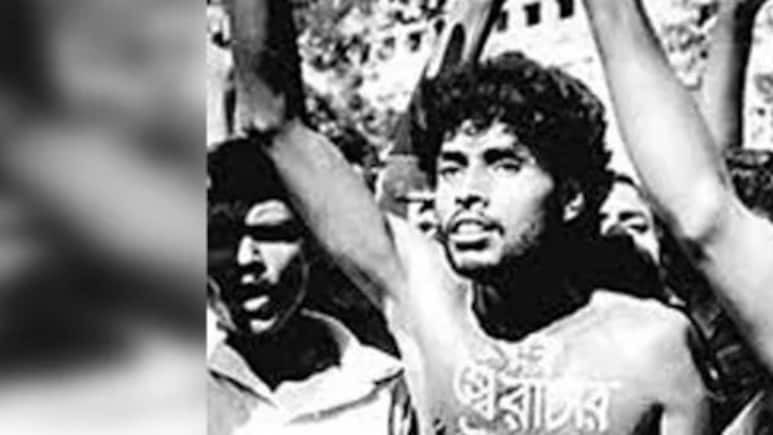
"One body stood out, it had a slogan painted on the bare chest," he wrote in his report for the BBC. "Sairachar nipat jak (Down with autocracy)."
The man was Noor Hossain.
Bangladesh Election 2026 LIVE: ‘Genocide' In Bangladesh
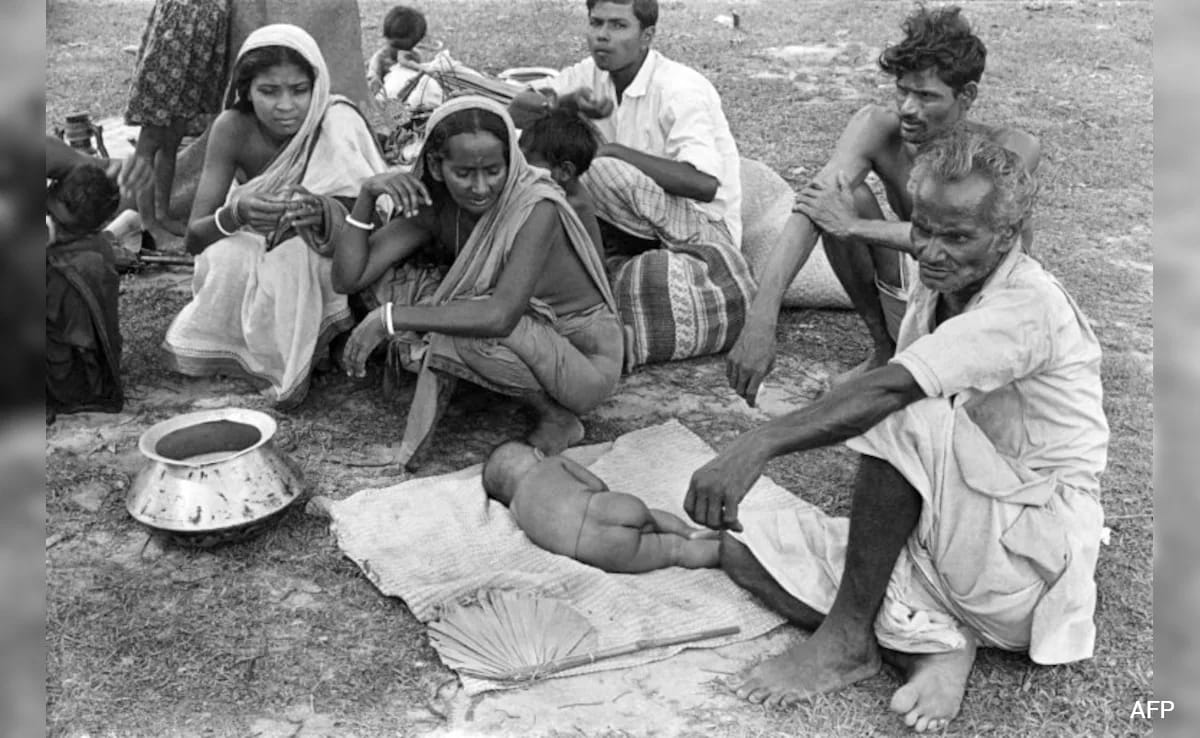
Much of what the world knows about those early months come from an article published far from South Asia. On June 13, 1971, The Sunday Times in London ran a report titled "Genocide". Its opening scene followed a young Bengali man, Abdul Bari, trembling as Pakistani soldiers prepared to shoot him. The journalist was Anthony Mascarenhas, a Pakistani reporter who had been taken on a guided military tour meant to show the army's "success" against Bengali rebels.
Mascarenhas, though, saw something else. He witnessed villages burned, civilians executed, and officers discussing daily body counts in mess halls. He later wrote of "kill and burn missions". Unable to publish in Pakistan under military censorship, he fled to London, helped his family escape in secrecy, and went public.
The article shocked international audiences and eventually led to India's military intervention.
By December 1971, Pakistan and India were at war. Within weeks, Pakistani forces surrendered. Bangladesh became an independent country. The independence came after nine months of violence that left scars still unaccounted for.
Bangladesh Election 2026 LIVE: How The Bangladesh Liberation War Started
The conflict started months earlier, with an election. In Pakistan's first general elections in 1970, the Awami League, led by Sheikh Mujibur Rahman, won an outright majority driven almost entirely by votes from East Pakistan.
Instead of transferring power, the military government in West Pakistan delayed the assembly, imposed martial law, and arrested Mujib. Civil disobedience followed and the army responded with force.
Bangladesh Election 2026 LIVE | 1971 Revisited: A Bloody War And Birth Of Bangladesh
On the night of March 25, 1971, the Pakistan Army launched Operation Searchlight in Dhaka. Students, professors, and civilians were executed. Sheikh Mujibur Rahman, erstwhile East Pakistan's elected leader, was arrested. Many Awami League leaders went into hiding. The army declared, "Big bird in cage. Little birds have flown." The crackdown was the start of a long conflict.
The crisis had been building for years. East Pakistan had a large population but limited representation in Pakistan's government. When the Awami League won the 1970 elections, then West Pakistani leadership refused to transfer power. Protests spread and civil disobedience increased and the army moved in to suppress the movement.
Bangladesh Election 2026 LIVE: Bomb Blast At A Polling Centre In Gopalganj
Three people suffered injuries in a crude bomb explosion at a polling centre in Gopalganj today.
"The explosion occurred around 9:00am at Reshma International School polling centre in Nichupara area," Additional Superintendent of Police Md Sarwar Hossain told The Daily Star.
The injured have been identified as Ansar members Sukanto Majumdar and Jamal Molla, and 13-year-old Amena Khanum.
Bangladesh Election 2026 LIVE: "This Election Is About Freedom Of People," Says Muhammad Yunus
Muhammad Yunus described the election and referendum as a moment of national joy and renewal.
“This is a day of great joy. Today is the birthday of a new Bangladesh. We will celebrate this birthday throughout the day,” he told reporters after casting his vote at Gulshan Model High School and College.
Yunus described the environment in Bangladesh as “festive atmosphere like Eid."
"This election is about freedom of people," he added while speaking to reporters.
Bangladesh General Election 2026 LIVE: BNP Chief Tarique Rahman's Message To Voters
BNP Chairman Tarique Rahman has called upon all citizens to exercise their franchise by going to their respective polling stations and casting their votes for candidates of their choice.
In a Facebook post on Thursday, Rahman said, "Dear pro-democracy brothers and sisters, I request everyone to exercise their voting rights in a festive and peaceful environment. Vote for whomever you deem fit. Vote according to your own choice, and ensure your state rights and ownership." "Insha'Allah, from tomorrow, your Members of Parliament will take on the responsibility of serving you. I will take on the duty of ensuring that every victorious candidate of the sheaf of paddy (Dhaner Shis) properly fulfills their responsibilities," he added.
Bangladesh Election 2026 LIVE: It's Birthday Of New Bangladesh, Says Chief Advisor Yunus
Bangladesh interim government head Muhammad Yunus on Thursday cast his vote at a polling booth in Dhaka as the 13th national parliamentary elections and constitutional referendum got underway in the country.
Yunus, who is leading the country's interim administration, described the election and referendum as a moment of national joy and renewal.
"This is a day of great joy. Today is the birthday of a new Bangladesh. We will celebrate this birthday throughout the day," Yunus said on the elections that comes after a student-led uprising brought down former PM Sheikh Hasina's Awami League government nearly 18 months ago.
"Through today's process, people have rejected the past. Whatever nightmarish past existed, we have completely discarded it. From today, at every step, we have gained the opportunity to build a new Bangladesh," he said.
"Voting for a candidate is important, but the referendum is very important. The whole of Bangladesh will change," Yunus said.
"I feel very happy. This is a day of great joy for me. It is a day of great joy for everyone in Bangladesh. A day of liberation. The end of our nightmares and the beginning of new dreams, that is what today's process is for," Yunus said.
Bangladesh Election 2026 LIVE | "On Verge Of Forming Government": NCP's Nahid Confident Of Victory
National Citizen Party (NCP) Convener Nahid Islam urged voters to go to polling centres and exercise their voting rights without fear.
“I urge everyone to cast your vote without fear. There was no opportunity for a fair vote over the last 16 years. Now, the chance has come to return to democracy by casting your votes,” he said after casting his ballot at AKM Rahmatullah College in Badda this morning.
He also expressed confidence, saying the 11-party alliance was formed to win the election.
“We are on the verge of forming the government if people are allowed to cast their votes freely and fairly,” he said, adding, “We are hopeful of victory and will accept the people’s mandate.”
Bangladesh Election 2026 LIVE | "Election Proceeding In 'Free And Fair Manner': Chief Election Commissioner
Chief Election Commissioner AMM Nasir Uddin said the election is progressing in a free and fair manner so far.
“A few untoward incidents were reported outside polling centres, which are not significant,” he told reporters after casting his vote at Eskaton Garden High School around 9:30am, as reported by The Daily Star.
“We are happy with the situation,” Nasir added.
Bangladesh Election Voting LIVE: Muhammad Yunus Casts Vote
Interim government chief Muhammad Yunus casts his vote.
Bangladesh Election 2026 LIVE: Bangladesh Voters Vote To "Uphold Democracy"
Farhana Islam Saima, 23, a fourth-year electrical engineering student at Rajshahi University of Engineering and Technology, said she returned home on leave specifically to vote.
“I came home to uphold democracy. I want to see democracy firmly established everywhere,” she told The Daily Star.
Bangladesh Election 2026 LIVE | "I Cam Feeling Quite Scared": Voter Shares Fear
In Dhaka-9, Sumaiya Akter Mim, currently in her second year of intermediate studies, cast her first ballot alongside her parents. She also took part in the referendum.
“There was a lot of tension about whether I would be able to vote. I came feeling quite scared. However, I was able to cast my vote in a peaceful environment for my preferred candidate,” she told The Daily Star.
Bangladesh Elections Live | "This Time It Feels Like Eid": First-Time Voter Shares Experience
At Mirzapur Government Primary School polling centre in Rajshahi city, Peyari Begum, a resident of Hanufar Mor, arrived at 7:30am to cast her vote.
“I did not vote last time. This time it feels like Eid. Everyone has come together early in the morning to vote. It feels festive,” she told The Daily Star.
Bangladesh Elections Live | "We Will Accept Results If...": Jamaat-e-Islami's Shafiqur Rahman
“If the voting is held in a free and fair manner, we will accept the results. Others should also accept the verdict of the people,” Jamaat-e-Islami's Shafiqur Rahman told reporters after casting his vote at around 8:30 am at the Monipur High School and College polling centre.
He also urged voters to go to polling centres and cast their ballots.
“After being deprived of voting for nearly a decade and a half, I finally got the opportunity to cast my vote today. I could not vote in the elections of 2014, 2018, and 2024 as I was in jail during those times. After missing three consecutive elections, Alhamdulillah, Allah has given us the chance to vote today,” the Jamaat ameer said.
Bangladesh Elections Live: Direct Contest Between BNP vs Jamaat-e-Islami
Coalition Led By Bangladesh Nationalist Party (BNP): Opinion polls indicate the BNP-led alliance holds an edge in the upcoming election. The BNP is contesting 292 of the 300 seats, leaving the remaining constituencies to its coalition partners, which include more than half a dozen smaller parties.
The BNP is led by top prime ministerial contender Tarique Rahman, the 60-year-old son of former Prime Minister Khaleda Zia and former President Ziaur Rahman.
Its promises for the election include financial aid for poor families, a limit of 10 years for an individual to remain prime minister, boosting the economy by measures including foreign investments, and anti-corruption measures.
Jamaat-e-Islami's 11-Party Coalition: The Islamist party, which had opposed Bangladesh's 1971 independence from Pakistan, was banned for years under former Prime Minister Sheikh Hasina, who was ousted in a youth-driven uprising in 2024.
Known for its anti-corruption image, Jamaat has been resurgent since Hasina's fall and is expected to deliver its best electoral performance, even if it does not win enough seats to form the next government. One of its main allies is the National Citizen Party (NCP), led by youth activists who were instrumental in toppling Hasina.
Jamaat is contesting 224 seats, the NCP 30 seats, and the rest are divided among other coalition constituents.
Should the Jamaat alliance win, its chief, Shafiqur Rahman will likely become prime minister.
Jamaat, which believes in a society governed by Islamic principles, has said that it will focus on reviving the economy, building good relations with neighbours, and reducing the country's heavy reliance on the export-focused garments industry by promoting other industries, such as leather goods.
(Reuters)
Bangladesh Elections Live: Jamaat-e-Islami Chief Shafiqur Rahman Casts His Vote
Jamaat-e-Islami Chief Shafiqur Rahman casts his vote at the Manipur High School centre.
Bangladesh Elections Live: Did You Know, Bangladesh Inks Voters' Thumb
In Bangladesh, indelible blue ink is applied to a voter's left thumb after they cast their ballot to prevent electoral fraud. In India, the ink is applied usually on index finger and in some polls, on middle finger.
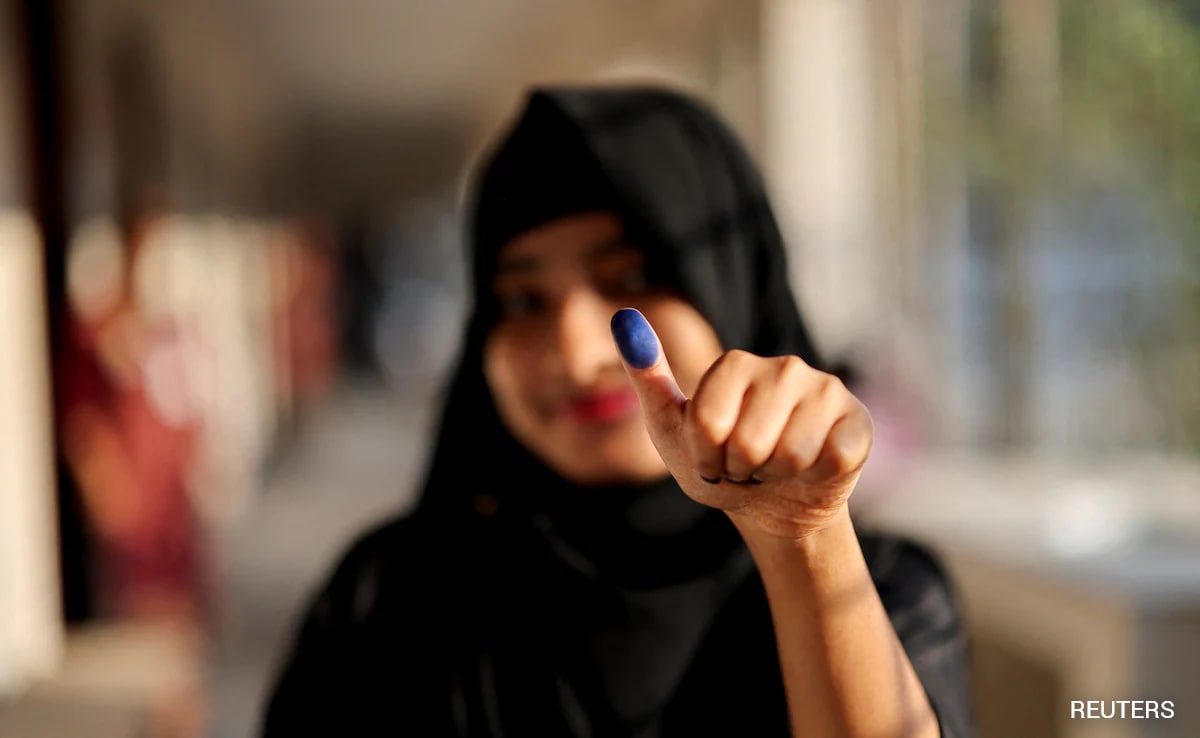
Bangladesh Elections Live: "Our Priority Will Be To Ensure Safety, Security Of Women," Says BNP Chief Tarique Rahman
Addressing the media outside the polling station in Gulshan, Dhaka, BNP Chairperson Tarique Rahman spoke about violence and ensuring women security.
"Some unexpected incidents took place last night. Law enforcement has acted to bring the situation under control. If people come out an vote, no conspiracy will succeed," he said.
Talking about BNP's priorities, Rahman said, "If we win, will be ensuring law and order situation. We will ensure everyone feels safe in Bangladesh . We cannot leave women behind. Our priority will be to ensure safety and security of women."
Bangladesh Elections Live: Security Tightened Outside Polling Centres
Security has been tightened outside polling centres in Bangladesh, with personnel deployed to manage crowds and ensure smooth voting.
#WATCH | Security has been tightened outside polling centres in Bangladesh, with personnel deployed to manage crowds and ensure smooth voting.#BangladeshElections2026 #BangladeshElections pic.twitter.com/QpEGpF2KY1
— NDTV WORLD (@NDTVWORLD) February 12, 2026
Bangladesh Elections Live: People Queue Up To Cast Their Votes
Bangladesh is voting for a crucial national election today, the first since the July 2024 uprising that ended former Prime Minister Sheikh Hasina's 15 years of iron-fisted rule.
— NDTV (@ndtv) February 12, 2026
As Bangladesh votes, NDTV's Saurabh Gupta (@MickyGupta84) reports LIVE from Dhaka… pic.twitter.com/YVzuH4Aul0
Hindu Man Ratan Shuvo Kar Killed In Bangladesh On Election Eve, Hands And Legs Were Tied
A 28-year-old Hindu man was found dead with visible injury marks on his body in Moulvibazar district in Bangladesh on Wednesday, a day before crucial voting, triggering fresh concerns among minorities about election violence amid a volatile political climate. Police said the body of Ratan Shuvo Kar, a worker of Champara Tea Garden under the Islampur union, was found with his hands and feet tied.
Bangladesh Elections Live: Clashes Reported Between Jamaat And BNP Supporters
Clashes have been reported between Jamaat and BNP supporters in Mirpur-10 Constituency in Dhaka.
Jamaat-e-Islami chief Shafiqur Rahman is contesting from this seat.
#BREAKING | Clashes Reported Between Jamaat And BNP Supporters
— NDTV (@ndtv) February 12, 2026
NDTV's @MickyGupta84 Reports LIVE From Dhaka#BangladeshElections2026 pic.twitter.com/dwMoC4zCsv
Bangladesh Elections Live: Yunus' Role In The 1971 Bangladesh Liberation War
During the war, he founded the Bangladesh Citizens' Committee in the US to raise awareness, support and funds. All members of the committee were required to contribute 10% of their salaries every month to the fund.
He even published the Bangladesh Newsletter from his home in Nashville to convey the news of the Bangladeshi people through the US media.
He narrated the scenario in his autobiography called "Banker to the Poor."
"On 25 March 1971, the Liberation War broke out in Bangladesh, and our plans to return there were abandoned. I devoted myself to the cause of liberation. Like all Bengalis, I was keeping a close watch on the events in Dhaka," he wrote.
Yunus even stated that he organised protests in the US, and they were widely covered by the media. He also helped set up the Bangladesh Information Centre in Washington to coordinate lobbying in the US House and Senate. He travelled across US university campuses to organise teach-ins and awareness programs.
On December 16, 1971, Bangladesh gained independence, and he returned to the country.
Bangladesh Elections Live: All About Muhammad Yunus, The Nobel Laureate Leading Bangladesh's Interim Government
Born in 1940 in the Chittagong District of the Bengal Presidency (now in Bangladesh), he studied in Lamabazar Primary School. He passed the matriculation examination from Chittagong Collegiate School, ranking 16th among 39,000 students in East Pakistan.
In 1957, Yunus enrolled in the Department of Economics at Dhaka University and completed his graduation in Economics in 1960 and master's in 1961. In 1965, he was awarded a Fulbright scholarship to study in the US, where he completed his PhD in Economics in 1969.
Bangladesh Elections Live: When Sheikh Hasina Was Accused Of Authoritarian Rule
Despite economic growth, her administration faced increased criticism from opposition parties and rights groups. Journalists and activists complained of growing restrictions. Some reporters were arrested or charged under digital security laws for online posts.
In 2024, protests first began on university campuses in Bangladesh. The issue was a long-standing quota system in government jobs. Soon, the demonstrators began raising broader issues such as a lack of political freedom, employment opportunities and arrests of critics.
By mid-2024, the protests had grown beyond the government's control. As unrest spread across the country, Hasina was forced to leave Bangladesh and seek refuge in India. She is observing the polls from here.
Bangladesh Elections Live: When Sheikh Hasina Entered Politics
In 1975, Sheikh Hasina, 27 years old at the time, was living abroad. While she was away, Bangladesh went through one of its darkest moments. Hasina's father and the country's first Prime Minister, Sheikh Mujibur Rahman, was murdered by rebel army officers. In the same attack, she lost her mother and three brothers.
Six years later, she returned to the country and took charge of Awami League, her father's political party. It was a tumultuous time for Bangladesh; the army had seized power from the civilian government, and leading politicians such as Hasina and Khaleda Zia were often arrested.
In the 1980s, Bangladesh was ruled by military dictator Hussain Muhammad Ershad. Despite being rivals, Hasina and Khaleda Zia joined hands to end military rule, and in 1990, Ershad was forced to step down.
Soon after, Hasina and Zia fell out, and for decades, Bangladeshi politics revolved around these two women.
Bangladesh Elections Live | Sheikh Hasina: The Rise, Rule And Downfall Of Bangladesh's 'Iron Lady'
For nearly two decades, Sheikh Hasina stood as one of the most powerful faces in Bangladesh's politics. She was often described as the country's "Iron Lady."
Hasina, who served multiple terms as Bangladesh's Prime Minister before a powerful student-led movement overthrew her Awami League government, is now watching the country go to the polls from across the border in India. The Awami League has been banned from contesting elections.
Under her leadership, Bangladesh saw major infrastructure projects, including bridges, highways and metro rail systems, take shape. The economy also grew steadily. For many ordinary citizens, life became stable compared to the past. But her critics accuse her of ruling like an autocrat.
Bangladesh Elections Live: All About Bangladesh's Student-Led Party That Toppled Sheikh Hasina
The Jatiya Nagarik Party (JNP), also known as the National Citizen Party (NCP), is a political outfit formed by student leaders who helped topple Hasina's 16-year rule.
The movement began in July 2024 as protests against discriminatory public-sector job quotas, a long-standing grievance among students and young graduates. The anger soon grew into a revolt against corruption, repression, and the lack of fair elections under Hasina's Awami League.
The government responded with brutal force. Police, paramilitary units, and ruling-party student activists cracked down on demonstrators. Curfews were imposed, and the military was deployed. According to United Nations estimates, up to 1,400 people, many of them students and teenagers, were killed.
Videos of police shootings and battered protesters went viral. Within weeks, protests turned into a nationwide rebellion. On 5 August 2024, Hasina resigned and fled to India. In November 2025, she was sentenced to death by a Bangladesh court for crimes against humanity.
Hasina, Zia Gone, Bangladesh To Vote In Most Important Polls In Decades Today
The polls will be held in the absence of its two most towering political figures, former Prime Minister Sheikh Hasina, who has been in India since she was deposed in 2024, and Khaleda Zia, who died in December 2025.
Bangladesh Elections Live: Why Bangladesh's Jamaat-e-Islami Is Controversial
- Role in the 1971 Liberation War - Jamaat opposed Bangladesh's independence and sided with West Pakistan. Its leaders helped form paramilitary groups like Razakar and Al-Badr, which killed thousands of civilians, raped hundreds of thousands of women, and targeted Hindus.
- War Crimes And Trials - In 2009, the International Crimes Tribunal (ICT) convicted top Jamaat leaders for genocide and crimes against humanity. Some were executed, and the party's registration was banned in 2013 for violating the constitution.
- Political Violence - Its student wing, Islami Chhatra Shibir, has been involved in violent clashes with rivals and unrest. Critics link Jamaat to radical Islamist networks.
- Islamist Agenda vs Secularism - Jamaat promotes Sharia-based laws and has opposed women's rights reforms, raising fears about its commitment to Bangladesh's secular constitution.
- Minority Concerns - The party's rise has alarmed minorities due to past attacks on Hindus and ongoing communal tensions.
- Corruption Allegations - Jamaat leaders have been accused of financial misconduct.
Bangladesh Elections Live: Resurgence Of Jamaat-e-Islami After 2024
The student-led uprising of July 2024 toppled Sheikh Hasina and banned her Awami League party. Jamaat re-entered politics, re-organised its leadership, and started campaigning actively. Opinion polls show Jamaat now close to BNP, its former coalition partner.
The party has tried to rebrand itself as moderate. It promotes minority rights, fielded its first Hindu candidate, and presents itself as "pro-Uprising" and "anti-fascist." Its student wing, ICS, won several key university elections.
Bangladesh Elections Live: Why Jamaat-e-Islami Remains Bangladesh's Most Controversial Party
Jamaat-e-Islami was founded in 1941 by Islamic scholar Syed Abul Ala Maududi. During the 1971 Liberation War, the party opposed Bangladesh's independence and supported West Pakistan.
Its leaders formed paramilitary groups such as Razakar, Al-Badr, and Al-Shams, killing thousands of civilians, allegedly raping hundreds of thousands of women, and targeting the Hindu community. The party aided the Pakistani army in suppressing the Bengali liberation struggle.
After independence, Jamaat was banned in 1972 for misusing religion for political gains. The ban was lifted in 1979, allowing the party to return to politics. Jamaat later joined coalitions with the Bangladesh Nationalist Party (BNP) and even held ministerial positions.
Bangladesh Elections Live: The Rise And Fall Of Sheikh Hasina's Awami League
The Awami League is one of Bangladesh's oldest political parties, originally established as the East Pakistan Awami Muslim League on June 23, 1949, in Dhaka. It represented a secular and progressive voice for the Bengali population of then East Pakistan. Sheikh Mujibur Rahman, a young student activist at the time, became one of its central figures.
1970 Elections
In the 1970 general elections, the Awami League swept East Pakistan, winning 160 out of 162 seats. West Pakistan's refusal to hand over power led to political unrest and a military crackdown known as Operation Searchlight.
On March 26, 1971, Bangladesh declared independence, launching a liberation struggle led by the Awami League. Sheikh Mujibur Rahman was arrested by Pakistani forces, while the Awami League-led Mukti Bahini, backed by India, fought a nine-month war. Bangladesh achieved independence on December 16, 1971, with Rahman hailed as the nation's founding father.
Bangladesh Elections Live: How Bangladesh Nationalist Party Was Founded
The BNP was founded by former Bangladesh President Ziaur Rahman on September 1, 1978. The party's ideology is rooted in 'Bangladeshi Nationalism,' recognising the right of people from all walks of life, irrespective of their ethnicity, gender or race.
As per its founding declaration, the BNP was established to achieve "unbreakable national unity and a broad-based democratic political structure," national economic liberation, self-reliance, as well as freedom from imperialism, expansionism and neo-colonialism.
During the 1979 elections in Bangladesh, the BNP bagged 207 seats, while the Awami League was restricted to 39 seats. The BNP formed the government, with Rahman stating at the time, "The first and foremost task of the BNP is to restore the democratic rights of the people."
Bangladesh Elections Live: Who Is 'Dark Prince' Tarique Rahman, Likely Frontrunner For Bangladesh PM Post
Tarique Rahman is the eldest son of former Bangladesh President Ziaur Rahman and three-time Prime Minister Khaleda Zia. His return to the country comes amid widespread political unrest, violence and debates over the interim government's role.
His father General Ziaur Rahman founded the BNP on September 1, 1978. He also played a major role in Bangladesh's liberation and set up the first civil administration in Roumari, a region that was reclaimed from Pakistani forces.
Days after Khaleda Zia's demise, Rahman formally assumed office as the Chairman of the BNP in December 2025. Before that, he was serving as the acting chairman of the BNP.
Bangladesh Elections Live: Khaleda Zia And Sheikh Hasina Feud
The Hasina and Zia feud goes back to the mid-1970s when Sheikh Mujibur Rahman and a few of his family members were assassinated in a coup. A few months later, Ziaur Rahman, then deputy army chief, took control and became president in 1977.
Since the 1980s, the contest between Zia and Hasina has gone far beyond electoral competition, fueling violence, hollowing out democratic politics and paralysing governance.
While Hasina championed secularism and continuity with the liberation struggle of 1971, Zia, at the helm of the BNP, emphasised conservative values and a stronger role for religion in politics, as well as a distinct nationalist narrative.
Zia's supporters saw her as polite and traditional, someone who chose her words wisely. Hasina was considered far more outspoken and assertive.
Interestingly, the two leaders joined hands to lead a popular uprising for democracy. This ultimately toppled military ruler Hossain Mohammad Ershad in 1990.
The cooperation between the two leaders did not last long. Once democracy was restored, the rivalry became the central axis of Bangladeshi politics.
Bangladesh Elections Live | Begums Of Bangladesh: Khaleda Zia And Sheikh Hasina's Tryst With Power
Over the past few decades, the political history of Bangladesh has been profoundly shaped by the rivalry between two towering figures: Sheikh Hasina and Khaleda Zia, often called the "Battle of the Begums."
Khaleda Zia, the wife of former President Ziaur Rahman, served as the prime minister thrice since 1991.
Hasina is the daughter of Sheikh Mujibur Rahman, Bangladesh's founding father. The five-time prime minister was ousted from power in August 2024. She's currently no more than an outside observer in this election.
The two women not only inherited their political parties but also competing visions of the country's identity.
Bangladesh Election Live: BNP Wants Best Of Both Worlds - Hasina's Return And Good Ties With India
The Bangladesh Nationalist Party (BNP) led by Tarique Rahman seems undecided about what kind of relationship to keep with neighbouring India.
Two things illustrate this. First, the BNP's manifesto released last week talked about working to improve ties with neighbours for growing together.
And second, the manifesto alluded to India as the BNP accused it of border killings and push-ins, which Rahman's party said will stop with strong measures.
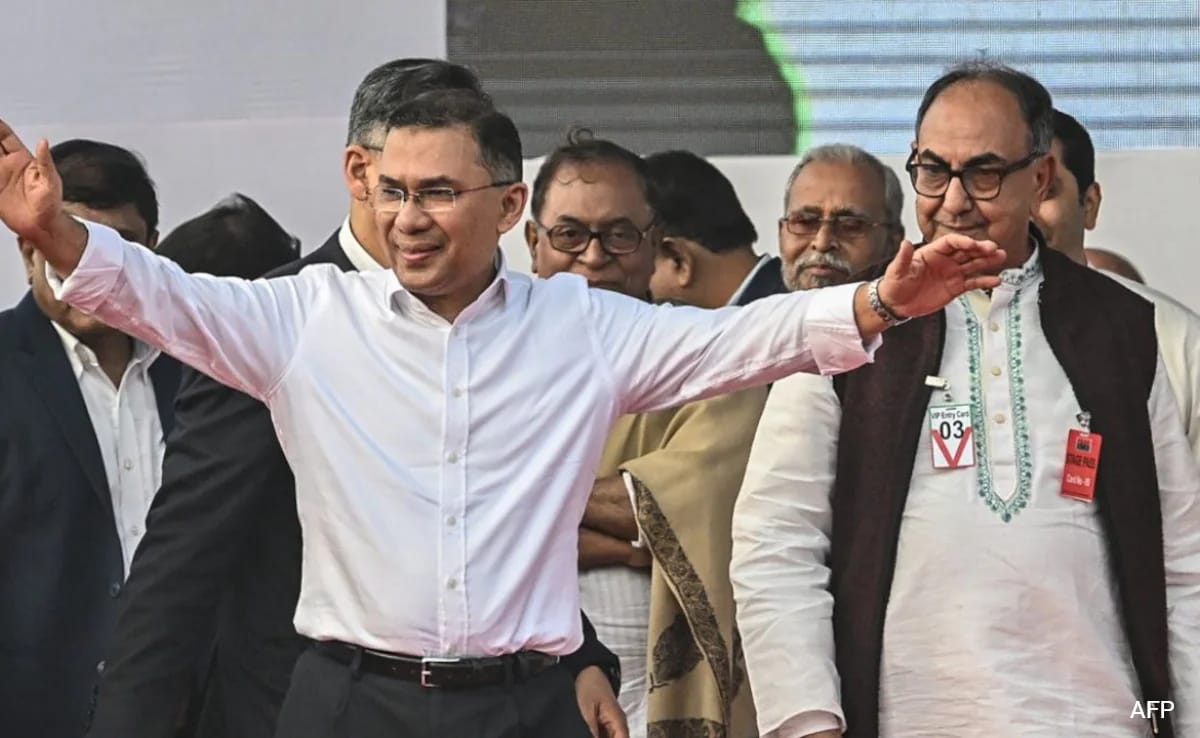
Bangladesh Elections Live: Bangladesh Votes In A First Without Sheikh Hasina, Khaleda Zia
Khalida Zia and Sheikha Hasina held the prime minister's post alternately from 1991 until the Awami League chief came to power in 2009. Hasina remained in the post for over 15 years and 200 days and had won elections again in 2024, until she was deposed months later.
These elections are the first without two of the most consequential political figures in the country in decades. People in Bangladesh are casting their votes in a completely changed political landscape and hope to start a new chapter in the country's history.
Bangladesh Elections Live: Voting Begins
Voters will cast their ballots for 299 seats in the Jatiya Sangsad, or parliament, for which the majority mark will be 150. Voting has been cancelled in the Sherpur-3 constituency following the death of a candidate.
A total of 12.77 crore registered voters will cast their votes in the first-past-the-post system. Voting began at 7.30 am local time (7 am IST) and results should start trickling in by evening.
Bangladesh Election 2026: Voting Time, Results- What To Know About Bangladesh Elections
Polls will open at 7:30am (01:30 GMT) on February 12 and close at 4:30pm (10:30 GMT). The polling will involve more than 127 million eligible voters in the nation of some 170 million people, with 1,981 candidates contesting across 299 parliamentary seats nationwide, according to the Election Commission of Bangladesh (ECB). Bangladeshi citizens living abroad will also be able to participate through a postal voting system for the first time.
Bangladesh's national legislature comprises 350 lawmakers. Of these, 300 are elected directly from single-member constituencies, while an additional 50 seats are reserved for women. Elections are conducted under a first-past-the-post system, so if a party wins 60 seats, it receives 10 reserved seats to be allocated to female politicians. Each parliament serves a five-year term.
Bangladesh operates a plurality voting system under which voters make one choice from a list of candidates, and, after the votes are counted, the candidate with the most votes wins the seat. This means that a party can win a large number of seats by only small margins, reflecting an imbalance between overall vote share and overall seats won.
Bangladesh Election 2026 | Bangladesh's 'Red Maulana': The Life And Legacy Of Abdul Hamid Khan Bhashani
He was an unconventional figure in politics. He started his journey as an Islamic cleric and defied all preconceived notions to emerge as a secular figure. Abdul Hamid Khan Bhashani, remembered as Maulana Bhashani or the “Red Maulana,” was the first president of Awami League, the party now banned from contesting the February 12 general elections.
Bangladesh Election 2026 | The End Of Sheikh Hasina's Reign: July 2024 Bangladesh Uprising Revisited
Students in Bangladesh started protesting in early July 2024 and demanded reform in the job quota system that reserved more than half of government jobs.
Bangladesh Election LIVE Updates: "Historic Poll," Says EU Observer
As Bangladesh prepares to vote on February 12, the Election Commission and security agencies have completed final arrangements aimed at ensuring a peaceful polling process. Results are expected to be confirmed on Friday, February 13.
Ivars Ijabs, Chief Observer of the European Union Election Observation Mission (EU EOM) for Bangladesh's 2026 parliamentary elections, underscored the historic significance of the polls, emphasising the EU's neutral and fact-based approach to assessment.
"The European Union has gladly responded to the invitation of the Bangladesh interim government and the Central Electoral Commission to observe these elections, recognising that they are historic and important for Bangladesh," Ijabs said while speaking to ANI.
Outlining the mission's mandate, he stated, "The end result of that is to produce a report on those elections about what have been the strengths, what have been, if any, problems or weaknesses. Our task is not to get involved in the political game. We are non-partisan and neutral."
Placing the observation exercise within the broader framework of EU-Bangladesh relations, Ijabs noted, "This is one of the steps in expanding our cooperation with Bangladesh, given how important these elections are after a lengthy period without credible, competitive elections."
He added that the mission's final report would recommend improvements to democratic processes. "We really need credible partners, and Bangladesh is, of course, a close partner. We want to build and expand this partnership on the basis of democracy, the rule of law, and accountability in the exercise of political power, which is why we are observing the reform process."
Bangladesh To Give Rs 37 Lakh Aid To Family Of Lynching Victim Dipu Chandra Das
The Bangladesh government has announced it will provide financial assistance and support for the family of Dipu Chandra Das, who was lynched in Mymensingh district last year in December.
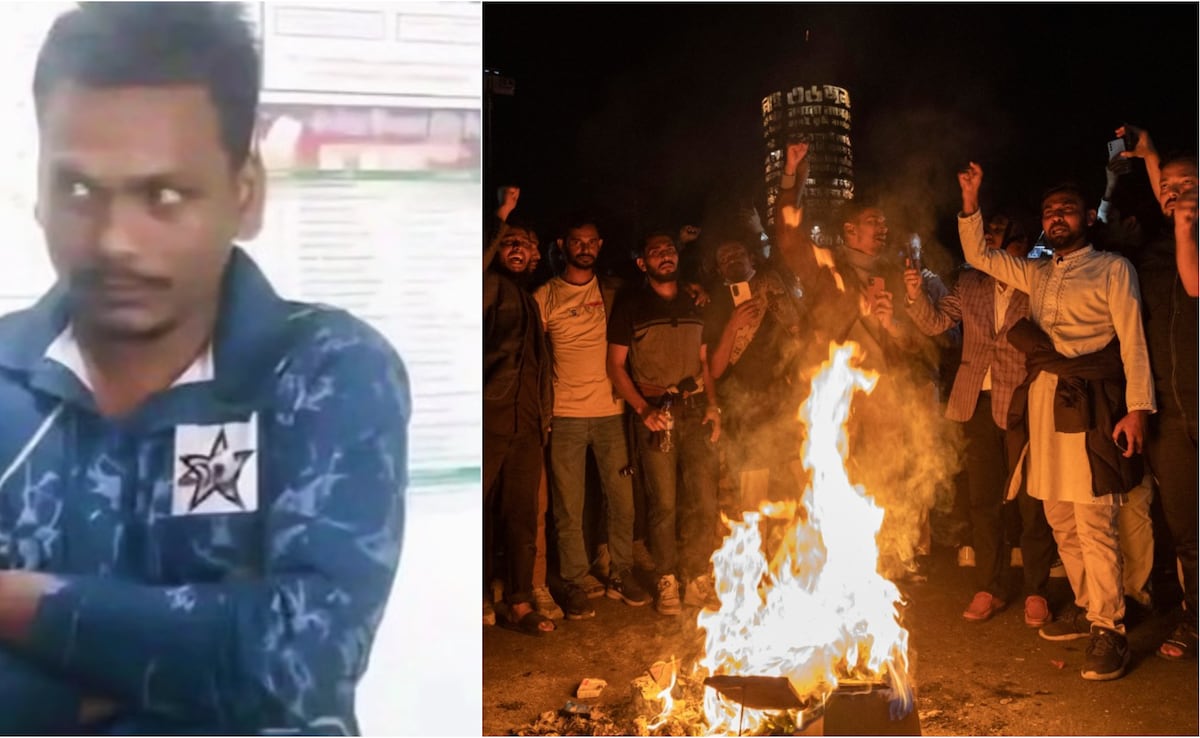
Bangladesh general election February 12, Bangladeshi Hindus' 'Future Concerns' Amid Rising Violence Ahead Of Polls
As Bangladesh is on the cusp of a historic election, the Hindus in the nation are grappling with living in fear of reprisals after the election as the targeted killings of Hindus continue in Bangladesh.
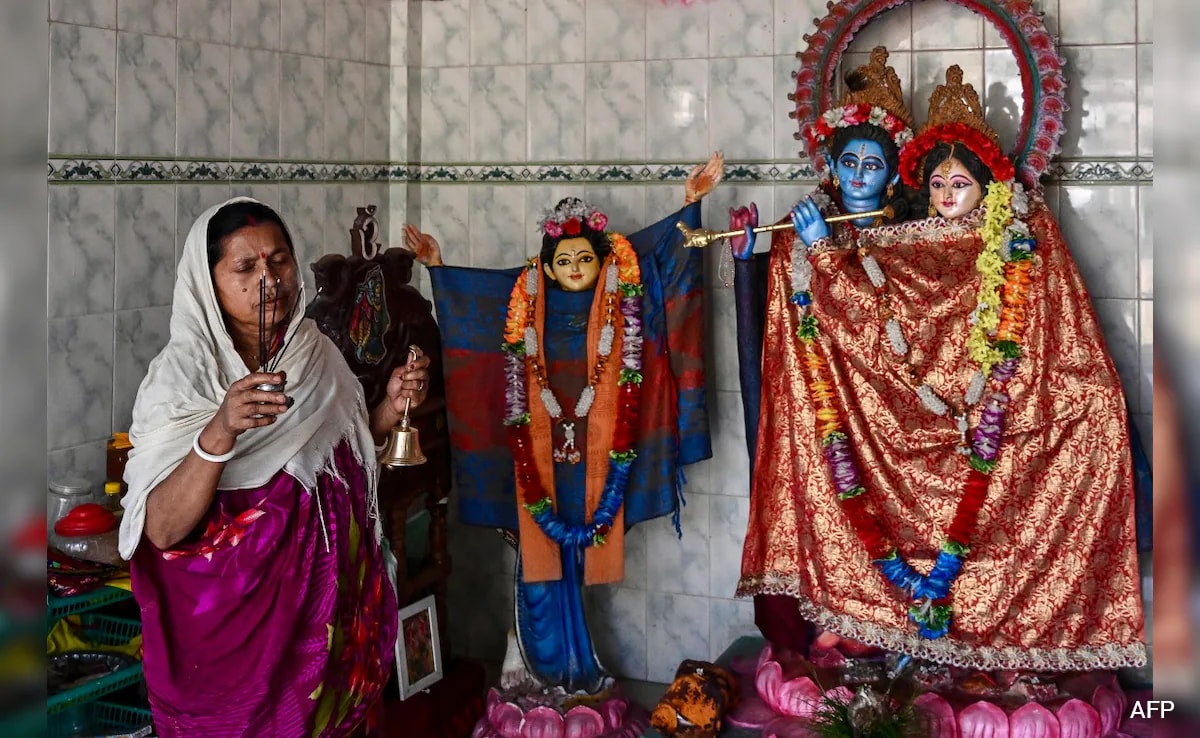
Bangladesh Voting LIVE: 394 International Observers, 197 Foreign Journalists To Monitor Voting
At least 394 international election observers and 197 foreign journalists have arrived in Bangladesh to observe the country's 13th general election and the referendum on the July National Charter, both scheduled to be held on Thursday, the Chief Adviser's Press Wing said in a statement on Wednesday.
Of the international observers, 80 represent various international organisations.
A total of 240 observers are from bilateral countries, including independent European observers.
Another 51 are individuals affiliated with different global institutions.
"The number of international observers for the upcoming polls is more than double that of the controversial general election held on January 7, 2024. By comparison, the 12th, 11th, and 10th general elections were monitored by 158, 125, and just four international observers, respectively," the statement added.
Key organisations sending observer missions include the Asian Network for Free Elections (ANFREL), with 28 observers, and the Commonwealth Secretariat, with 27.
The US-based International Republican Institute (IRI) has deployed 19 observers, while the National Democratic Institute (NDI) has sent one.
Bangladesh Polls: How Yunus' Fate Will Also Decide The Country's Fate
Yunus sees himself as the prime candidate for the post of President. Yet, on the streets of Bangladesh, he is unpopular and much reviled.
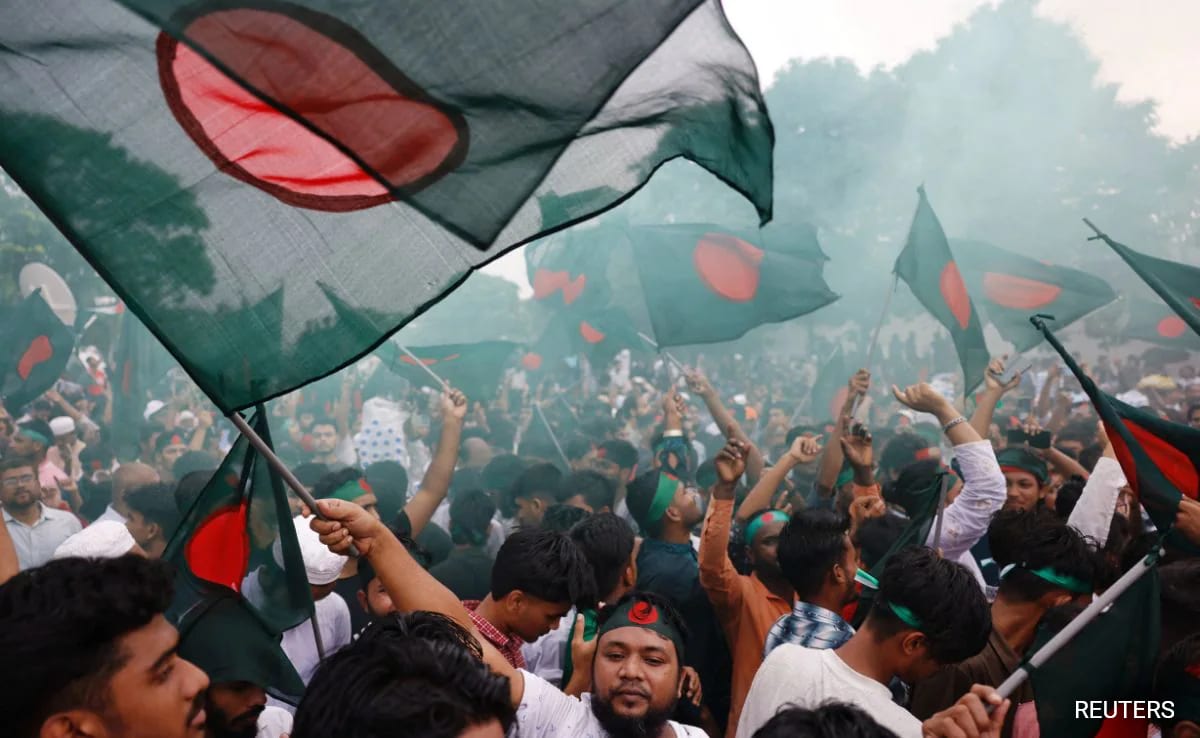
Bangladesh Election 2026: 24 Hours Before Bangladesh Votes, US Lawmakers' "Not Free Or Fair" Warning
With Bangladesh heading into national elections in less than 24 hours, a rare and urgent congressional briefing on Capitol Hill has thrown a harsh spotlight on what speakers described as the accelerating persecution of Hindu.
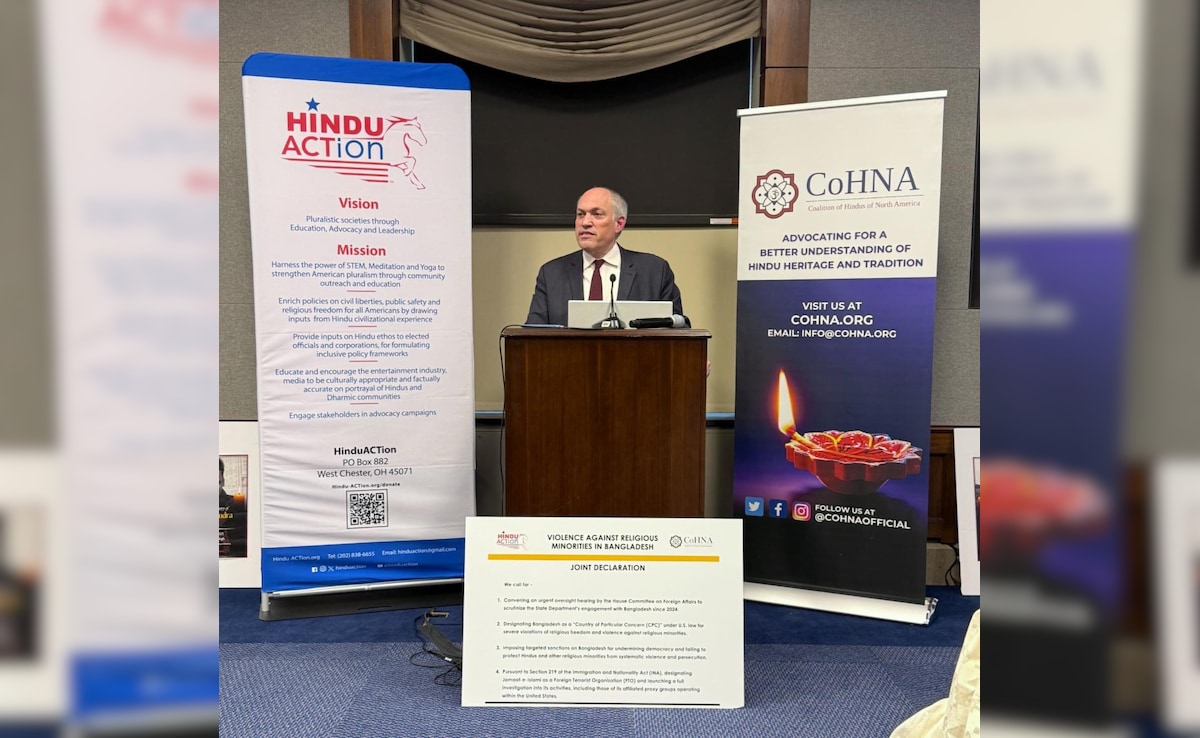
Elections 2026 LIVE: Exiled Envoy Says 2026 Election Among 'Ugliest In Bangladesh's History'
Mohammad Harun Al Rashid, a seasoned Bangladeshi diplomat, in an exclusive interview with a leading think tank, described Bangladesh's national election slated for Thursday as one of the "ugliest" in the country's history.
He warned that the interim government's Chief Advisor Muhammad Yunus, who has long survived by repackaging the grotesque as virtue, cannot evade accountability.
In an interview with Sri Lanka-based think tank Trinco Centre for Strategic Studies (TSST), Rashid said, "Like everything Yunus calls 'beautiful', this election is among the ugliest in Bangladesh's history, and that is not hyperbole. Yunus has long survived by repackaging the grotesque as virtue. This time, he will not get away with it."
He asserted that what is unfolding is not a genuine election but a contest between two factions of the 2024 "jihadist coalition" that seized power by overthrowing former Bangladesh Prime Minister Sheikh Hasina.
He argued that on one side stands the Bangladesh Nationalist Party (BNP) and its allies, while on the other is the radical Islamist party Jamaat-e-Islami and its partners.
Bangladesh Election 2026 LIVE Updates: What's At Stake
The election is going to be the first since the ouster of Sheikh Hasina, who now lives in exile in India. She was sentenced to death in absentia last year by a special tribunal under the Yunus-led administration. The charges against her relate to crimes against humanity over the deaths of hundreds of people during the 2024 uprising.
The election results will serve as an important test of whether popular protest movements by young people can translate into durable democratic change. Nearly 5 million people are new voters and will be casting their ballots for the first time.
An increasingly urgent concern in Bangladesh is the rising prominence of hard-line groups. Their influence has raised alarms about the rights and safety of women and religious minorities. Minority communities, particularly Hindus, report increased intimidation and incidents of violence, deepening fears about their place in the Muslim-majority nation.
There are growing concerns that the Islamist coalition could exploit these tensions to reassert political influence. Bangladesh is over 90 per cent Muslim, while around 8 per cent are Hindu.
Bangladesh Election LIVE: Who Are Frontrunners In First Post-Hasina Polls
Bangladesh’s political landscape has for decades revolved around two rival dynasties. On one side is the Awami League, headed by Hasina, the daughter of the country’s founding president. Opposing it is the Bangladesh Nationalist Party, now led by Tarique Rahman, son of former Prime Minister Khaleda Zia . who died in December.
With the Awami League banned, the BNP has emerged as the front-runner, positioning Rahman as the leading candidate. Rahman returned to Bangladesh in December after 17 years in self exile and has promised to rebuild democratic institutions, restore the rule of law and revive the economy.
Challenging the BNP is a broad 11-party coalition spearheaded by the Islamist Jamaat-e-Islami, which is seeking to expand its influence in national politics. Jamaat-e-Islami was banned under Hasina but has gained influence since her ouster.
The alliance also includes the newly formed National Citizen Party, created by leaders of the 2024 uprising.
Bangladesh Election 2026 LIVE: All About Post-Hasina Polls
Polls will open at 7:30am (01:30 GMT) on February 12 and close at 4:30pm (10:30 GMT). The polling will involve more than 127 million eligible voters in the nation of some 170 million people, with 1,981 candidates contesting across 300 parliamentary seats nationwide, according to the Election Commission of Bangladesh (ECB). Bangladeshi citizens living abroad will also be able to participate through a postal voting system for the first time.
Bangladesh's national legislature comprises 350 lawmakers. Of these, 300 are elected directly from single-member constituencies, while an additional 50 seats are reserved for women. Elections are conducted under a first-past-the-post system, so if a party wins 60 seats, it receives 10 reserved seats to be allocated to female politicians. Each parliament serves a five-year term.
Bangladesh operates a plurality voting system under which voters make one choice from a list of candidates, and, after the votes are counted, the candidate with the most votes wins the seat. This means that a party can win a large number of seats by only small margins, reflecting an imbalance between overall vote share and overall seats won.


