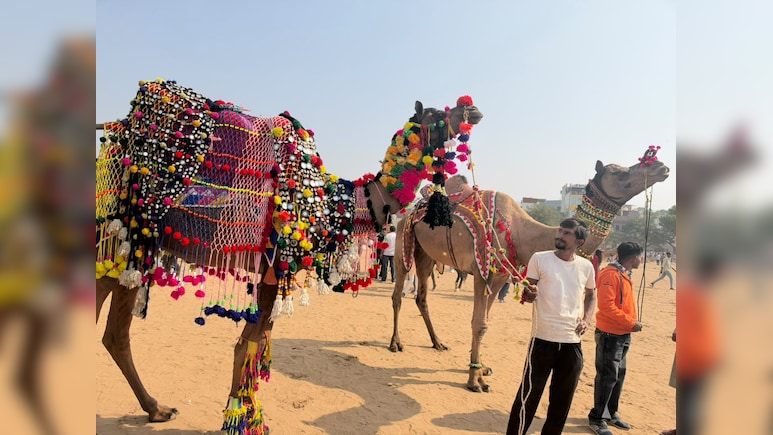
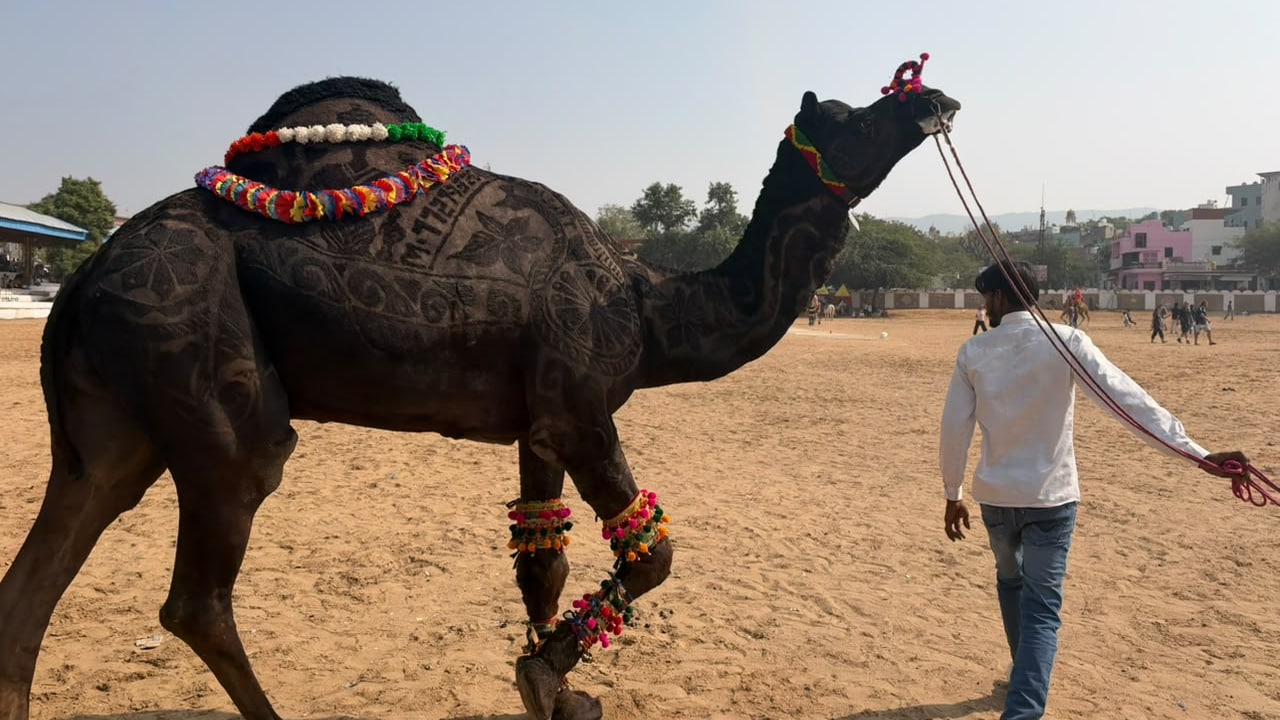
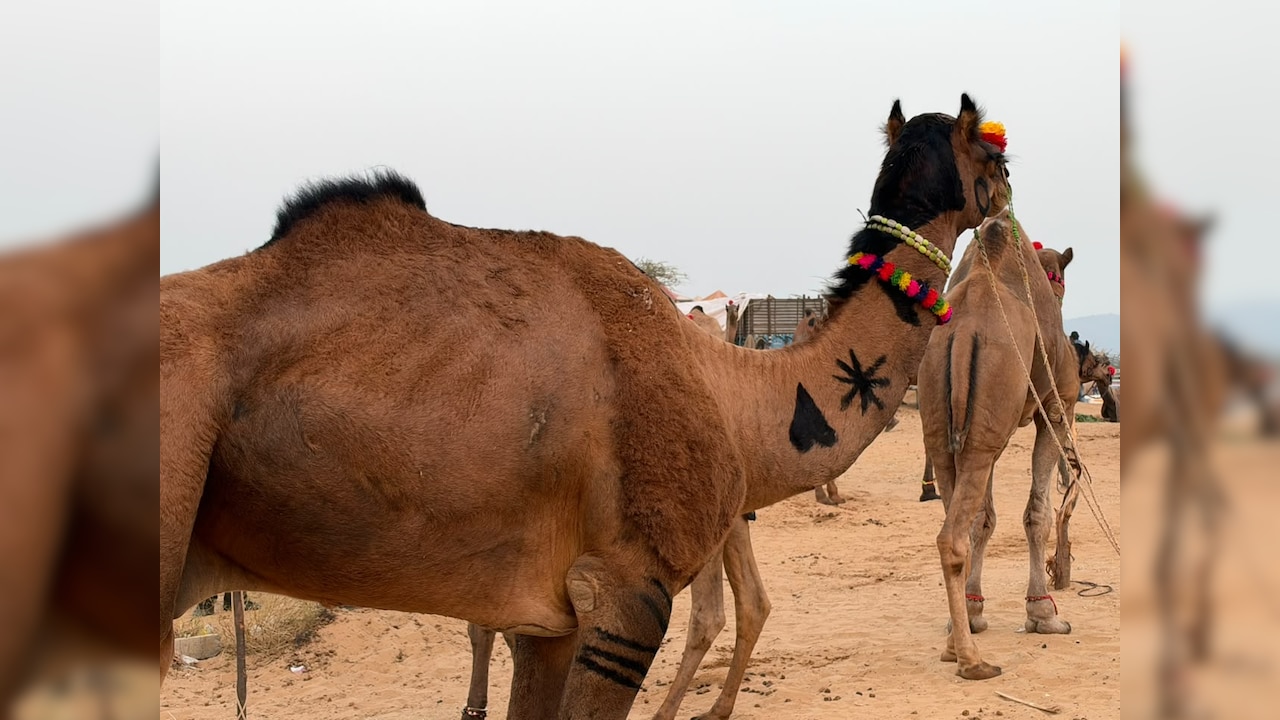
The camels arrived at the Pushkar Fair in all their splendour, sporting black-dyed "haircuts", intricate patterns shaved into their coats, and words and motifs etched across their fur.
Their look was completed with colourful bridles, glittering nose rings, jingling anklets and handcrafted ghorbands - decorative necklaces that are an iconic symbol of Rajasthan's folk culture.
A camel beauty contest was followed by a dance performance, with the animals showing off tricks to the beat of traditional drums.
Grooming Camel Hair, Beautiful Handmade Gorband
Ashok brought his six-year-old camel, Sultan, for the exhibition.
"It takes us four to five days to get a camel ready for the competition," he said. "Sultan doesn't actually have hair, but we have applied dye to his head to make it look as though he does. There is a special razor used to trim camel hair and create designs on their bodies.
He explained, "The ornament around his neck is called a gorband. We make these by hand at home, and sometimes it takes an entire year to complete one. We have also adorned him with a garland."
Dwindling Number Of Camels
"But what worries us is that 10 years ago, at least 10 to 15 camels would participate in this competition. Today, there are only five. This is a matter of concern for us," Ashok said.
Once synonymous with the Pushkar Fair, camels were at the heart of Rajasthan's rural economy, drawing traders and livestock breeders from across the region.
But times have changed. Today, the animals are more likely to be seen competing in beauty contests and performing for visitors than being bought and sold. While the spectacle adds colour to the fair, breeders are increasingly worried about the rapid decline in Rajasthan's camel population.
A Shrinking Space for Camel Breeders
At the far end of the Pushkar fairground lies the camel encampment.
Ganesh and Deva, two camel breeders from a village near Pushkar, are among those camped here. Both are worried about the future of camel rearing.
"Camels need to graze," says Deva. "They cannot be stall-fed. I have 10 camels. You cannot simply tie them up and feed them fodder. They need grazing land and access to forests, where they can roam and find their own food."
"But now the government has put up fencing in many places, and grazing lands have been encroached upon. Keeping camels is no longer economically viable," he added.
Further, he questioned, "Camel milk fetches only Rs 10-20 per litre, whereas cow and buffalo milk sells for Rs 40-50 per litre. What option does a camel breeder have in such circumstances?"
Ganesh says the decline is also linked to changing demand. "There was a time when camel wool was in demand, and camels were sought after for weddings and other occasions. Just look at the Pushkar Fair today. Camels are confined to one corner, while horses are everywhere."
Dr Naveen Parihar, Joint Director in the Animal Husbandry Department and currently deployed at the fair, acknowledges that the decline is a matter of concern.
According to the 2019 Livestock Census, Rajasthan had 212,739 camels, down from 421,836 in 2007.
Why Is The Number Of Camels Declining?
Officials attribute the fall to mechanised farming, expanding road networks, shrinking grazing land, restrictions on forest grazing and curbs on inter-state camel trade following the Rajasthan Camel Act of 2015.
Camel rearing is no longer as rewarding as it once was, prompting younger generations to move away from the occupation.
"We need to take steps to stop the dwindling numbers of camels," said Dr Parihar. "We have made several suggestions to promote camel rearing and support breeders. Camel milk has several health benefits, particularly for people with diabetes. If arrangements can be made to transport camel milk to larger markets, it could benefit the breeders."
He added, "We also want to develop a dedicated Camel Village here, along the lines of Jaipur's Hathi Gaon, which could serve as a shelter and conservation centre for camels."
READ | Man Seen Working On Laptop While Riding Camel In Sahara Desert, Leaves Internet In Stitches
Once the heart of Pushkar's livestock trade, the camel camp now looks deserted.
Every morning, photographers arrive in large numbers, paying owners Rs 2,000-3,000 to pose camels against the rising sun. Now, the camel, once central to Rajasthan's desert economy and trade, is increasingly valued more as a photographic backdrop than as a working animal.
Track Latest News Live on NDTV.com and get news updates from India and around the world


