




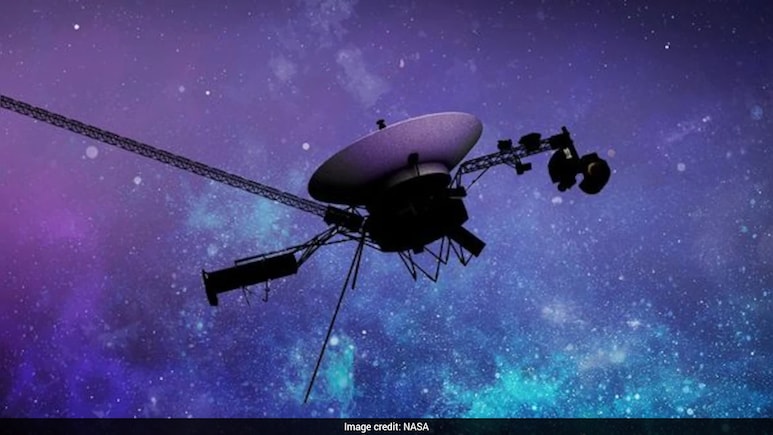
NASA's Voyager 1 spacecraft is going to be the farthest human-made object in existence, reaching a distance of one light-day from Earth on Wednesday (November 18). But have you ever wondered what one light-day away from Earth actually means? Imagine turning on a powerful flashlight and aiming it straight up into the night sky. The beam starts travelling out into the solar system and keeps going. The distance that flash of light travels in twenty-four hours of nonstop flying is what astronomers call a light-day.
A light-year is the distance light travels in one year. Light travels through interstellar space at 186,000 miles (300,000 kilometres) per second and 5.88 trillion miles (9.46 trillion kilometres) per year.
Also read | 'AI Or Robert Pattinson: Who Will Steal Your Job Faster?' Internet Reacts To New James Bond
And a light-second is the distance light covers in a single tick of a clock, about the trip from Earth to the Moon. A light-minute gets you past the Sun. But a light-day? That is roughly 16 billion miles (or about 26 billion kilometres).
Earth is about eight light-minutes from the Sun. In a blog, NASA explained, "A trip at light speed to the very edge of our solar system - the farthest reaches of the Oort Cloud, a collection of dormant comets way, way out there - would take about 1.87 years."
"Keep going to Proxima Centauri, our nearest neighbouring star, and plan on arriving in 4.25 years at light speed," NASA added.
Right now, the first human-made object is scripting history.
Also read | "She's Angry": Boss Refuses Employee's Leave Request Despite Unused Earned Leave Balance
A record-breaking journey
The Voyager 1 spacecraft, launched way back in 1977, is nearing a full light-day away from Earth. NASA confirmed that the spacecraft is speeding at 38,000 mph (61,155 kph) and that on November 18, it will have travelled farther than any other human-made object will be, that is, 16.09 billion miles (25.89 billion kilometres) from Earth, the equivalent of one light-day, or the distance that light can travel in one day.
When NASA engineers send a radio signal to the probe, it takes an entire day just for the signal to reach the spacecraft. And if Voyager 1 sends a message back, Earth has to wait another twenty-four hours for the reply.
"If you want to say 'hello' to Voyager, you send your message, and then you go home, and you wait two days before you finally get a response," Suzanne Dodd, Voyager project manager at JPL, recently said.
Track Latest News Live on NDTV.com and get news updates from India and around the world

