





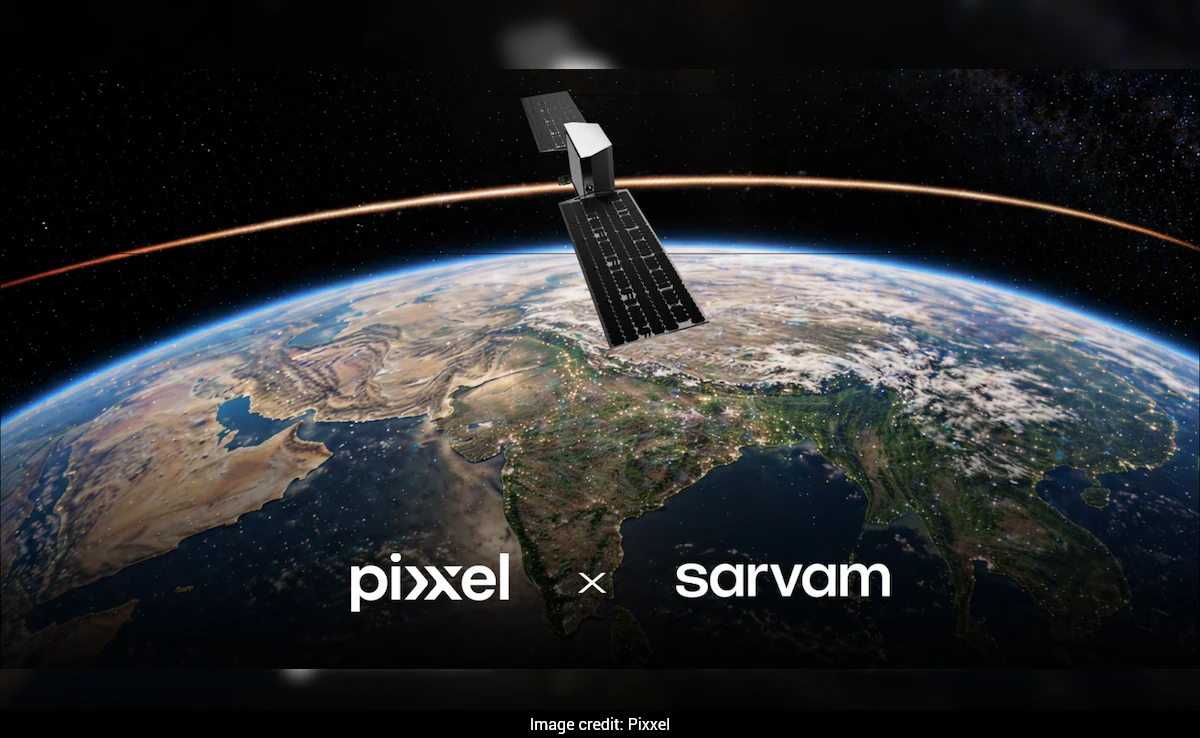
On a day celebrated globally as Star Wars Day, May 4, two Indian technology start ups chose to make a statement that reaches well beyond symbolism. Pixxel and Sarvam announced plans to jointly build what could be India's first sovereign artificial intelligence (AI) enabled space based data centre, signaling a decisive push by Indian start ups to claim strategic ground at the intersection of space, AI and national capability.
The announcement comes at a moment when Indian private space companies are rapidly breaking new ground. On Sunday, GalaxEye demonstrated a unique eye in the sky capability that drew global attention. Pixxel and Sarvam unveiled development of Pathfinder, a satellite designed not just to observe Earth, but to think in orbit. In doing so, the two firms are attempting something only tested once before by a US company in 2025, placing high performance AI compute in space and processing data directly where it is captured.
Pixxel plans to design, build, launch and operate the Pathfinder satellite, a 200 kilogram class spacecraft. Scheduled to reach orbit as early as the last quarter of 2026, Pathfinder is intended as a demonstrator for an entirely new class of space infrastructure, an orbital data centre powered by Indian built AI.
Sarvam will provide the AI backbone for the mission. Its full stack sovereign language models will run directly onboard the satellite, handling training and inference in orbit without reliance on foreign cloud services or ground based infrastructure. This combination, an India built satellite carrying India built AI models, is central to the ambition both companies are articulating. Made in India, made for the world, taking atmanirbharta into outer space.
Pixxel founder and CEO Awais Ahmed framed the effort as a response to mounting pressures on Earth bound computing. "Ground based data centres are facing increasing constraints around energy, land, regulation, and scale, and the current model is becoming harder to sustain environmentally," he said. "Orbital data centres open up a new frontier, where compute can be powered by abundant solar energy, operate closer to space based data, and move beyond some of the limits faced on Earth."
For Pixxel, the Pathfinder mission also reflects its evolution from satellite imaging provider to space infrastructure builder. The company already operates six hyperspectral Firefly satellites launched in 2025, the first Indian private sector constellation in space. Pathfinder will carry Pixxel's flagship hyperspectral imaging camera, capable of capturing high fidelity spectral data across hundreds of bands. What makes this satellite distinct is what happens next. Instead of downlinking massive volumes of raw imagery to Earth for analysis, the spacecraft will process the data in orbit using foundation models running on data centre class GPUs.
This marks a stark departure from conventional satellite computing, which typically relies on low power processors designed primarily for reliability and survival. Pathfinder will host GPUs of the same generation used in terrestrial AI data centres, enabling real time pattern detection, change analysis and insight generation in space. The goal is to reduce delays between observation and action, particularly for applications such as environmental monitoring, resource management and critical infrastructure tracking.
Sarvam CEO Pratyush Kumar described the project not just as a technological milestone but as a strategic one. "AI infrastructure is not just a software question. It is a sovereignty question," he said. "Sarvam has been building India's full stack AI platform from the ground up, and partnering with Pixxel allows us to extend that sovereign stack into space."
He added that having Indian models running on Indian hardware in orbit addresses long term control over intelligence infrastructure. "The goal has always been to make intelligence accessible to everyone, everywhere. Now, everywhere includes space," Kumar said.
The timing of the announcement is notable. Indian start ups are increasingly asserting themselves in domains that were once the preserve of governments or a handful of global corporations. GalaxEye's recent demonstration of advanced Earth observation capabilities has already drawn international interest. Agnikul and NeevCloud have also signaled plans to pursue space based data centre concepts, underscoring a broader trend toward orbital compute emerging from India's private sector.
Space based data centres offer several intrinsic advantages. Solar power in orbit is continuous and abundant, removing dependence on terrestrial energy grids. The vacuum of space enables efficient passive cooling, a major challenge for Earth bound data centres. Processing data closer to where it is generated also cuts latency and reduces the need to transmit vast datasets to the ground. At the same time, bandwidth remains a key limitation. Downlinking insights rather than raw data helps mitigate this bottleneck, but high speed communication infrastructure will be crucial as orbital compute scales.
The Pathfinder mission is designed to test these tradeoffs under real operational conditions. Pixxel and Sarvam plan to validate performance, power management, thermal control and real time data workflows in the harsh space environment. The satellite will be developed at Pixxel's upcoming Gigapixxel facility, which is intended to scale production to as many as 100 satellites, reinforcing India's ability to build advanced space systems at industrial scale.
Seen in a wider context, the partnership reflects a growing confidence among Indian start ups to tackle frontier technologies head on. On Star Wars Day, the symbolism was hard to miss. Two Indian companies announcing a sovereign AI battle in outer space, not as science fiction, but as a concrete engineering mission scheduled for launch.
If successful, Pathfinder could lay the groundwork for a new layer of infrastructure orbiting above the planet, Indian owned, Indian governed and built to serve strategic and commercial needs alike. As Awais Ahmed put it, Pixxel does not want to watch this shift happen from the sidelines. With Sarvam, the company is betting that the future of planetary intelligence will be thought out in space, powered by Indian innovation.
Track Latest News Live on NDTV.com and get news updates from India and around the world

