




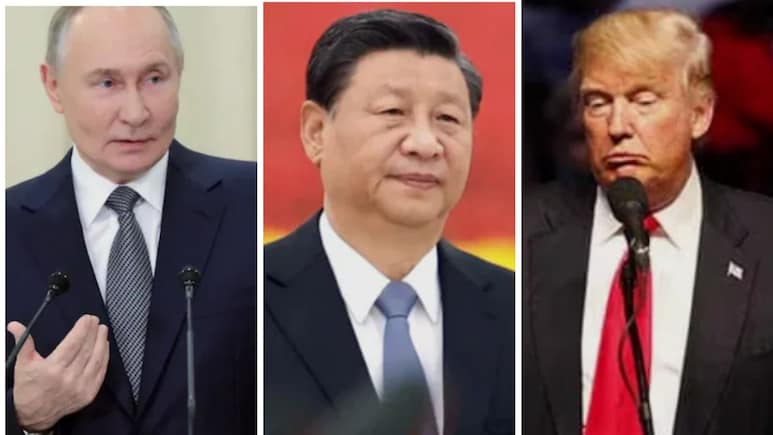
A meeting between G3 leaders -- Donald Trump, Xi Jinping and Vladimir Putin -- took place on the sidelines of the APEC Summit in Shenzhen, China, on Thursday (November 19). It is historic and unprecedented in true sense as it is the first time that these three leaders are meeting separately and exclusively. Some analysts are comparing this meet with the famous Yalta meet between the leaders of the US, UK and Soviet Union in February 1945, which was to decide how World War II is to end, how the defeated Nazi Germany will be treated and most importantly, what a post-war Europe will look like.
The discussions during the summit also led to the eventual creation of the United Nations a few months later.
This summit, too, comes against the backdrop of a war in Europe (Russia-Ukraine war) and the war in Iran. It also comes at a time of global disorder when conflicts, choked maritime routes, trade frictions and weaponisation of many critical issues is posing unprecedented challenges to the global order and world peace.
Also, the dominance and supremacy of the US in managing the 'world order' is under serious doubts as it is itself embroiled in conflicts it can't end. China is rising rapidly while keeping itself out of conflicts and Russia is showing that it still is a power to reckon with as it refuses to relent in the Ukraine war. Europe is in a rapid decline as its voice is being sidelined in most issues and a rising India is still trying to find its rightful place in the global order.
In such a scenario, how does the 'G3' meeting play out?
The US and China have contradictory and often adversarial positions on many issues and their ties oscillate between strategic competition to selective engagement. On the other hand, Russia and China enjoy a 'No Limits Friendship' and align closely on many issues, including the ongoing conflicts. On US-Russia equation, Trump claims a close personal relationship with Putin although the US and Russia stand on the opposing sides in the wars, especially Ukraine. The meeting of the three leaders thus brought together countries which cannot be called friends or allies and where each has a contrasting, if not contradictory position on major issues.
The Iran War
Given the influence that China and Russia have over Iran, it is but obvious that one of the points on the agenda of the trilateral meeting was how to end the war in Iran. It is, however, unlikely that a magic bullet would have been found in the first meeting on ending the war. It is also unlikely that any agreement or consensus taken during the meeting will actually lead to the end of the war and opening of the blockade in the Strait of Hormuz, primarily because of the massive trust deficit between Iran and the US and largely divergent positions to start any peace process.
Meanwhile, the countries in the Gulf region, which were caught in the crossfire and bore the brunt of Iranian attacks, are fully cognisant of the prevailing situation and the likely outcomes of the war. Four things are significant in this regard.
Firstly, the inadequacies of American security assurances have been exposed and the Gulf nations have been given a rude reality check on how little the billions of dollars spent on outsourced security have meant when it actually mattered.
Secondly, Iran has proven that it is a formidable military power which has not only survived unrelenting military strikes by the US and Israel but continues to build its military capabilities rapidly. And, therefore, war or no war, a future military threat from Iran cannot be dismissed.
Thirdly, with Palestine statehood pushed to the background post the Gaza war, it is difficult to see how Saudi-Israel normalisation can move forward and consequently, the expansion of Abraham Accords in the region.
Fourthly, the proxies of Iran, Hezbollah and Houthis are resurgent while Hamas is still not eliminated. Syria too has started exerting itself against Israeli expansion.
As a result, the regional countries are exploring options for a future security framework, one that does not wholly depend on the American security umbrella. Result: a slew of defence pacts signed in recent months.
Defence Pacts in Pursuit of a Collective Security
The recent defence pacts curiously predate this war in Iran. The first was the Saudi-Pakistan Strategic Mutual Defence Agreement (SMDA) signed on September 17, 2025. The agreement came soon after an Israeli missile attack into Qatar on September 9, targeting senior Hamas leadership. Although the attack failed, it has sent shock waves across the region. The SMDA had NATO Article 5 type provisions stating that "any aggression against either country shall be considered an aggression against both". It also pledged to "strengthen joint deterrence against any aggression".
The Mecca Pact signed on August 7, 2026, between Saudi Arabia, Pakistan and Turkiye too came about in the backdrop of failed security guarantees of the US and the failure of '14-Point MoU', to end the war in Iran. Once again, the pact committed to strengthen collective security and collective deterrence against any act of external aggression and that any armed attack against anyone of the three states will be regarded as an attack against all, again a NATO, Article 5 type of provision. However, when the Houthis from Yemen struck Saudi Arabia in August, the pact was found wanting as neither Turkiye nor Pakistan initially agreed to send troops to aid Saudi Arabia, with some inputs suggesting that the excuse given was that since it was a 'pre-existing conflict', the Mecca Pact did not apply. Interestingly, Egypt, which did not join the Mecca Pact, sent military support to Saudi Arabia to fight against the Houthis.
Soon, another defence pact, between Kuwait and Pakistan was announced on August 27, calling it the 'Protocol Agreement-2026'. This pact is, however, limited to training of Kuwait's military, building its defence capacity and assistance with border management. It does not contain any provision similar to NATO Article 5 or any active role against external aggression.
The Badr Pact was the next, signed between Pakistan, Turkiye, Qatar and Indonesia on October 21 in Doha. The pact "aims to foster cooperation in the field of defence manufacturing, enhance defence capabilities, and promote collaboration in technical defence training and research and development fields". A significant addition was Indonesia, a Muslim country but located well out of the region. Also, unlike the Mecca Pact or the SMDA, it did not contain NATO Article 5 type of provisions.
The most recent defence pact is the Turkiye-Qatar Mutual Defence Pact signed on November 13 in Istanbul following a high-level meeting of the Turkiye-Qatar Supreme Strategic Committee. It aims to commit them to a common position against any external armed attack on either country. It reflects "not only the commitment of its signatories to safeguarding their sovereignty and territorial integrity, but also their shared vision of contributing to a more secure and stable regional order". It, however, stops short of active support during external aggression.
Among the other countries in the Gulf region, the UAE has reportedly struck its own 'non-aggression' deal with Iran quietly while Oman continues to maintain its neutrality in the region. Bahrain, which is also a signatory of Abraham Accords with Israel, has been conspicuous by its absence in any of the pacts, but is known to normally follow the Saudi lead.
Concurrently, hectic parleys have been going on between Gulf countries and Iran on options on ending the war and a possible security framework which contains 'non-aggression' features and strict monitoring mechanisms. Obviously, Iran is demanding that US military bases should be first removed from the region. In this context, the visit by Mecca Pact countries to Iran on October 26 is particularly interesting. During the visit, Saudi Defence Minister Khalid bin Salman Al Saud, Pakistan's army chief Asim Munir and Turkish intelligence Chief Ibrahim Kalin met Mohsen Rezaei, Secretary of Iran's Supreme National Security Council. The statement that the four states "agreed to continue the dialogue to strengthen cooperation amongst the four regional countries, including for peace and security in the region", is reflective of the possibilities being explored.
Conclusion
The meeting of the G3 is an important signal to the world, especially in context of diminishing US supremacy, emerging global influence of China and Russia's continued resilience and relevance. However, the conflict in West Asia is no longer about who rules the world but more about how the region visualises its own collective security for the future.
The defence pacts and ongoing dialogue with Iran are clearly indicative of the fact that sole reliance on an external security guarantee is no longer a viable option. And therefore, an inclusive security architecture with strong sovereign military capabilities and a 'non-aggression' pact with strict monitoring mechanisms between countries North and South of the Persian Gulf may be the only viable long-term solution.
(Col Rajeev Agarwal is a foreign policy and security expert and author of 'Between Tehran and Tel Aviv: Gaza's Story of Unending War')

