






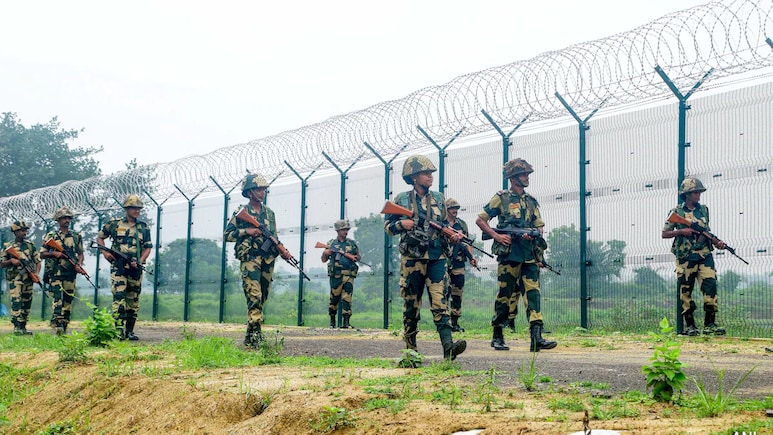
After the BJP's victory in West Bengal and the formation of what the party calls a "double-engine government", meaning the BJP is now in power both at the Centre and in the state, the focus has rapidly shifted toward one of the most politically and strategically sensitive issues in eastern India: the Indo-Bangladesh border.
For years, border security, infiltration, illegal migration, smuggling, and fencing delays have remained subjects of political rhetoric. But now, according to the BJP leadership, the intention is to move beyond slogans and optics and enter a phase of direct administrative action.
Union Home Minister Amit Shah has reportedly instructed officials that the border issue must be handled with a practical and result-oriented approach rather than through symbolic announcements. Those close to the developments say Shah has repeatedly emphasised that no "half-done" operation should be carried out merely for publicity. Every action, he believes, must be legally sustainable, diplomatically careful, and operationally effective.
Senior officials from the Ministry of Home Affairs, along with top Border Security Force (BSF) officers, have already prepared a detailed action plan to tackle infiltration along the India-Bangladesh border. The emphasis is now on identifying genuine infiltrators carefully instead of carrying out random or hurried pushback operations.
According to sources, Amit Shah has instructed officers to avoid any move that could unnecessarily damage India-Bangladesh diplomatic relations. In the past, whenever alleged infiltrators were simply "pushed back" without proper verification or coordination with the Bangladeshi authorities, Dhaka reacted sharply, leading to avoidable diplomatic tensions.
This time, the strategy appears different.
The Centre wants a process where infiltrators are properly identified, documented, and then handed over to Bangladeshi authorities through official mechanisms. The objective is to avoid international controversy while strengthening border management in a structured way.
Officials involved in the process say that the current approach is based on the understanding that border management is not merely a law-and-order issue; it is also a humanitarian, geopolitical, and diplomatic challenge.
Even globally, border control has proved far more complicated than political speeches often suggest. During his first presidential term, former US President Donald Trump repeatedly promised to completely seal the Mexico border. Yet illegal immigration into the United States continued despite aggressive measures. That example is now frequently being cited internally to underline how difficult it is to entirely secure a long and porous international boundary.
The India-Bangladesh border, particularly in West Bengal, presents an even more complex challenge.
Large stretches of the border run through densely populated villages, agricultural fields, riverine terrain, char lands, forests, and difficult geographical zones. In several places, the so-called "zero line", the actual international boundary, cuts through settlements where families have lived for generations.
The Government of India has now accelerated fencing projects across West Bengal. Compensation packages are being prepared for landowners whose lands are needed for fencing and BSF infrastructure. However, officials admit that completing the fencing work across the entire border is not an easy task.
The government believes the process cannot succeed through force alone. Locals must be convinced and taken into confidence. Farmers, villagers, and landowners living near the border have to be consulted carefully because fencing often affects their agricultural access, movement, and livelihoods.
As per the latest data available till May 2026, West Bengal shares a 2,216.7-kilometre border with Bangladesh. Out of this:
- Around 1,647.696 kms have already been fenced.
- Nearly 569 kms remain unfenced.
- Approximately 112.780 km is considered "non-feasible" for conventional fencing because of riverine and swampy terrain.
- Around 456.224 km is technically feasible but remains unfinished.
Following the BJP's electoral victory in West Bengal, Chief Minister Suvendu Adhikari reportedly made border fencing one of the top administrative priorities of the new government.
One of the biggest recent developments has been the approval for transferring nearly 600 acres of land to the BSF for fencing and border infrastructure projects. In Phansidewa near Siliguri, the state government has already handed over a 27-km stretch to the BSF, where fencing work officially began between May 21 and 22.
The Chief Secretary and the Land Department have reportedly been instructed to complete all remaining land transfers within 45 days.
Apart from fencing, the state government has also promised land for new Border Outposts (BOPs) and other BSF infrastructure facilities.
This marks a major policy shift because one of the biggest hurdles in the past was land acquisition and administrative delay.
The Calcutta High Court had repeatedly criticised the previous TMC government over delays in handing over acquired land to the BSF. On January 27, 2026, the High Court directed the state to transfer 127 km of already-acquired and compensated land to the BSF by March 31. But by April 22, only 8 km had reportedly been handed over. The court even imposed a financial penalty on a senior official for non-compliance.
Data from the Ministry of Home Affairs in August 2025 showed:
- 77.935 km of land had been handed over.
- The acquisition had not even begun in 148.971 km.
- 229.318 km remained under process.
- Compensation had been paid for 181.635 km, but possession was still not transferred.
Now, under the new administration, the government claims that the process is finally moving.
Ground reports from areas like Phansidewa suggest that many residents feel relieved. Several villagers have reportedly said that for years they lived under fear because of cross-border crime, cattle smuggling networks, and infiltration. Some residents even claimed they could not safely rear cattle because of organised criminal groups operating near the border.
The BJP government has now adopted what officials describe as a "detect, delete, and deport" framework. Under this system, police and local administration are expected to coordinate directly with the BSF in identifying suspected infiltrators.
Particular attention is being given to sensitive districts such as Malda, Murshidabad, and North 24 Parganas, which have historically remained vulnerable because of porous border stretches.
However, despite the aggressive push, major challenges remain.
Former Intelligence Bureau officials and security experts have already warned that completing all fencing within a short deadline is unrealistic. Legal disputes, rehabilitation issues, land compensation, environmental complications, and terrain difficulties make the process extremely slow.
One of the biggest obstacles is the "150-yard rule" under the 1975 India-Bangladesh border agreement. According to this understanding, no permanent defence structure can normally be built within 150 yards of the zero line without mutual consent from both countries.
India does not classify border fencing as a military defence structure, but Bangladesh has often objected to fencing too close to the international boundary. As a result, fencing is usually constructed 150 yards inside Indian territory.
This creates what many villagers describe as a "no man's land".
In several border districts, villages, schools, temples, agricultural fields, and markets fall between the actual border and the fencing line. As a result, many Indian citizens effectively end up living outside the fence even though they are within Indian territory.
This creates enormous security and humanitarian problems.
People living outside the fence are often exposed to smuggling networks, infiltration, extortion, and cross-border criminal activity. Farmers face restrictions in accessing their own land because BSF regulations often limit movement timings.
Many villagers have therefore demanded that fencing should either be done directly on the zero line or at least much closer to it.
Bangladesh, however, continues to raise objections in many sectors, arguing that such construction violates earlier border understandings.
In recent bilateral talks, the Border Guard Bangladesh (BGB) reportedly demanded fresh joint inspections in nearly 90 disputed locations where India wants fencing closer to the border.
At the same time, difficult terrain continues to complicate the process. Nearly 175 km of the border areas are riverine or swampy. Rivers like the Ichamati and Padma create shifting char lands and unstable soil where conventional fencing becomes nearly impossible.
To address this, India is increasingly using "smart fencing" technology involving cameras, thermal sensors, laser systems, drones, and radar surveillance.
Security experts say this hybrid model, combining physical fencing with electronic monitoring, may eventually become the future of border management in eastern India.
Yet officials admit that technology alone cannot solve the issue.
Border security in Bengal is deeply connected to politics, diplomacy, economics, migration, demography, and local social realities. That is why the Centre now appears to be adopting a more calibrated and phased strategy rather than relying only on aggressive rhetoric.
Still, politically, the BJP sees the current moment as extremely important.
The party believes that if the "double-engine government" succeeds in visibly improving border security, controlling infiltration, and completing long-pending fencing projects, it could significantly strengthen the BJP's political position in West Bengal for years to come.
As of late May 2026, fencing work has finally begun after years of delay. But with nearly 450 km still unfenced and multiple legal and geographical obstacles unresolved, even government insiders privately acknowledge that the full process will take far longer than political timelines suggest.
(The author is Contributing Editor, NDTV)
Disclaimer: These are the personal opinions of the author

